
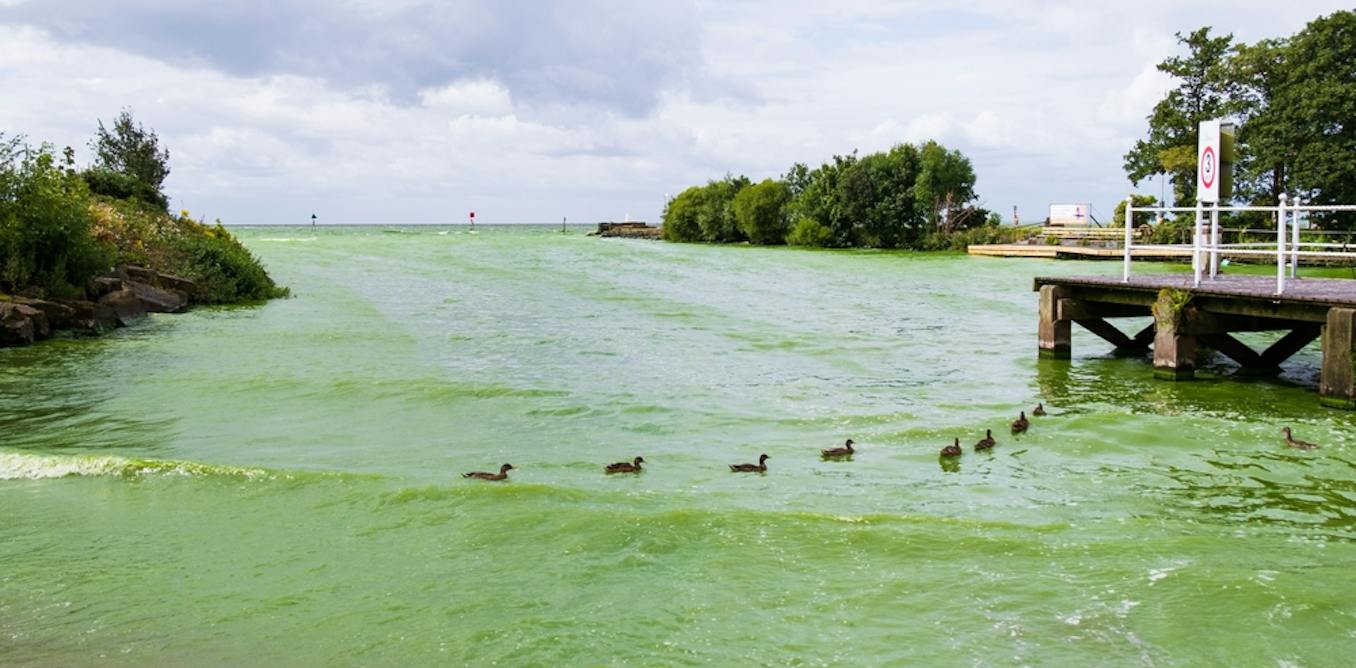
Lough Neagh in Northern Ireland has been a dumping ground for soil, fertiliser and wastewater for centuries. It is the largest body of freshwater in the British Isles and was once surrounded by extensive Atlantic woodlands – woodlands that covered almost all of Ireland between 8,000 and 6,000 years ago. In recent research I carried out with my co-author – the late Julie Fossitt – we looked at the impact of the removal of those forests. The last woodlands were cleared in the early 1600s, leaving waterways unprotected and the landscape vulnerable to erosion. The research also reveals what has ultimately contributed to the ecological vulnerability of Lough Neagh today. By using palaeoecology (the study of relationships between ancient organisms and their environments across geological timescales) what grew in and around Lough Neagh can be reconstructed from the fossil pollen and other biological remains deposited in the lake sediments. For the project, I analysed the fossil pollen preserved in the layers of lake sediment from the deepest part of Lough Neagh. Using a microscope, I could see evidence of the different herbs, shrubs and dwarf trees that had colonised the bare soil during the early Holocene period between 11,000-10,000 years ago, after the ice had disappeared in northern Europe. As well as the pollen I also counted the green alga Pediastrum and particles of microcharcoal. Pediastrum is an indicator of soil erosion from nearby rivers and streams. As temperatures rose after the last ice age, high levels of Pediastrum revealed how fragile the open landscape had been. But after the Atlantic woodland was established 8,000 years ago, the trees helped stabilise the landscape by helping to build the soil and holding the soil infrastructure together. Our research shows large-scale native woodland can also significantly reduce runoff and buffer against extremes of droughts and floods. Our second observation is that the Atlantic woodlands of the past did not burn, or not easily, whereas the open landscapes of today are prone to wildfires. A fragment of surviving Atlantic woodland, County Antrim, Northern Ireland. D McCullough, Author provided (no reuse) What happened over time Once the first farmers began to settle in the region over 5,000 years ago, the landscape became vulnerable to erosion again, due to deforestation as farmers removed trees and introduced livestock. Read more: Trees discovered at record-breaking altitudes highlight why we should restore Scotland’s mountain woodland After that clearance period, fertilisers used on the land increasingly entered Lough Neagh. Soil became more fragile and runoff increased, as shown by growing levels of Pediastrum in the samples. The value of the tropical rainforests in south-central America, central Africa or south-east Asia, is widely recognised as is their ongoing destruction, loss of biodiversity and their importance as carbon sinks and for regulating the global climate. But in Europe the value of the great Atlantic woodlands, another type of rainforest, is often ignored. Between 8,000-6,000 years ago, these woodlands provided enormous environmental benefits such as stabilising and enriching soil. British Isles woodland cover 6,000 years ago and today Simon Crowhurst, CC BY-ND According to the Woodland Trust, Northern Ireland currently has only 0.04% of ancient woodland remaining, the lowest in the United Kingdom. And even this has been threatened by the commercial planting of spruce trees. Resurrecting the great woodlands The question now is how we make use of the knowledge of the value of these ancient Atlantic woodlands. Increasing global warming and unpredictable rapid swings between dry and wet weather conditions raises the risks of extreme agricultural runoff into waterways. Natural woodland cover in the Lough Neagh catchment area could help mitigate these effects. This is particularly relevant in the light of the completion of the £37 million soil nutrient scheme from the Department of Agriculture, Environment and Rural Affairs across Northern Ireland. This is a massive soil sampling programme. This not only sampled up to 650,000 fields looking at soil content, including phosphorus, but also it produced runoff risk maps showing what is leaking from soil into lakes and rivers. This should help farmers manage fertiliser applications on their fields more effectively and help to protect the environment. Planting and restoring natural woodlands and hedges with appropriate tree and shrub species should form part of the approach at sites particularly vulnerable to runoff and soil erosion. In 1998, I reviewed scientific papers on climatic crises around 4,000 years ago, particularly droughts that appeared across the world causing famines and societal disruption. Oddly, the British Isles was one of the least effected areas. But at that time there was still significant Atlantic woodland cover to buffer climate extremes. Many huge Mesolithic and Neolithic log boats have been discovered by archaeologists in the area around Lough Neagh. The size of oak trees required to build them can only be found in the primeval forests of Poland today. But these give an indication of the size of the trees in those oak Atlantic woodlands and the biodiversity required to support them. What’s happening now? Lough Neagh has been considered “dying” since 2023 due to toxic blue-green algal blooms and pollution. People are heavily discouraged from swimming in the water and fishing is restricted because of the environmental issues. This situation has been made worse by agricultural runoff and sewage being brought in from waterways across Northern Ireland. This has also been exacerbated by the shallow water and increasingly warm conditions of Lough Neagh caused by climate change. But the significant value of large native woodlands in helping to address the ecological problems of Lough Neagh and protect its waterways is being undervalued in current government plans.
Fossilised pollen reveals how forests can protect Lough Neagh and other waterways
Full Article
Original Source
Read the full article at Theconversation →KhanList aggregates and links to publicly available news content. We do not host full articles from third-party sources. Always verify important information with original sources.