
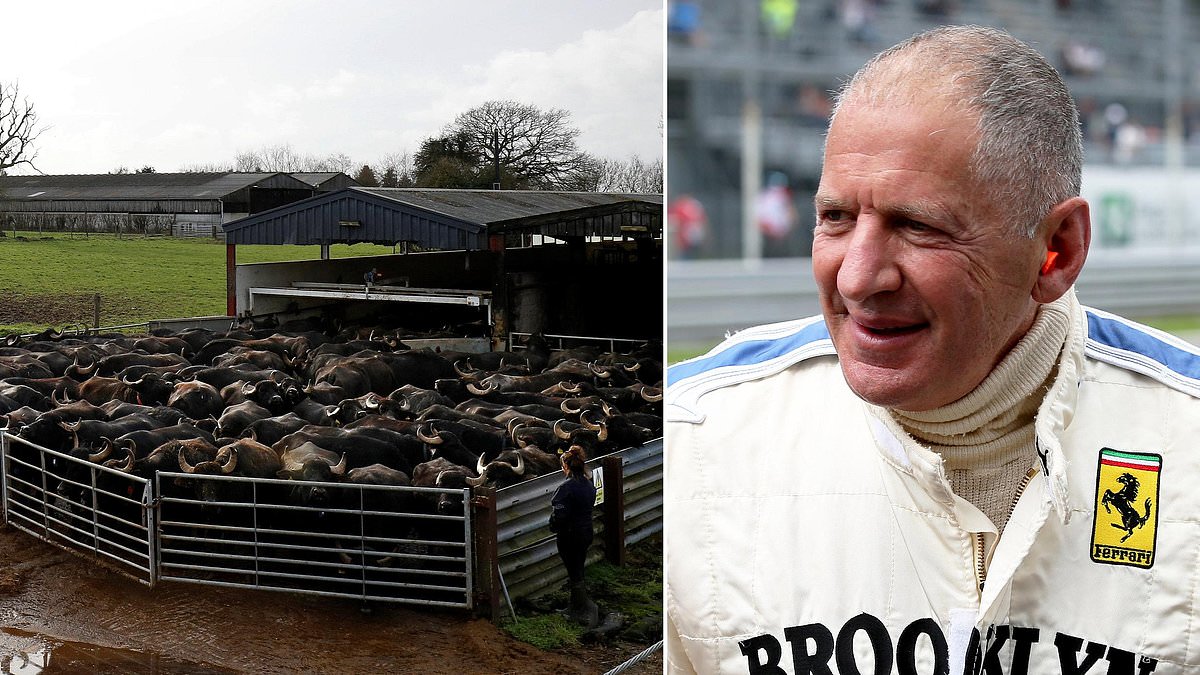
A Formula One world champion who became the UK's biggest organic buffalo farmer has lost a court fight with the taxman to avoid a £1.4million bill over his herd.South African born driver Jody Scheckter, 76, retired from a highly successful career on the racetrack in 1980 and went on to become a biodynamic farmer and one-time owner of Britain's largest herd of water buffalo.On relocating to England in 1996 with his wife Clare, he acquired Laverstoke Park, in Overton, Hampshire, going on to pour £55million of his fortune into the farm and around 3,000 acres of surrounding land in a labour of love bid to 'produce the purest, best quality, organic food'.However the buffalo business, which had supplied organic meat to Ocado and specialised in buffalo mozzarella, announced it was folding in 2024, citing 'significant increases in costs, a reduction in milk volumes, and the additional capital investment required for future-proofing'.On top of his business woes, the ex-racer had been fighting with the taxman over a backdated bill for £1,457,634, after an inspector ruled that the farming partnership through which he ran the buffalo business had wrongly offset losses it incurred against profits from other parts of his overall business between 2008 and 2010.Seven-figure losses incurred by the LLP Laverstoke Farm Produce had been set off against taxes due on his other income – known as sideways loss relief – until in 2019 HMRC ruled that the offset was not valid and demanded he pay up.The offset mechanism is open to farmers and smallholders, but only if the farm has become a profitable enterprise within five years of being set up.However the farm partnership had registered a loss almost every single year since it was founded and therefore did not qualify for the offset provision. Formula One world champion Jody Scheckter, 76, who became the UK's biggest organic buffalo farmer, has lost a court fight with the taxman to avoid a £1.4million bill over his herd Buffalo stand outside the milking parlour at Laverstoke Park Farm near Overton, Hampshire, in 2019 Niki Lauda and Jody Schekter at the Race of Champions, Brands Hatch, Kent, in 1973Dismissing his appeal in the tax chamber of the First Tier Tribunal, Judge Tony Beare expressed 'sadness' at the failure of Mr Scheckter's buffalo passion project and 'regret' for having to hand him a massive tax bill for the failed venture.'It is impossible to have been involved in this case without feeling considerable sadness at how a project which was conceived with such imagination and originality by the appellant and on which he expended so much financial capital and personal energy has turned out,' he said.'He was...extremely passionate about the positive effects which healthier eating would engender for everyone and wanted the business to be a model for organic farming and healthier eating across the world.'We would be remiss if we did not conclude this decision by acknowledging that and expressing our profound regret for the way that things developed, regret which is compounded by the conclusions which we have felt compelled to reach in the present proceedings.'Mr Scheckter is a former racing driver and business leader who competed in Formula One from 1972 to 1980, winning 10 Grands Prix across nine seasons, as well as the World Drivers' Championship in 1979 with Ferrari. He is still the only African to have won a F1 Grand Prix or the World Drivers' Championship.After his retirement, he founded a weapons simulation business in 1984 called Firearms Training Systems (FATS), whose revenue eclipsed £100million by the early 1990s. The company built firearms training simulators for military, law enforcement and security organisations.He went on to pour much of his fortune from FATS into Laverstoke Park, a very different business focused on biodynamic buffalo farming and aiming to provide a model to show that an integrated organic farming system could work on a large scale.As well as raising buffalo, he set up an abattoir to slaughter his own animals, a composting plant and a soil testing lab to monitor soil quality, as well as a farm shop, dairy and ice cream production plant.The business as a whole saw increasing turnovers aided by TV appearances, including on Countryfile and the BBC's Escape To the Country, but the farming partnership continued to post losses in its accounts year on year.In 2024, the farm ceased dairy production and buffalo farming, although other operations including the profitable composting plant and a car festival at Laverstoke Park still continue.Setting out the evidence given by Mr Scheckter, the judge said he began organic farming as a hobby to feed himself and his family, having no previous experience in the field.'His aim in starting the business was to produce the purest, best quality, organic food, to do so on a large scale, which was something that no-one else in the market was doing at the time and ultimately to make profits,' he said.'He admitted that he had made mistakes. He had thought that he could replicate his success in relation to FATS in the US in this different context.'However, he had under-estimated the differences between the two businesses and the difficulties to which that gave rise.'He had spent too much money and over-committed because he wanted to move fast and create something substantial but, in this case, he should have been more circumspect and listened to the experts who were telling him not to proceed in such haste.'The business faced many challenges and a number of factors contributed to the losses. It was difficult for an organic farming business to make a profit for a considerable period after commencement, particularly in the late 2000s.'Ruling that the losses for the three relevant years could not be legally offset against other earnings, the judge said that because the LLP had not been profitable for more than five years previously, it fell foul of rules designed to prevent 'hobby farmers' from avoiding tax on other income under the Income Tax (Trading and Other Income) Act 2005.Stressing that Mr Scheckter did not fall under that category but nevertheless has to pay up, the judge expressed regret at dismissing his appeal and 'considerable sadness' at the outcome.'He did have an altruistic purpose in carrying on the business in addition to his profit motive,' he said.'We would be remiss if we did not conclude this decision by acknowledging that and expressing our profound regret for the way that things developed, regret which is compounded by the conclusions which we have felt compelled to reach in the present proceedings.'
Formula One world champion loses £1.4million tax bill fight over his Hampshire buffalo farm
Full Article
Original Source
Read the full article at Dailymail →KhanList aggregates and links to publicly available news content. We do not host full articles from third-party sources. Always verify important information with original sources.