
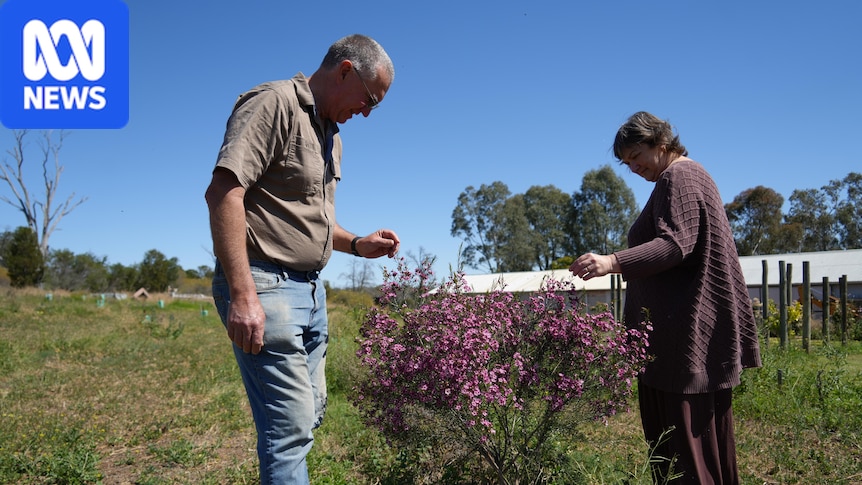
On the banks of the River Murray in South Australia once lay rows of wine grapevines as far as the eye could see.In the middle of Australia's largest wine grape growing region at Murtho in the Riverland, Tony and Cherie Townsend's property is one of many that have ripped vines out of the ground.Rather than replace 40 acres of vines with another crop, in 2022 the pair decided to return their property to native vegetation."It was a lot of time and effort [managing vineyards] and it wasn't the reason we bought the property in the first place," Ms Townsend said.Cherie and Tony Townsend say they are grateful for the opportunity to leave their property in a better place than they found it. (ABC Riverland: Jackson Byrne)"The native bushes, the flowers and the birds that they bring are just really good for the soul."The decision to revitalise the riverfront property was an easy one for Ms Townsend, but she recognised the fortunate situation they were in to be able to make such a sacrifice compared to others nearby."The decision to remove the vines was probably not as hard as what it has been for some other local growers," she said.Her 61-year-old husband said one of the driving factors in returning the site to native vegetation, rather than transitioning to another crop, was the potential return of the endangered regent parrot.Flowers are blooming four years into the restoration project at the Townsends' property. (ABC Riverland: Jackson Byrne)"We don't get an income from it but we get an emotional return," Mr Townsend said.The pair said they would not have been able to do it on their own and have collaborated with the Murraylands and Riverland Landscape Board in bringing the site to life.The Townsends' property was identified as close to the perfect site for regent parrots, sitting right along a flight path for the eye catching native bird.There are extensive efforts across the Riverland to help the endangered regent parrot. (Supplied: Sputnik)Regent parrot numbers have been in decline for several years, with a lack of available nesting sites part of the population problem.In its most recent census, the Landscape Board only recorded 400 breeding pairs of regent parrots in the Riverland.It is a number they are desperate to see rise during ongoing monitoring of the parrots, during the parrot's breeding season between August and November."With regent parrots ... anything we can do to restore and return land back to its natural form is amazing," threatened fauna ecologist Melissa Burford said.Mel Burford has been undertaking regent parrot surveying in recent weeks. (ABC Riverland: Jackson Byrne)"They breed along the river corridor in the river red gums, but they forage in the mallee, so having that forage food available for them is really important."The South Australian Regent Parrot Recovery Team has also been consulted in the best way to attract the parrots and boost populations.Chair Kevin Smith has been surveying the parrots for 35 years and said populations had remained steady in recent years.He said the Townsends' property was so far the best example of native vegetation reintroduction helping the endangered species.Kevin Smith says regent parrots breed across a 200 kilometre stretch of the River Murray and backwaters in South Australia. (ABC Riverland: Tom Nancarrow)"It's very early stages but the regent parrots can get to their food source and not have to go through dangerous obstacles to get out to the mallee," Mr Townsend."That's a real winner and we're working with a number of other growers and conservationists too."Industry in crisis creates opportunityWhile the Townsends did not buy their current property for the purpose of growing wine grapevines, they have been involved in the industry since the late 1990s.It's meant they have a good understanding of the industry and its struggles in recent years."We've done eight harvests here and after 2022 ... pricing was heading south," Mr Townsend said."We really sat down and didn't really see a future for ourselves in that industry."That is a feeling shared right across the Riverland, as the wine grape industry continues to battle an oversupply and a decline in wine consumption globally.The sight of grapevines being ripped out has become increasingly common across the Riverland. (ABC Riverland: Sam Bradbrook)Wine grape growers have been encouraged by industry experts and the South Australian government to transition to more profitable crops, such as almonds or olives.The cost of that can be prohibitive, and while assistance in the form of the government's recently announced $109 million package has arrived, for the Townsends' it has come too late.It would also not facilitate the pair's goal of returning their land to its natural state and a sanctuary for bird life."We've been lucky enough to utilise some of the poly [polyethylene pipe] back onto the trees and use a small amount of our water allocation to get the plants going," Mr Townsend said.Mr Townsend is also the chair of Destination Riverland and has lived in the region his entire life. (ABC Riverland: Jackson Byrne)"I'm grateful for the position that we're in to be able to do this, but it is not for everyone."From one generation to the nextWhile the story of the Townsend property is already a resounding success, it is still in its infancy.The process is expected to take time, but it is hoped when the trees and vegetation begin to mature, even more birds will be drawn to the area."We've had school students get out there on their property," Ms Burford said."To get that next generation involved is amazing, as it's a tangible thing that's helping a threatened species."Local schoolkids have helped restore the Townsends' property to native vegetation. (Supplied: Riverland Murraylands Landscape Board)Mr Townsend said they benefited tremendously by revegetating the land, which had helped deepen the bond between their family."We've had four generations of our family involved in planting, which has been amazing itself," Mr Townsend said.At some point, they know all of their work will be passed onto someone else.It is something they are at peace with, and hope their efforts can be enjoyed for generations to come."I'd like to leave it in a better place than we found it," Mr Townsend said.
Former vineyard turned into sanctuary for endangered birds
Full Article
Original Source
Read the full article at Abc →KhanList aggregates and links to publicly available news content. We do not host full articles from third-party sources. Always verify important information with original sources.