
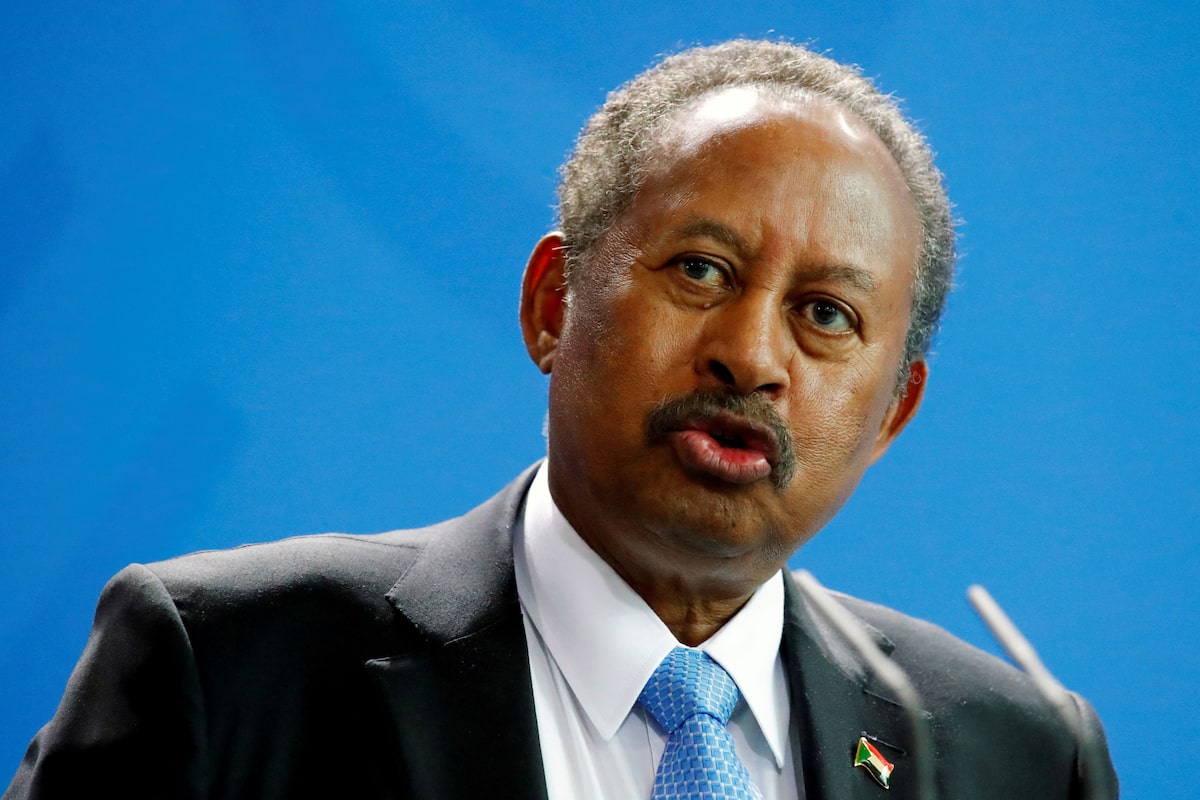
Open this photo in gallery:Sudan's then-prime minister Abdalla Hamdok speaks during a press conference at the Chancellery in Berlin, Feb. 14, 2020.HANNIBAL HANSCHKE/ReutersAt a time of mounting pessimism over Sudan’s relentless war and soaring death toll, former prime minister Abdalla Hamdok insists that peace is still possible. And he believes Canada can help in that process.Mr. Hamdok, a civilian leader who was toppled in a military coup in 2021, is in Ottawa this week for talks with federal officials and politicians. He said he received a “very good commitment” that Canada will lend its diplomatic expertise to the Sudanese peace effort, despite severe headwinds.“Canada has been involved in many peace initiatives, like Colombia and others,” he told The Globe and Mail, referring to federal funding for Colombia’s 2016 peace accord. “We are working to have a political process, which will require a lot of support in capacity and expertise.”For more than three years, Mr. Hamdok has been trudging around the world, lobbying for peace efforts, while working on a civilian-led process of political unity among key Sudanese groups and parties.He admits it is a struggle. The war is still raging in many parts of Sudan. Hundreds of thousands of people have been killed, and about 13 million have been forced to flee their homes since the conflict erupted in 2023 between the Sudanese army and the paramilitary Rapid Support Forces (RSF). More than 30 million people need emergency food aid, relief agencies say.UN investigators find evidence of UAE links to Sudan warCountless ceasefires have been discussed, rejected or broken. Both sides appear convinced they can win the war. Cities have been captured and recaptured, while drone strikes grow heavier.“This is a war of attrition,” Mr. Hamdok said. “I don’t see any outright victory for any side. There’s no military solution.”The war has worsened recently, spilling across the border to Ethiopia, where the RSF reportedly has access to drone bases and weapon supplies. Ethiopia now has its own escalating conflict, with Eritrean troops crossing the border into the north of the country this week.“This has the potential of engulfing Sudan,” Mr. Hamdok said. “It’s dangerous because this is the most fragile region in the continent. It’s alarming. All the neighbouring countries are definitely involved. Already our house is on fire, and then you see neighbours’ houses also going up in flames.”Mr. Hamdok believes, however, that Sudan’s peace process is gaining momentum. He cites the emergence of the “Quintet” – five international blocs seeking to resolve the conflict, including the African Union and the European Union – along with an expanding “non-aligned” coalition of Sudanese civilian groups and political parties, including Mr. Hamdok’s own group, known as Sumoud.Canada has provided about $2.5-million to Sumoud since early 2024, and it welcomes the group’s efforts to work toward a postwar civilian government, according to John Babcock, a spokesperson for Global Affairs Canada.After finishing his Ottawa visit, Mr. Hamdok is heading next week to Ethiopia, where the Quintet will be meeting with the non-aligned coalition.Sudanese professor flees war-torn country, finds new life in Ottawa in AI research roleIndependent analysts question whether Canada has enough diplomatic involvement in Sudan to exercise much influence over the peace process. Canada closed its embassy in Sudan’s capital, Khartoum, after the war began. It currently covers Sudan from its embassy in Ethiopia. And it lacks any formal affiliation with the Quintet.Earlier this year, a House of Commons subcommittee called on Ottawa to appoint a special envoy for Sudan, to boost its response to the conflict. Dozens of civil society groups have made a similar call.“Canada cannot be helpful in terms of the peace process without meaningfully joining the Quintet and appointing a special envoy for Sudan or the Horn of Africa,” said Khalid Mustafa Medani, chair of the African Studies Program at McGill University.Canada should push for an expansion of Mr. Hamdok’s civilian alliance, which is weak in its representation of youth groups and women, Prof. Medani told The Globe. “It is still too narrow,” he said.Nicholas Coghlan, a former senior Canadian diplomat in Khartoum, said the government is “nearly blind in an exceedingly complex, shifting scene” because it lacks a diplomatic presence in Sudan.In response to the Commons subcommittee, Foreign Affairs Minister Anita Anand said she “takes note” of its recommendation. But she defended the decision to leave Sudan diplomacy in the hands of the embassy in Ethiopia, saying it can co-ordinate with other like-minded countries there. “Canada remains actively engaged,” she said.Many people in the Sudanese diaspora – including the Sudan Solidarity Collective, a Canadian-based group – have argued that Mr. Hamdok’s coalition should not be seen as the main representative of the Sudanese people, partly because of its alleged links to the United Arab Emirates, which is reportedly the biggest weapons supplier to the RSF.The UAE routinely denies that it provides arms to the paramilitary force, and Mr. Hamdok says his group’s leaders are scattered across many countries.The narrative about his group’s connections to the Gulf state is being promoted by the Sudanese army, he said. “Only three or four of us in the leadership are living in the UAE. The bulk of our leaders are in Egypt. As refugees, we cannot pick and choose where to live. The UAE is not imposing anything on us.”
Former Sudanese PM seeks Canadian support, says peace is still possible
Full Article
Original Source
Read the full article at Theglobeandmail →KhanList aggregates and links to publicly available news content. We do not host full articles from third-party sources. Always verify important information with original sources.