
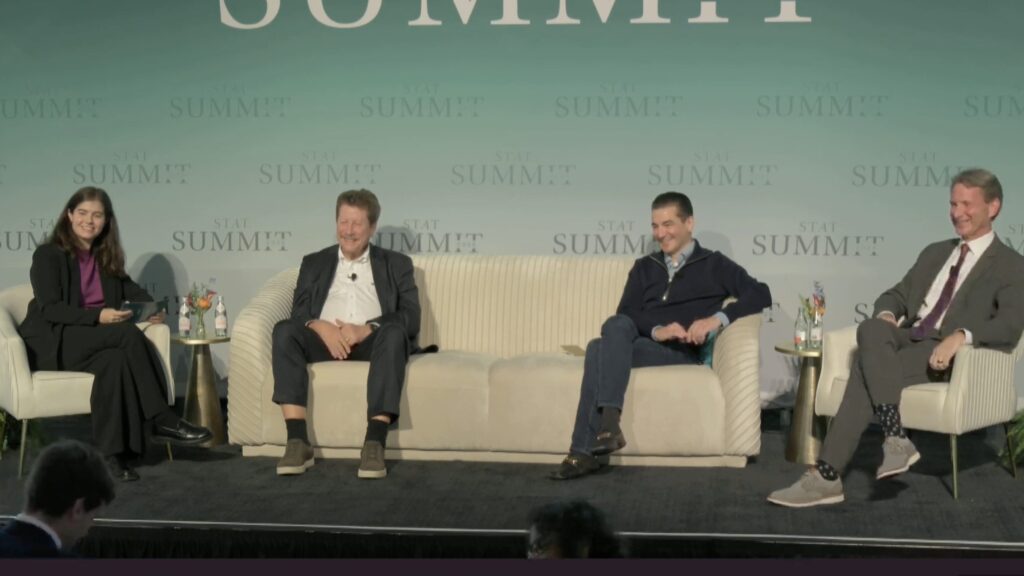
BOSTON — Three former Food and Drug Administration chiefs lit into the Trump administration Wednesday, criticizing the now former FDA officials who oversaw a massive staffing exodus and robbed the agency of institutional knowledge that will take years to restore. “DOGE will go down as one of the biggest disasters in American history,” Rob Califf, former FDA commissioner under Presidents Obama and Biden, said during the STAT Summit, referring to the Elon Musk-led initiative that conducted mass layoffs of government employees. The DOGE cuts of 3,500 workers preceded a larger staff exodus under the tumultuous leadership of former FDA Commissioner Marty Makary, who resigned in May. White House official Heidi Overton has since been nominated to replace Makary, though she has yet to face a Senate confirmation vote. Califf’s sharp tone was echoed by Scott Gottlieb, who served as commissioner for part of the first Trump administration, and Ned Sharpless, who was acting commissioner towards the end of the first Trump administration. Sharpless called the cuts “arbitrary” and said that the companies he works with as co-founder of Jupiter BioVentures often now find themselves in meetings with more junior and less experienced drug and medical device reviewers. “You lost a lot of institutional memory,” Gottlieb added. The panelists offered some optimism, however. The former officials said the agency may be turning a new leaf with departures of certain high-profile officials, who they did not name, but include Makary and former top drug and device regulators Vinay Prasad and Tracy Beth Høeg. “I think the sowers of chaos came and went,” Califf said. Gottlieb, in particular, praised Kyle Diamantas, the agency’s top food regulator who is now acting commissioner, and FDA’s policy lead Grace Graham, who he said are encouraging the agency to get “back to the basics.” “Now we have, I think, sensible leadership that’s doing smart things in the organization. I think things have gotten back to people feeling confident that the regulatory agency is making rational decisions,” Gottlieb said. But even with new leadership, the former officials warned that rebuilding the agency will take time. They advised Overton, if confirmed, to focus not just on rehiring staff (which the agency has already started), but on reassuring officials that they will be protected from political meddling or further firings. “Recruit, support, and defend the workforce,” Gottlieb said. “That will bring them back.” They also offered advice on how to restore trust in federal agencies, a top-of-mind topic for public health officials since the Covid-19 pandemic. Sharpless lamented “errors” made in public communication by federal officials on vaccines during the pandemic that linger today. “During the pandemic, number one is, don’t politicize a vaccine, and, you know, that didn’t last very long,” he said. Califf and Gottlieb more pointedly addressed health secretary Robert F. Kennedy Jr., who has a long history of sowing distrust in vaccines. Since becoming Health and Human Services secretary, Kennedy has aggressively tried to reform existing vaccine policy. Within the FDA, that has included pushing for renewed reviews of vaccine safety and efficacy, including post-market surveillance. Last year, when Makary was still commissioner, the FDA added safety warnings to mRNA Covid-19 vaccines about a rare heart inflammation side effect. Kennedy “is just actively still eroding public confidence in these issues,” Califf said. “It’s going to be hard to overcome that until he’s moved on to some other job.” Gottlieb added that he had been critical of Kennedy since his nomination, which he said resulted in him needing to hire extra personal security for his safety. But Califf also said that distrust in federal health agencies goes beyond Kennedy and reflects the frustration Americans have with high health care costs. “If I would just get one biotech exec to say you know what, our drugs are too expensive,” Califf said. “You just never hear that and you know you wonder why people are upset and going to other sources of information.” At the same time, all three urged the FDA to focus on its core mission, rather than trying to tackle some of these policy issues. It is not in the FDA’s mandate, Sharpless said, to change drug prices or address vaccine hesitancy, but rather work in statute to prioritize safe and effective medicine. “And if it sticks to its sort of statutory role, it’ll be fine,” he said.
Former FDA officials blast DOGE as ‘one of the biggest disasters in American history’
Full Article
Original Source
Read the full article at Statnews →KhanList aggregates and links to publicly available news content. We do not host full articles from third-party sources. Always verify important information with original sources.