
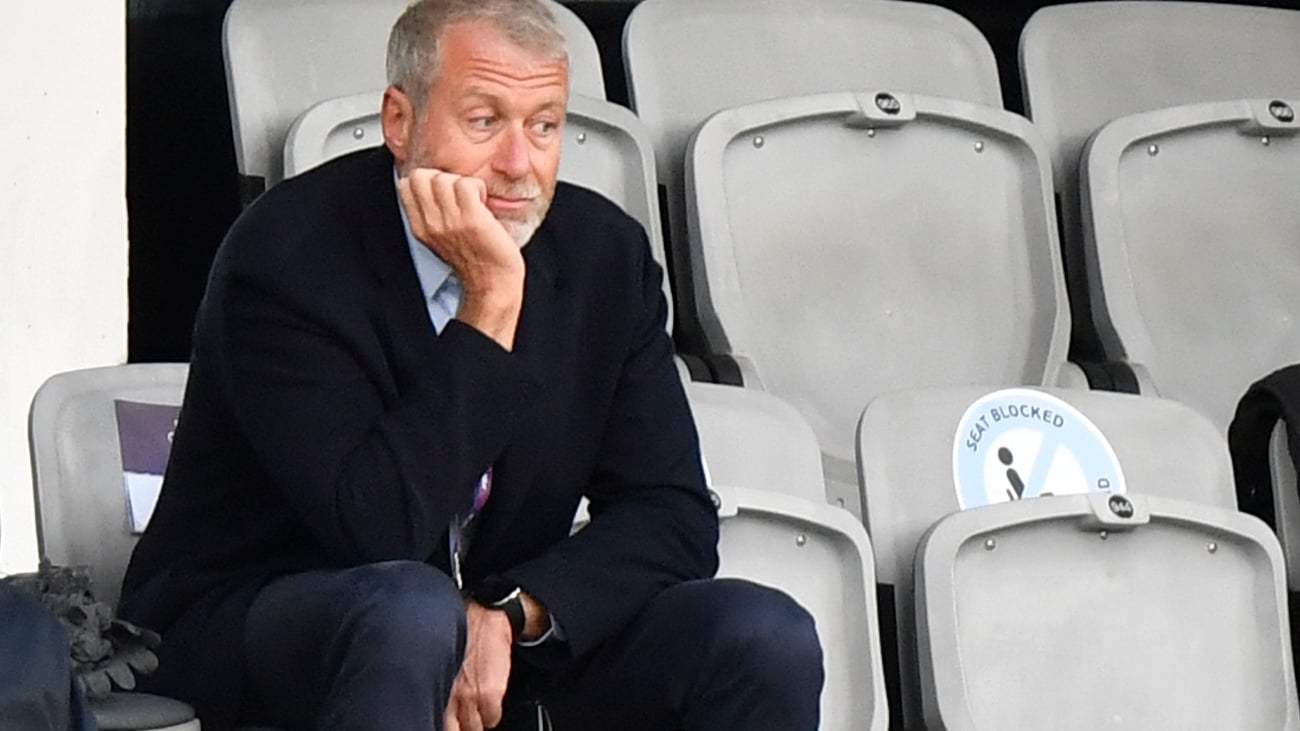
The EU’s General Court ruled that Roman Abramovich’s large, longstanding stake in Russian steelmaker Evraz was enough to justify sanctions, even without proof the former Chelsea owner controlled the company or influenced the Kremlin.(CN) — Roman Abramovich’s 28.64% stake in a Russian steel giant proved enough for the EU’s second-highest court to keep the billionaire, who owned Chelsea for nearly two decades, under sanctions Wednesday.The General Court of the European Union rejected his bid to overturn an asset freeze and travel restrictions renewed in 2025, along with his $1.16 million (1 million euros) damages claim. Abramovich, a Russian, Israeli and Portuguese citizen, also must pay the Council of the European Union’s legal costs.To soccer fans, Abramovich is the deep-pocketed owner who bankrolled Chelsea’s transformation into a global powerhouse. The fortune behind it came from Russia’s oil and metals industries, the same business world now keeping him sanctioned.For the judges, leading meant economic weight, not political clout. Abramovich had long been the largest shareholder in Evraz, a major Russian steel and mining group. Steel generated 66.3% of Evraz’s 2021 revenue, while his separate interest in Norilsk Nickel extended his reach in Russian mining. The council did not need to prove that he controlled either company, supported Moscow or influenced the Kremlin.Niall Moran, assistant professor of EU sanctions law at Dublin City University’s School of Law and Government, said the council had broad room to act as the war worsened. “The evidential test is thus real, but the threshold the council must reach in order to satisfy it is not especially demanding.” Abramovich also failed to identify a narrower measure that would work just as well, Moran said.Abramovich said overlapping sanctions had trapped him in the Evraz stake now keeping him listed. The judges found no proof that a sale was impossible and said the measures were meant to squeeze Moscow, not necessarily coax each sanctioned person into changing course.The EU began imposing Ukraine-related sanctions amid Russia’s seizure of Crimea in 2014 and expanded them sharply after the full-scale invasion in February 2022. Abramovich was listed weeks later. The bloc has adopted 21 sanctions packages, but individual measures covering almost 3,000 people and entities expire next Tuesday. Broader economic restrictions run through July 31, 2027.After losing earlier challenges in 2023 and 2025, Abramovich called the rule vague and disproportionate, accused council working groups of effectively deciding his fate, invoked dignity and free-movement rights and challenged the review of his circumstances. The judges found the rule clear, the restrictions reviewable and the council still in charge.Francesca Finelli, assistant professor of sanctions, EU law and international law at Luxembourg School of Business, saw more repetition than revelation. She said Abramovich’s Evraz stake remained the evidence holding the sanctions case together, while his roughly 2.55% interest in Norilsk Nickel merely gave the council extra support.His newer arguments also went nowhere: The judges found that council committees had not taken over the final decision, rejected human dignity as an independent reason to lift the sanctions and gave limited weight to a legal opinion Abramovich had commissioned about his inability to sell.Finelli nevertheless flagged a real-world problem: “It is interesting to note that overlapping multijurisdictional sanctions regimes can create a listing ‘trap’ a person cannot exit even by divesting.”Yuliya Miadzvetskaya, a researcher in EU sanctions law at the Centre for European Law and an affiliated researcher at the Institute for European Studies at Université libre de Bruxelles, pointed to Abramovich’s participation in 2022 peace talks and reported involvement in evacuation corridors and prisoner exchanges.Listed people can submit observations and fresh evidence during periodic reviews, she said, while the judges accepted the committee-level scrutiny here because the council retained the final say.Miadzvetskaya said one practical route off the list is to shed the business ties that justify the designation, such as relevant roles, shareholdings or activity in certain sectors. But she questioned what room that leaves for someone seeking to change behavior in other ways. “If some humanitarian and peacebuilding efforts, such as facilitating peace talks, are not acknowledged by EU policymakers, this could limit the possibilities for listed individuals to change their conduct other than by exiting the Russian economy.”Katarzyna McNaughton, a postdoctoral fellow in Russian sanctions law at McGill University and visiting research fellow at King’s College London’s Russia Institute, said the judgment sharpened the emerging doctrine of oligarchic disengagement: A large, longstanding stake can remain economically significant without giving its owner control. “An oligarch’s inability to alter the circumstances sustaining his designation therefore does not, by itself, undermine the legitimacy or proportionality of continued sanctions.”Abramovich’s spokesperson said the expected outcome showed even passive minority investors could be treated as sanctionable Russian businesspeople, although the council dropped its claim last year that he benefited financially from the government. “Mr Abramovich continues to pursue a number of legal proceedings challenging these measures and remains confident that, ultimately, the unjustified sanctions imposed against him will be lifted.”The Council of the European Union did not comment on the judgment.Abramovich remains sanctioned under a separate March renewal, which he is challenging in a pending case. He receives no compensation from Wednesday’s judgment and can appeal it to the EU’s top court on points of law within two months and 10 days of notification. The ruling therefore ends one round of the litigation, not the fight.Courthouse News reporter Eunseo Hong is based in the Netherlands.Subscribe to our free newslettersOur weekly newsletter Closing Arguments offers the latest about ongoing trials, major litigation and rulings in courthouses around the U.S. and the world, while the monthly Under the Lights dishes the legal dirt from Hollywood, sports, Big Tech and the arts.Additional Reads
Former Chelsea owner Roman Abramovich loses another EU sanctions fight
Full Article
Original Source
Read the full article at Courthousenews →KhanList aggregates and links to publicly available news content. We do not host full articles from third-party sources. Always verify important information with original sources.