
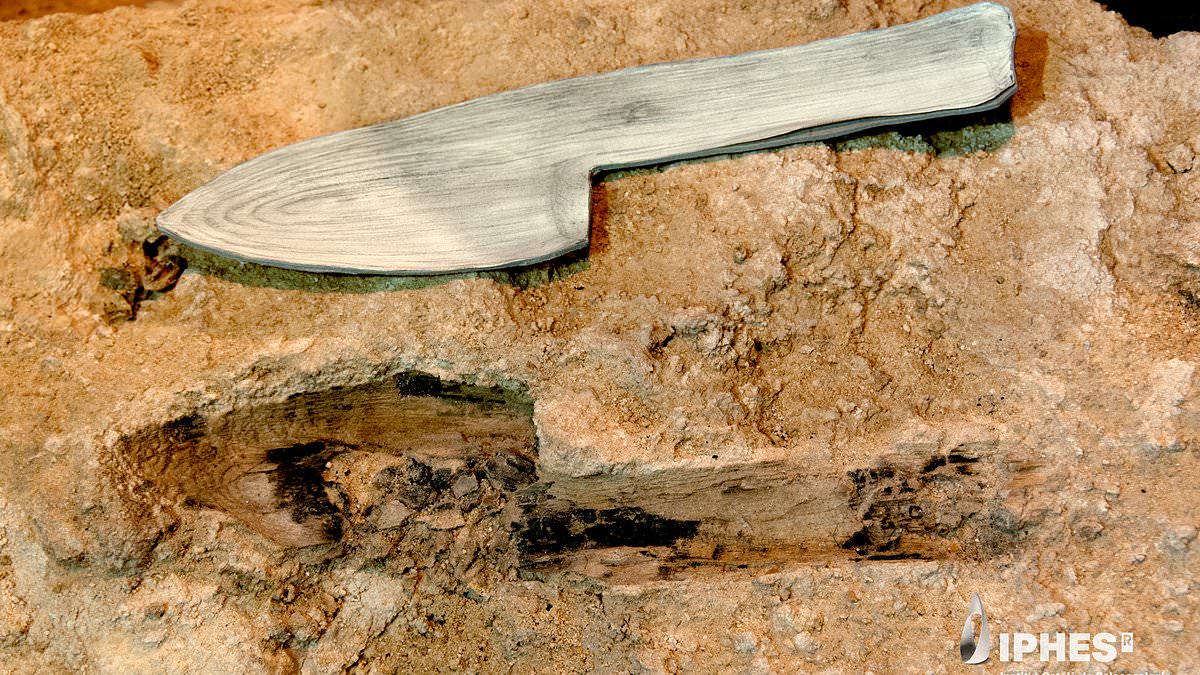
Neanderthals might be famous for their use of sophisticated stone tools, but new evidence suggests that they were also accomplished carpenters.Archaeologists investigating the site of Abric Romaní in Spain discovered evidence of wooden tools, structures, and woodworking dating from 40,000 to 62,000 years ago.The researchers uncovered the imprints and charred remains of 13 objects ranging from spears and a club to trays and tripods.It appears that Neanderthals even specifically sought out different types of wood for different applications, displaying a surprising level of technical know-how.A collection of small trays, for example, were shaped from the flexible bark of the juniper tree – perfect for lightweight, flexible equipment.Meanwhile, the Neanderthal carpenters sought out Scots pine for their harder-wearing tools, selecting a wood which is 'relatively compact and resistant, yet easy to work with'.In their paper, published in Science Advances, the researchers say that this small collection of artefacts shows 'a remarkable technological versatility and the diversified exploitation of wood as a raw material'. Archaeologists have uncovered wooden tools created by Neanderthals, including a club that could have been used as a weapon in war or hunting. Pictured: The preserved impression of a club in the ground and a model of what it would have looked like The remains of wooden tools were found in the Abric Romaní, an enormous sheltered area covering more than 300 metres squared, where our ancient relatives once took shelter Researchers also discovered trays, expertly shaped from the light, flexible bark of mulbury trees (pictured) The Abric Romaní is an important archaeological site tucked beneath a dense limestone cliff known as Cinglera del Capelló.It comprises an enormous sheltered area covering more than 300m squared, where our ancient relatives once took refuge.In the Middle Palaeolithic period, 300,000 to 30,000 years ago, the site was a vital corridor connecting inland Catalonia with the coast, attracting both Neanderthals and early Homo sapiens.Excavations began in 1983, but what makes this site so important is the fact that it is one of the few places to preserve evidence of ancient woodwork.Scientists have observed that even our distant primate relatives, such as chimpanzees, are capable of using simple wooden tools to crack nuts or catch ants.This means that the evolution of wooden technology likely plays an extremely important role in the development of human society.However, unlike stone tools which can survive for millennia, wood rapidly breaks down and decays, making evidence extremely rare.Luckily, at Abric Romaní, researchers have found charred remains preserved by carbonisation and imprints preserved by a process called travertine incrustation. The wooden works were mainly found as impressions in the surrounding ground, preserved through a process called travertine incrustation Archaeologists say that Neanderthals could have used the club and wooden spear to hunt down animals such as deer and horses (artist's impression) This is a process by which calcium carbonate from the surrounding rock builds up in a layer around the wooden artefact as it slowly decays.This leaves an impression on the rock which can preserve fine details, even down to the cellular level.Using these remains, archaeologists have found extensive evidence of Neanderthal woodwork at the site, spanning a period of 22,000 years.Some of the simplest are a collection of wooden trays crafted from bark that have been preserved in a carbonised state.The researcher suggests that these may have 'functioned as containers for transporting food or as scoops or ladles, perhaps for collecting embers or ashes'.The excavations have also revealed a collection of pointed sticks that appear to bear the marks of deliberate shaping.These sticks could have been used as spears for hunting, fishing and warfare, or as simple tools for digging holes.However, the archaeologists also uncovered evidence of more elaborate woodwork, including structural features.In one part of the site, researchers found fragments of three sticks, each over a metre in length, that likely came together to form an elevated structure or tripod that could have been used in food processing.In another, the team found a 16.7-feet-long (5.1m) tree that had been stripped of its branches, apparently intended to function as a 'structural element and as part of a resting area'. Neanderthals also appear to have carved large pieces of wood to create structures, either for shelter or to help with processing food But the most advanced object of all is a unique wooden club carved from a single piece of wood.Shaped almost like a kitchen knife, the club features a clear handle and head section that show a 'deliberate and technically controlled shaping process'.The handle is wider towards the bottom end, making it more secure in the hand during a swing, and there is a sharp transition between handle and head which would have stopped the hand from slipping on impact.Likewise, the 'blade' section is carefully tapered to a point to form a working point.Wooden Neanderthal clubs like this are astonishingly rare, with only one other possible example dating from around 400,000 years ago, making it hard to determine what it was used for.However, the researchers say that its shape suggests it might have been used as a weapon against other Neanderthals or for 'dispatching' animals like deer and horses.So, although they might have lived in the Stone Age, the researchers say Neanderthals' craftwork may have been a lot more diverse than you would expect.The researchers conclude: 'Beyond their deftness with stone, Neanderthals had a remarkable ability to work with organic materials such as bone, shell, fiber, and wood.'
Forget stone tools! Neanderthals were master woodworkers who crafted spears, trays and even tripods, scientists discover
Full Article
Original Source
Read the full article at Dailymail →KhanList aggregates and links to publicly available news content. We do not host full articles from third-party sources. Always verify important information with original sources.