
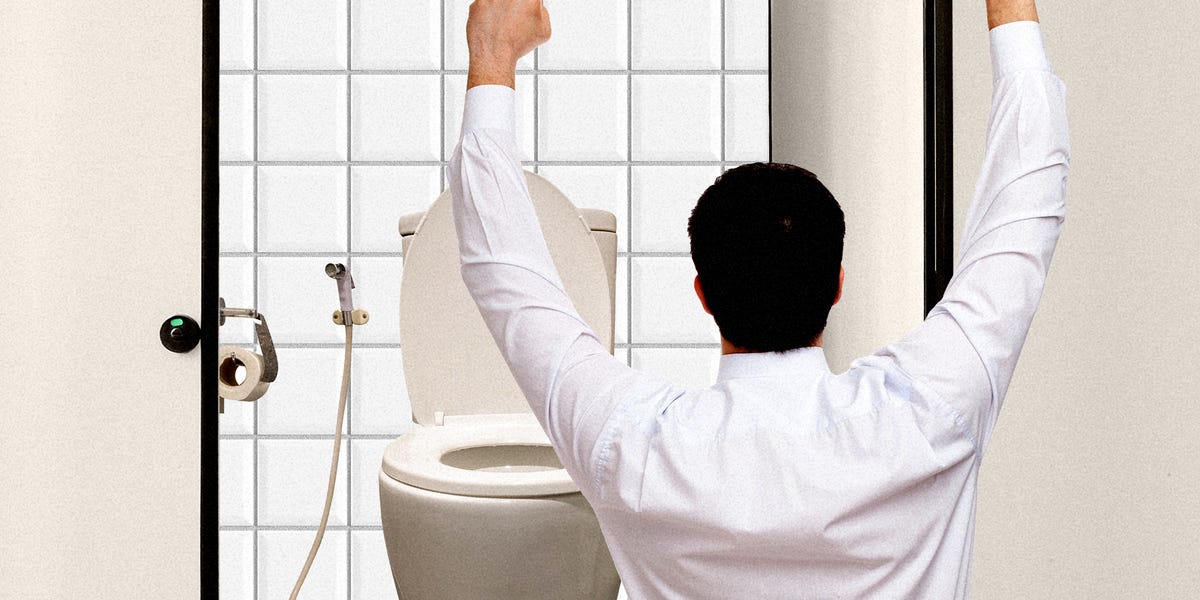
Forget free lunch. Some workers just want an office bidet. Getty Images; Alyssa Powell/BI Seungmin Hong felt he had two options: Stay at Tesla or have a clean tush.After finishing an engineering internship at the automotive giant last year, the University of Waterloo student was weighing whether to stick around or accept a job offer from much smaller Simbe Robotics.During Hong's final interview at Simbe's San Francisco office, he asked to use the restroom, and there it was: a glistening, inviting bidet."That cemented in my mind: 'Yeah, this company actually cares about their employees,'" said Hong, who grew up with a bidet in the bathroom of his childhood home. He took the job.Move over espresso machines, ping-pong tables, and nap pods. For workers like Hong, the humble bidet is the ultimate job perk.In recent years, the hygiene-friendly fixtures have gone from novelty to must-have for many US households. Toto, one of the biggest manufacturers in the space, said cumulative global sales of its Washlet bidets surpassed 70 million units last year, up from 50 million in 2019. High-profile fans include Dodgers pitcher Shohei Ohtani, actor Janelle James, and New York mayor Zohran Mamdani.Now, some devotees are pushing to make bidets a standard in offices. Once you get used to one at home, they say, going bidet-less at work is a pain in the rear.Michael Fiore used to sometimes get about halfway through his commute, then turn around and drive back home just so he could use the bidet in his bathroom. About a year ago, he had an epiphany: Why not install a bidet at work, too?So he did. "It's been a total game changer," said Fiore, president of Smith's Gardentown, a retail garden center in Wichita Falls, Texas. "It's the superior way to live."There's just one wrinkle. Employees who were accustomed to using the restrooms available to shoppers have started coming to what Fiore jokingly calls the "executive" bathroom, which is reserved for staff. It houses one bidet-equipped toilet, meaning he now often has to wait to use it himself."Word has spread," he said.Persuading the bossThis past summer, Cynthia Howard asked her boss to install a bidet in the single-seat restroom she shares with about a dozen of her colleagues. The fulfillment specialist at Swifthouse, a logistics company outside Philadelphia, argued it would reduce toilet paper costs, cut employees' restroom time, and improve morale.Swifthouse's founder and CEO, Dave Harriger, said the proposal persuaded him to order a $60 bidet attachment that same day. He said he's pleased that Howard and other employees like it, though he's not a convert himself."I used it once. I yelped and don't know if I'll use it again," he said. "It's cold water on your butt." Swifthouse CEO Dave Harriger was persuaded by his employee, Cynthia Howard, to order a $60 bidet attachment in the office restroom. Shifthouse Pricier bidet models that sell for thousands of dollars apiece offer warm-water sprays, air dryers, deodorizers, and even Bluetooth speakers.Not every worker is comfortable asking their boss to install the devices in the office. To help those folks out, Jonathan Brown, a data scientist in Orange County, California, launched buttstuff.work earlier this year. The site lets employees register their interest in having bidets at work without directly approaching management.Brown said he has long wondered why Silicon Valley workplaces offer perks like beer taps and catered lunches but not bidets. He plans to share the data his site collects with bidet manufacturers to help them find potential customers. So far, Brown said, about a dozen people, mostly from small businesses and universities, have signed up. His only promotion has been a post on Reddit."People don't love talking about bathroom stuff at work," said Brown.The bidet goes to workBidet makers say interest has surged since what Bill Strang, president of corporate strategy at Toto, called "the great toilet paper panic of 2020," when pandemic shortages sent Americans searching for alternatives.Strang and Justin Allen, CEO of Tushy, another bidet maker, said workplaces are a relatively small but growing part of the bidet business. Installing the devices in office restrooms can be challenging, as some require plumbing modifications, code compliance, and a nearby electrical outlet.Allen sees the demand firsthand. The bidets in Tushy's shared office restroom in Brooklyn, New York, are a draw for employees of neighboring companies, he said, adding that a FedEx driver regularly stops by during his route to use the facilities.Cushy tech companies have long dotted their stalls with bidets. Business Insider spoke with workers who spotted them years ago at some Google and Microsoft offices. Now, with awareness and interest spreading, some workplace observers say what was once a nice-to-have perk could become a competitive advantage for employers well beyond Silicon Valley.A recruiting toolRobert Hatta, an executive recruiter and talent consultant in Columbus, Ohio, thinks employers pushing return-to-office mandates would have a much easier time attracting and retaining talent by investing in the fixtures.In a LinkedIn post that drew nearly 150 comments last year, Hatta argued that flimsy toilet paper and a lack of privacy can make office life less appealing. His prescription? Sound-insulated, well-ventilated stalls, preferably equipped with bidets."It's about respecting people's dignity," Hatta told Business Insider. Going to the bathroom "is an important part of the workday."The state of a workplace's facilities can reveal a lot about its culture, said Lou Downe, director of the School of Good Services, a UK-based provider of leadership training. Details such as free menstrual products, well-maintained soap dispensers, and bidets can offer clues about how much thought an employer puts into its workers' comfort, they said. Seungmin Hong said access to a bidet was a factor in picking his last job. Seungmin Hong Hong, the bidet-loving Tesla alum, has since left Simbe to build his own startup, Simantic. While the company goes through Y Combinator, he and his cofounder are shacking up in an Airbnb. No modifications are allowed, so no bidets.Once Simantic raises its seed round, Hong said he and his cofounder plan to rent some office space. He knows what their first purchase will be. Read next Business Insider tells the innovative stories you want to know Business Insider tells the innovative stories you want to know Business Insider tells the innovative stories you want to know Business Insider tells the innovative stories you want to know Sarah E. Needleman covers leadership and the workplace for Business Insider.Previously, she was a reporter for The Wall Street Journal for more than two decades, covering technology companies, entrepreneurship, and recruiting.In 2022, Sarah received an honorable mention with WSJ colleagues for their coverage of workplace misconduct at Activision Blizzard from the Society for Advancing Business Editing and Writing.Sarah graduated from Rutgers University in 1997 with a bachelor's degree in journalism. She lives with her husband, daughter, and fur child (an Australian labradoodle) in northern New Jersey. Henry Chandonnet is a senior reporter on the Business News desk. He writes about tech culture, from Silicon Valley's startup class to the everyday AI user. He also closely covers Big Tech and the workplace. Henry previously wrote for Fast Company, where he covered trending tech news. He's written for The Daily Beast, People Magazine, and Vulture.Email Henry at hchandonnet@insider.com, reach him on Signal at henrychand.30, or follow him on X @HenryChandonnet. Careers Tesla
Forget free lunch. Some workers just want an office bidet.
Full Article
Original Source
Read the full article at Businessinsider →KhanList aggregates and links to publicly available news content. We do not host full articles from third-party sources. Always verify important information with original sources.