
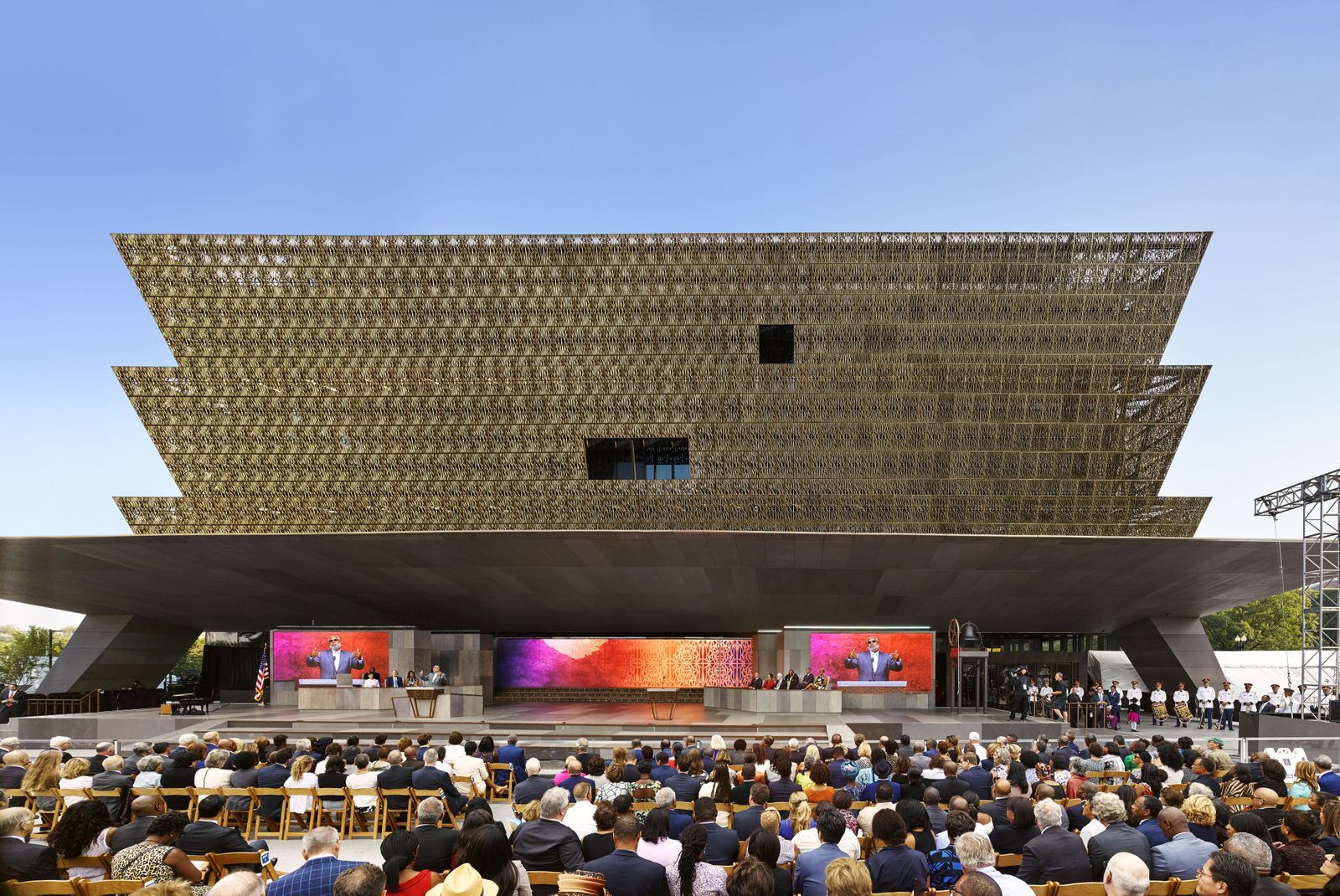
The museum lovingly called the “Blacksonian” chronicles the past and present and envisions the future to tell the stories of Black life in America September 22, 2026 1:55 p.m. The exterior of the National Museum of African American History and Culture during its opening ceremony in 2016 Alan Karchmer / National Museum of African American History and Culture On a visit to the Smithsonian’s National Museum of African American History and Culture, Elizabeth Beckett stands proudly in front of a uniform worn by one of the thousands of Black men who worked aboard segregated trains, in palace cars built by industrialist George Pullman. They were called Pullman porters, and Beckett’s grandfather was among them. “His name was James Syres. He died when he was 90 or 91,” Beckett recalls. The first porters were recently emancipated men hired by Pullman starting around 1867 to staff the luxury sleeping cars. They did everything from serving gourmet meals to shining shoes to carrying baggage. Some were even forced to sing and dance. The porters formed the backbone of the Black middle class, following the path of their wealthier white passengers to save money to send their children and grandchildren to college. That opened the door to opportunities they never had, and many descendants of porters went on to become influential figures in American society, including Supreme Court Justice Thurgood Marshall. A Pullman porter cap in the museum's collection National Museum of African American History and Culture Just around the corner in the “Defending Freedom, Defining Freedom” exhibition is a gorgeous pump organ bought by Pullman porter Henry L. Long in 1911. Museum curator Mary Elliott, whose uncle was a Pullman porter based in Denver, says the organ is a symbol of the importance of the men who formed the first predominantly Black labor union, which was later crucial to the civil rights movement. “Let’s think about these men as Pullman porters just like we think about people who held prestige in their communities—a teacher, a doctor, a lawyer,” Elliott says. In their everyday lives, Elliott notes, the job allowed porters like Long “to celebrate their being a community, being Black, being middle-class, even to acknowledge how far they had come, just gathering around an organ and singing.” Elliott says these are the connections she hopes visitors consider when they peruse the thousands of objects on view at the museum as it celebrates its tenth anniversary. “I want you to go home and look at something in your own home that has that same impact,” Elliott says. “How does that bring us together in these everyday, mundane moments?” The organ once owned by Henry L. Long National Museum of African American History and Culture The museum opened on September 24, 2016, with a staff of about 200 people. It would serve as a living symbol of the importance of the nation’s shared history and the joy of celebrating a journey begun by African American Civil War veterans in 1915 who sought to get a museum built on the National Mall. The decades-long effort got its final push with the bipartisan efforts of Congressman John Lewis of Georgia, a stalwart of the civil rights movement, and Senator Sam Brownback of Kansas; the bill establishing the museum was signed by President George W. Bush in 2003. During a recent visit, throngs of visitors wandered transfixed through the galleries at the museum known colloquially to some as the “Blacksonian,” a few crouching down to read the dense signage and panels that crowd the walls and exhibitions. Carolyn Harris came with her husband, Shawn, from Mount Vernon, New York, and says this museum is crucial to teaching young Black people about their history. “They need to know what we went through to get where we are now,” Harris says. She also thinks the museum is important for those who aren’t African American, to understand “where we came from.” Quick facts: Celebrating ten years Smithsonian Secretary Lonnie G. Bunch III, the founding director of the National Museum of African American History and Culture, will commemorate the tenth anniversary on September 25 with a conversation moderated by the journalist Laura Coates. Founding deputy museum director Kinshasha Holman Conwill feels the occasion is more like the museum’s 20th anniversary because of all the longtime legwork the staff put in. Celebrities—Oprah Winfrey and Michael Jordan, among others—donated millions of dollars to the museum prior to its opening, and $4 million alone came in gifts of less than $1,000 from average Americans. At the opening dedication, President Barack Obama reminded the crowd how many historians, civil rights leaders, lawmakers and others in the nation came together, across parties and politics, to make this happen. Those gathered at the event were serenaded by the likes of Stevie Wonder and Patti LaBelle. Lonnie G. Bunch III, the founding director of the National Museum of African American History and Culture, overlooks the building's construction site in Washington, D.C. on November 17, 2013. James Di Loreto / NMAAHC Bunch and Congressman John Lewis at the museum's opening ceremony in 2016 Leah L. Jones / National Museum of African American History and Culture Conwill says the museum’s founding director, Smithsonian Secretary Lonnie G. Bunch III, had a wish list of major objects, including a slave ship remnant and a cabin that housed enslaved people. Today, the collection has searing artifacts, such as a prison guard tower from the infamous Louisiana State Penitentiary at Angola, which was built on land that formerly held a plantation. Conwill notes that the museum was constructed around that guard tower and a segregation-era railway car, because of their size. Another haunting artifact at the museum is the casket of Emmett Till, the Black 14-year-old who, in 1955, was kidnapped and murdered in Mississippi. The killing of Till became a rallying point for the civil rights movement. “At the core of some of the questions were: What is appropriate for a Black museum to collect?” Conwill says, referencing Till’s casket and the prison tower. “Should we collect it? And if we do, how do we display it? And that’s why, from the beginning, it has been displayed in a very respectful way.” The Point of Pines cabin that housed enslaved people in the museum's "Slavery and Freedom" exhibition Eric Long / National Museum of African American History and Culture A silk lace and linen shawl given to Harriet Tubman by Queen Victoria around 1897 was a gift to the museum from scholar and collector Charles L. Blockson, who also donated Tubman’s hymnal. She was nicknamed “Moses” because she repeatedly returned to the South to rescue enslaved people. A 19th-century carte-de-visite portrait of Harriet Tubman National Museum of African American History and Culture “It’s such an extraordinary thing to know that you are literally touching history, that you are in the presence of an object that was owned by a woman who helped you become free,” Conwill says. “There’s something about Harriet Tubman that is quintessential of the struggle of Black people, and having those objects made all the difference.” Standing with her daughter between Tubman’s shawl and the slave cabin, visitor Maureen Bobo says she wanted to stop at every exhibit “just to inhale it.” “I’m trying not to cry, but it is hard not to, because our ancestors endured so much so that we can have what we have,” she says. “Everyone who is American in the world should know this, because they view us in a certain way without knowing, and there’s been a narrative going on in this nation since we set foot in this land about who we are and the way we are that just isn’t true.” Beyond the high-profile objects, donated images help define the meaning of African American history and culture. Conwill points to the Henry Clay Anderson collection of photographs and the Johnson Publishing photo archives, in which the lives of both well-known and ordinary Black people are captured for posterity. “Everybody was not Benjamin O. Davis Sr., the first African American general officer in the U.S. armed forces, or Benjamin O. Davis Jr., right? Not everybody was Joe Louis, the great boxer who was also in the service,” Conwill says. Black people “were the heroes and the marquee names, but they were also everyday people.” Elliott says part of the museum’s mission, and legacy, is giving the American public credit for being able to look at this history in its fullness. “This is a shared history,” Elliott says. “We’re still all in this together. We’re talking to each other, right? … It’s a cacophony of all of these voices. And what does that tell us about the development of this nation in its many aspects?”Bunch, who recently announced he would retire at the end of the year, put his soul into this museum, and he persuaded others to do the same. He “felt the weight of history” in this endeavor, he says, and realized that he “wanted it to be a museum that both celebrated African American culture and made this the quintessential American story.” The museum's second floor interactive education gallery Alan Karchmer / National Museum of African American History and Culture Visitors learn about the segregation era and civil rights at the museum Eric Long / National Museum of African American History and Culture He says he kept “a huge chart” that questioned what each exhibition says about African American culture and American culture in general, and he “sat in every design meeting.” Bunch and the staff fine-tuned every detail. Shortly before the museum opened, those who worked to create it visited and brought their families, to see how their achievement could help transform a nation. As Bunch says, “I guess the best way I can describe it is a sense that we gave a gift to America.” You Might Also Like Get the latest on what's happening At the Smithsonian in your inbox. More about: African American History African American History Museum American History Celebrations Civil Rights Exhibitions Exhibits Museums Slavery
For Years, the Smithsonian Strove to Bring the African American History and Culture Museum to the National Mall. Now, It Celebrates a Decade as a Beacon of Understanding, Community and Resilience
Full Article
Original Source
Read the full article at Smithsonianmag →KhanList aggregates and links to publicly available news content. We do not host full articles from third-party sources. Always verify important information with original sources.