
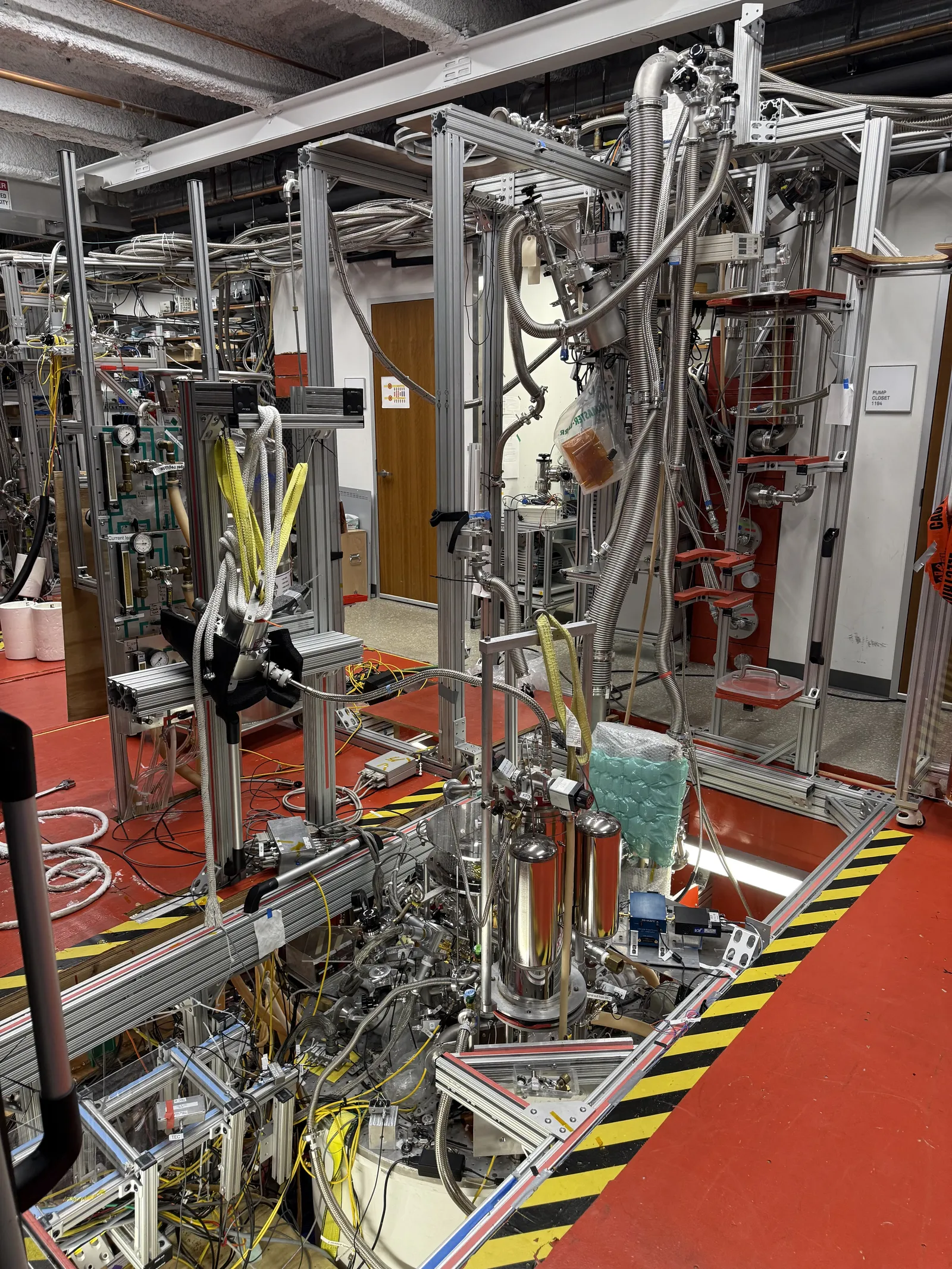
The standard model of particle physics works really well, but it can’t explain why the universe exists. Something is missing, and this trapped particle might hold a clue to the answer October 23, 2026 2:59 p.m. The positron is held inside a tank beneath ground level. Northwestern University How do you contain a fast-moving particle that disappears as soon as it touches almost anything? You build a very special trap. For the first time, researchers have used electric and magnetic fields to capture and maintain an elusive kind of particle known as a positron—the antimatter cousin of an electron. In a study published October 21 in Physical Review Letters, the team describes how they have kept the particle trapped for months, where they can control and study it. The work paves the way for a test that could make or break a longstanding theory of particle physics. “Trapping an antiparticle is extremely difficult,” says Stefan Ulmer, a researcher at the Japanese scientific institute RIKEN who was not involved in the study, to New Scientist’s Karmela Padavic-Callaghan. The work is a “remarkable achievement,” Barbara Latacz, a particle physicist at CERN who did not participate in the study, tells Nature’s Elizabeth Gibney. Many people are familiar with electrons, protons and neutrons—three kinds of particles that make up atoms—but the universe also hosts particles known as antimatter, essentially the opposite of “regular” matter. Every kind of “regular” particle has a twin-like particle of antimatter with an equal mass but the opposite electrical charge. Positrons are the antimatter versions of electrons, antiprotons are the antimatter versions of protons and antineutrons are the antimatter versions of neutrons, for example. When antimatter meets its equivalent matter, the particles annihilate, or essentially disappear, converting their mass into energy. Annihilation presents an interesting conundrum regarding the birth of the universe. Scientists would have expected the Big Bang to produce the same amount of matter and antimatter. But this scenario would have also caused the entire universe to disappear. “All the matter and antimatter would annihilate and there’d be no universe left,” Gerald Gabrielse, a physicist at Northwestern University who led the study, tells Nature. That clearly isn’t the case, and today the known universe has significantly more matter than antimatter. The standard model of particle physics—which explains the interactions between the building blocks of matter and fundamental forces in the universe—doesn’t have an explanation for why this is our reality. Even though this theory has proven to be extraordinarily accurate overall, it still has glaring issues—and it can’t predict why the universe exists. So something must be missing.To investigate, the team wanted to compare the magnetic properties of positrons and electrons to see whether they align with the standard model’s predictions. They had already figured out how to catch and precisely study a single electron. So they needed to do the same for a positron, which can shoot out from the radioactive decay of certain atomic nuclei. “The biggest challenge,” Gabrielse tells Science Alert’s Michelle Starr, is to persuade that high-energy positron “to slow down enough that we can capture it into our particle trap.” He and his colleagues began with a rare, radioactive sodium isotope that emitted the positrons. Then, they slowed the positrons by passing them through a crystal of tungsten—some were annihilated, but others survived. With specialized electric and magnetic fields, they captured one of those particles and suspended it in a near-perfect vacuum at a temperature just barely above absolute zero, according to a statement. “If you want to hold on to antimatter, you have to hold it in a container without walls,” Gabrielse tells Clara Moskowitz for Scientific American. In this container, the team was able to observe and use microwaves to control the particle’s quantum energy states. “It’s a real kick to stand in my lab and watch a positron making transitions—‘quantum jumps’ we call them—between its lowest energy states. How much more fundamental, how much neater can it get?” Gabrielse tells New Scientist. But the best is yet to come. Now that they’ve proven they can observe and control a positron in this manner, they can compare its precise magnetic properties to those of a normal electron. The current theory states they should be the same. But if they prove to be different, it could reveal a much-sought-after flaw in the standard model—and begin to suggest why regular matter is so much more ubiquitous. “We know the standard model has to be wrong somewhere—or at least incomplete,” Gabrielse says in the statement. “We’re very precisely examining the most fundamental and simple systems to find where the theory breaks down. We hope to find an unambiguous answer.” You Might Also Like Get the latest stories in your inbox every weekday. More about: New Research Physics universe
For the First Time, Scientists Trapped an Elusive Antimatter Particle—and Contained It for Months. It Could Allow Them to Test an Enduring Physics Theory
Full Article
Original Source
Read the full article at Smithsonianmag →KhanList aggregates and links to publicly available news content. We do not host full articles from third-party sources. Always verify important information with original sources.