
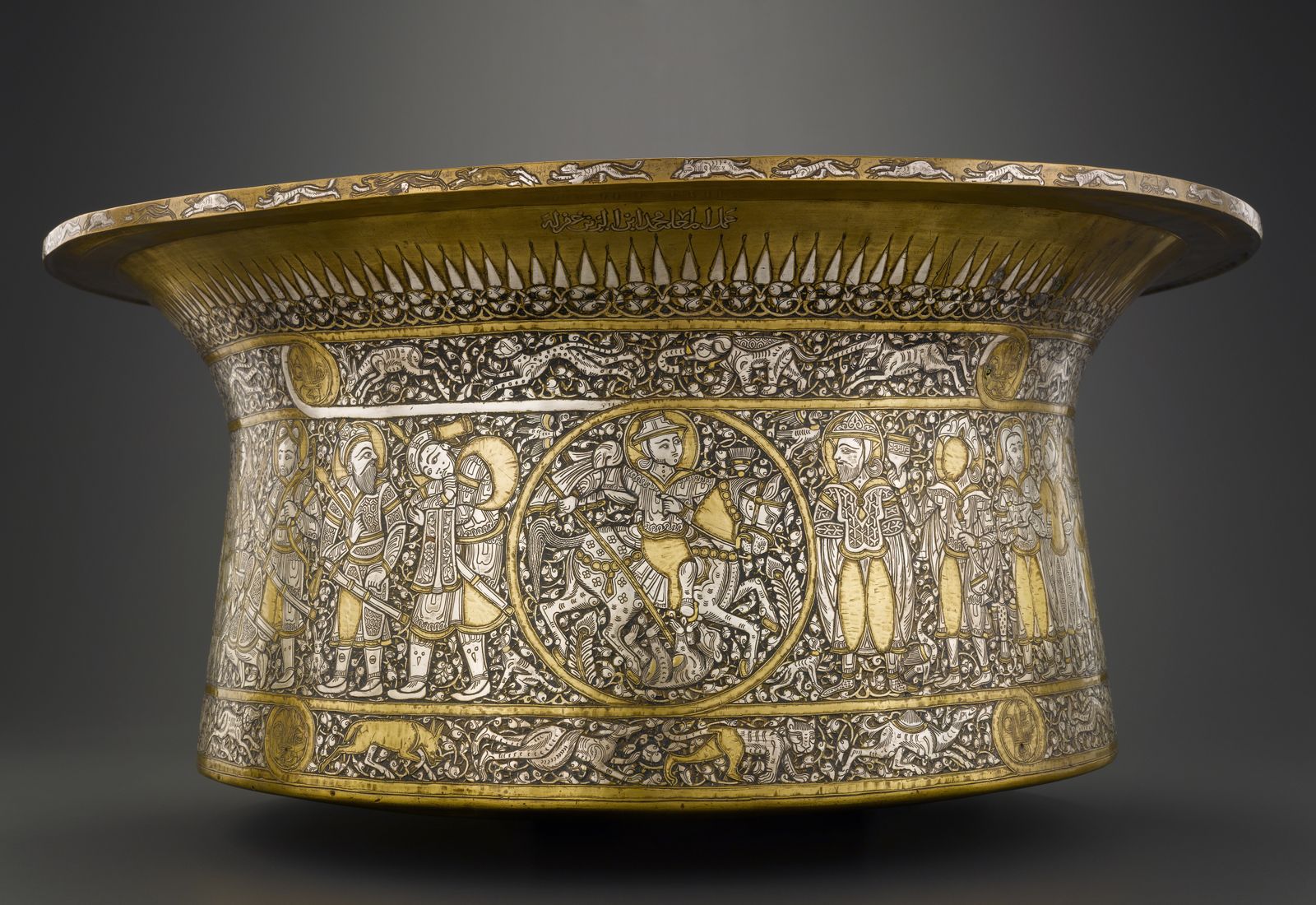
Twenty-six works spanning many centuries and regions will form the September exhibition titled “From the Louvre: Masterpieces of Islamic Art” August 26, 2026 3:00 p.m. Baptistery of Saint Louis basin, copper alloy with engraving and inlay of silver, gold and black paste, Egypt or Syria, Mamluk period, ca. 1325-1340 © Musée du Louvre, Dist. GrandPalaisRmn / Hughes Dubois The latest exhibition at the Smithsonian’s National Museum of Asian Art is set to present 26 Islamic masterworks from the Louvre in Paris. Opening on September 26 and on view through January 18, 2027, “From the Louvre: Masterpieces of Islamic Art” will showcase objects spanning from the 7th century to the 19th century, crafted in locales as far west as Spain and as far east as India. The display marks the first time that these 26 masterpieces will be in the United States together. Curated by Simon Rettig of the Asian Art museum and Souraya Noujaim of the Louvre, the exhibition spotlights wide-ranging artifacts of the Islamic world, works made with bronze, wood, ceramics and other materials. Visitors will see the stunning 14th-century Syro-Egyptian Baptistery of Saint Louis basin, and a circa 18th-century Mughal dagger made with Damascus steel, inlaid with gold and featuring a horse head handle. The basin is “an astonishing object, which is in pristine condition,” Rettig, a curator of Islamic art at the museum, tells Smithsonian magazine. Dagger With Horse Head, jade, rubies, emeralds and kundan gold; Damascus steel inlaid with gold, Mughal India, ca. 1700 © Musée du Louvre, Dist. GrandPalaisRmn / Hughes Dubois Vase Inscribed With the Name of Sultan Salah al-Din Yusuf, made by Dawud son of Salama al-Mawsili, Ayyubid period, 1237-1260 © Musée du Louvre, Dist. GrandPalaisRmn / Hughes Dubois “Objects seldom are considered masterpieces when they are made originally,” Rettig says. “It’s through time that they become masterpieces or are acknowledged as a masterpiece, and that’s especially in the present day. Now, it’s the public, it’s museums’ visitors who make a work of art a masterpiece.” Quick fact: A masterpiece gets a new home A new gallery is being designed for Leonardo da Vinci’s Mona Lisa, the Louvre’s most famous artwork. The 33,000 square-foot, custom-built exhibition space is expected to be complete in 2031. The full histories behind many of the works is unknown. But this exhibition will encourage viewers to explore the journeys that these objects took before eventually being displayed at the museum. For example, Rettig notes, the Saint Louis basin got its name from being associated with Louis IX, and was used for French royal baptisms. However, that particular king was born more than a century before the basin was made. During the 18th century, the French created a “forged identity” for the basin as part of their culture, the curator says. It wasn’t until the 20th century that the basin’s Islamic roots were widely acknowledged. “It tells you that history is not linear,” Rettig says. “You don’t have a single identity, and that’s what makes these objects and the others presented in the exhibition even more iconic and extraordinary.” Aquamanile Peacock, bronze cast and chiseled, Al-Andalus Spain, probably Cordoba, Umayyad period, 972 © GrandPalaisRmn (Musée du Louvre) / Mathieu Rabeau The museum has had a long history of collaboration with the Louvre thanks to its founder, Charles Lang Freer, who befriended French curator Gaston Migeon. In 1903, Freer visited a landmark Islamic art exhibition in Paris that Migeon had organized. “That was very transformative for Freer,” Rettig says. “That’s when he started acquiring Islamic art.” In 1906, he donated his art collection to the nation, and the Freer Gallery of Art, which now partly forms the National Museum of Asian Art, opened to the public in 1923. Jade Cup With Rubies and Gold, Turkey, Ottoman period, ca. 1550-1600 © Musée du Louvre, Dist. GrandPalaisRmn / Raphaël Chipault The museum displayed Islamic artworks upon its opening, and all of those pieces “tell their own stories,” Rettig says. Witnessing the Louvre works in this new exhibition, he notes, will allow visitors to learn “what makes a masterpiece a masterpiece.” You Might Also Like Get the latest stories in your inbox every weekday. More about: Art Artifacts Artists Arts Asian Art Museum Egypt Exhibitions France India Islam Spain Turkey
For the First Time, a Selection of Islamic Masterpieces From the Louvre Is Coming to the United States. See the Treasures Soon to Be Displayed at the Smithsonian's National Museum of Asian Art
Full Article
Original Source
Read the full article at Smithsonianmag →KhanList aggregates and links to publicly available news content. We do not host full articles from third-party sources. Always verify important information with original sources.