
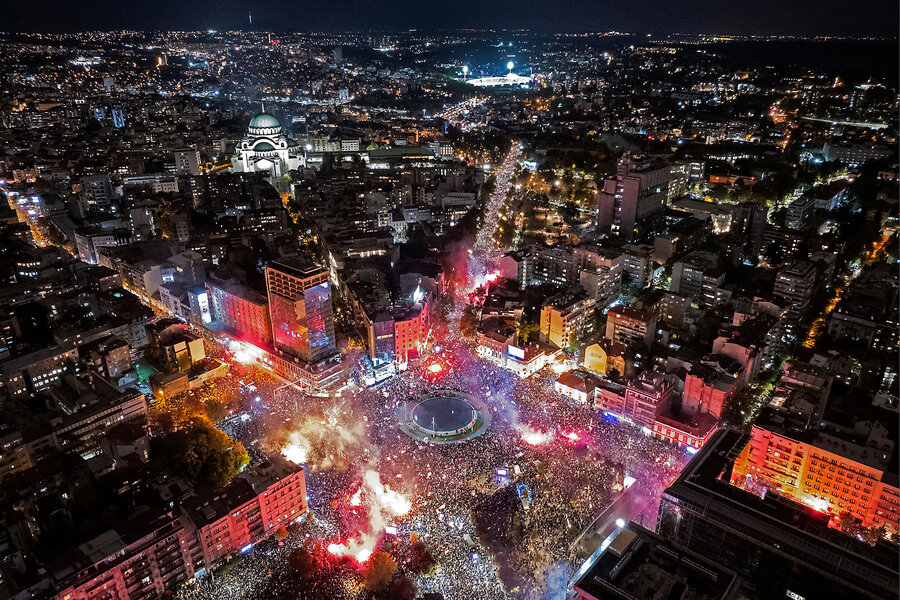
Belgrade, Serbia | Oct. 23, 2026, 2:00 p.m. ET | 5 min read A young man holds a banner that reads, “Honk for the students.” A police car complies, eliciting cheers.It’s Sunday evening, and Serbian streets are filled with people blowing whistles, waving banners and balloons shaped like the number 3. The atmosphere resembles a celebration of national football victory.They are cheering for something else, though: the possibility of ending the grip of Serbia’s governing party. On Oct. 25, Serbia votes in what could prove to be the most consequential election since Slobodan Milošević was removed from power in 2000. The crowds here support the newly formed Student List, No. 3 on the ballot, which is attempting to oust the Serbian Progressive Party (SNS) and its leader, Aleksandar Vučić. They say the SNS, in power since 2012, is a highly corrupt, illiberal government. International watchdogs agree. Transparency International ranks Serbia as one of the most corrupt countries in Europe (ahead only of Russia, Turkey, and Belarus).And unlike in previous elections in which his party won easily, Mr. Vučić now faces an entirely unfamiliar opponent. Most of the 250 candidates put forward by the Student List for Serbia’s National Assembly have no political background, and are drawn from universities and academia. Radmilo MarkovićPolitical scientist Angelina Ivanović holds a balloon at a rally for the Student List in Belgrade, Serbia, Oct. 18, 2026. “These elections for Serbia are historic,” says Angelina Ivanović, a political scientist in the crowd holding a silver balloon. ”That means that citizens are choosing freedom and justice, as opposed to the crime that has entered all possible pores of this society.”Novi Sad and the student protestsThe SNS and Mr. Vučić, formerly Serbia’s president and now an aspiring prime minister, firmly control the country’s financial and economic life, nearly all media, the police, prosecutors, and institutions that are nominally independent. They have also been in control of almost all local governments since 2016.But in 2024, the canopy of a railway station collapsed after millions of euros were spent on renovations. Sixteen people were killed. The public widely blamed it on shoddy construction rooted in corruption, but no one has been brought to trial. Serbia has seen a wave of protests ever since. Jacob Turcotte/Staff Mass protests completely stopped the country for most of 2025, with students at the helm. At first, they asked only for accountability for those killed. In March 2025, they organized the largest protest rally in the history of Serbia. In May 2025, they followed with demands for snap parliamentary elections. Mr. Vučić eventually relented, announcing elections for October 2026. Students across Serbia elected their parliamentary candidates through an opaque, 18-month process ending in September 2026. Unlike political parties’ top-down selections, the Student List was formed at a grassroots level. Courtesy of Relja JarkovačkiSanja Fric, a Student List candidate and assistant professor at the Faculty of Civil Engineering, attends a rally in Belgrade, Serbia. “This is one of our last chances to return the country to the right path, to the rule of law, democracy, media freedom, an independent judiciary,” says Sanja Fric, a Student List candidate and assistant professor at the Faculty of Civil Engineering in Belgrade. “Otherwise, I fear we will become a dictatorship.”SNS entrenchmentsThe ruling party enters the contest with enormous advantages.The vast majority of media outlets in Serbia are linked to the SNS, and they give proportional support to Mr. Vučić. During just 11 days in August 2026 – before he resigned to run for prime minister – Mr. Vučić gave 49 televised speeches, while the student movement has been smeared since it was formed.Ana Martinoli, a professor and media theorist at the Faculty of Dramatic Arts in Belgrade, says the media favors the government by spreading fear of change and promising stability and security if Mr. Vučić remains. “Opponents of the government are presented as the extended arm of foreign interests, and their eventual victory as a risk of destabilizing the country,” she says. “In this way, the debate about the government’s accountability is shifted to the question of patriotism and loyalty to the state.”According to several articles published last week by the Balkan Investigative Reporting Network, there is also an entire organization designed to coerce – and even blackmail – state employees into voting for SNS candidates. Through the testimonies of about 180 people from several dozen state companies, administrations, and institutions, BIRN revealed that these legal entities have been turned into “political factories” that actually work for the ruling party to produce as many votes as possible in elections.Employees are pressured to register as guaranteed votes for the SNS and attend party rallies, under threat of dismissal, pay cuts, stalled promotions, or transfers to distant workplaces. Djordje Kojadinovic/ReutersSerbia's former President and the ruling Serbian Progressive Party candidate for Prime Minister Aleksandar Vučić speaks at a pre-election rally at King Milan Square in Nis, Serbia, Oct. 21, 2026. Such abuses in connection with voting are a long-standing practice, but ahead of these elections, it for the first time involved the state agency responsible for land registries – showing that the effort is still expanding. “This has never happened before, everyone is in disbelief. Even older colleagues who have years of service going back to Milošević,” said one agency employee, adding that everyone in the office nevertheless signed for fear of punishment. The SNS did not comment on the BIRN report, and a prominent SNS member of parliament did not respond to an inquiry from the Monitor. “Elections in Serbia have almost never been equal, but the course of the campaign so far shows that the scale of these irregularities will now be far greater than before, because this is the most serious challenge for the government and the most uncertain election result,” says Nemanja Nenadić, program director of Transparency Serbia.“Change is coming”Despite the government’s advantages, the atmosphere on the streets echoes the mass protests of 2025. As in Hungary, part of the opposition has stepped aside in favor of the Student List, turning the election into a referendum on the government. Deepen your worldviewwith Monitor Highlights.Politics with respectGet political stories with respectful analysis.There‘s a world of new ideas in everyBooks newsletter.There‘s more to life, enrich yours withCulture & Learning weekly.Follow humanity‘s discoveries withScience & Nature stories in your inbox.Gain a spiritual perspectivefrom the stories in your inbox.Want to understand the deeper impact of critical events? Learn the Monitor‘s insight.Already a subscriber? Log in to hide ads. But unlike Hungary, Serbia lacks reliable opinion polls. Those close to the authorities predict a convincing victory for the SNS, while those closer to the Student List predict the opposite.“Change is coming,” says Miloš Vučković, an opposition activist. “Either we will democratize and set out on the path of a normal state and a democratic society, or the darkness that has already engulfed us these 14 years will swallow us completely.” ALREADY A SUBSCRIBER? LoginReal news can be honest, hopeful, credible, constructive.The Christian Science Monitor was founded in 1908 to lift the standard of journalism and uplift humanity. We aim to “speak the truth in love.” Our goal is not to tell you what to think, but to give you the essential knowledge and understanding to come to your own intelligent conclusions. Join us in this mission by subscribing.
For Serbia’s students, years of protest come down to this weekend’s elections
Full Article
Original Source
Read the full article at Csmonitor →KhanList aggregates and links to publicly available news content. We do not host full articles from third-party sources. Always verify important information with original sources.