
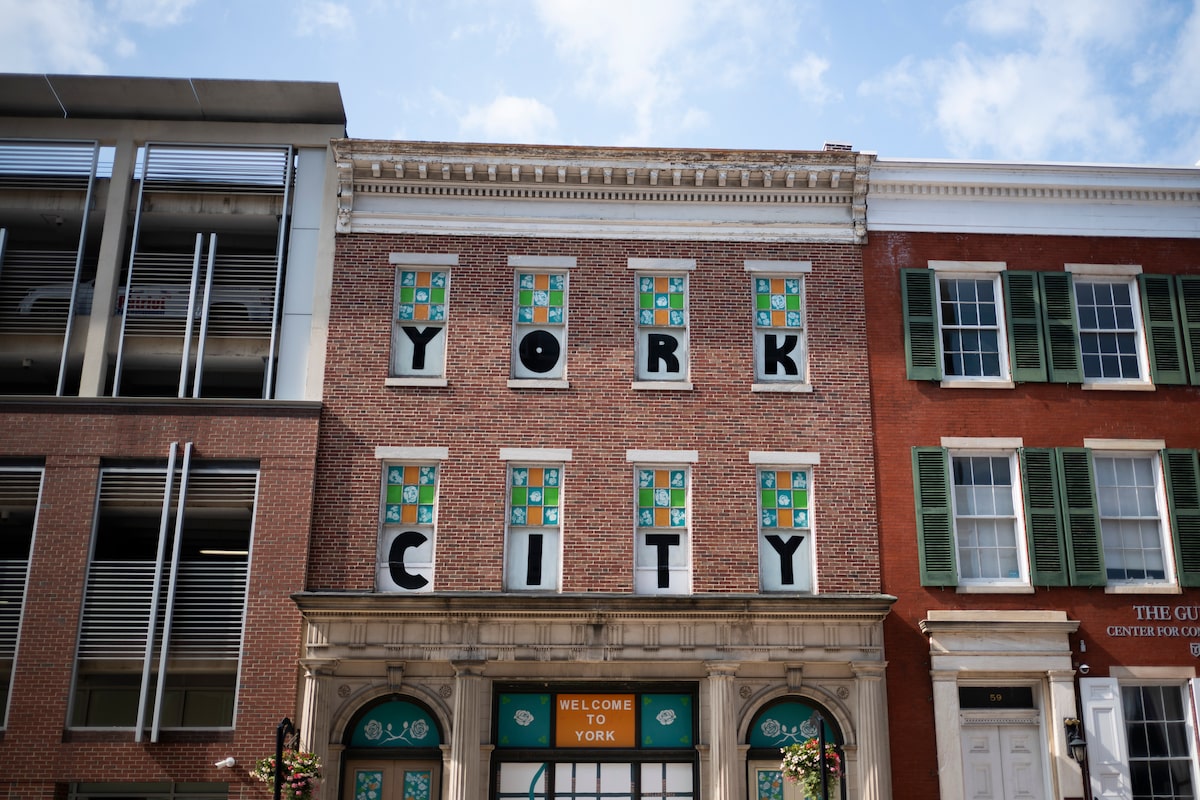
Open this photo in gallery:Voters in York, Pa., will cast their ballot in November’s midterm elections. But the trade fight with Canada likely won’t be a factor.Joe Lamberti/The Globe and MailOn a Monday night in York, Pa., Michael Helfrich was among the regulars gathered inside First Capital Dispensing Co., a smoky bar where the two-man band Snack Club played Dolly Parton covers. Mr. Helfrich took a drag from his cigarette and moved his foot to the beat. Formerly York’s mayor, he left office in January and has since taken a hiatus from all things political. “I’m completely out of it,” he said. “I’ve given over 100 per cent for a long time, so this was my time to step away. … I’m exhausted, you know? I fought and fought and fought since I was a teenager.” That’s perhaps one reason why he didn’t want to discuss the trade war between Canada and the United States. “This stuff is so ethereal, you know, it comes and goes and I can’t be bothered with it,” he said. “And honestly, come on, I mean out of all the crazy stuff that I do know that’s going on, Canada is the least crazy thing.” Manufacturing plays a key role in the local economy, including a Harley-Davidson factory that employs more than 1,000 people. But many people in and around York are occupied with day-to-day concerns, from violence in schools to making ends meet.As a result, they aren’t paying much attention to the trade war launched by U.S. President Donald Trump, despite the fact that Canada’s countertariffs will soon have a direct local impact. Open this photo in gallery:A billboard criticizing President Donald Trump in York. Some residents who have heard of the trade war say they’re worried about much more than the tit-for-tat.Joe Lamberti/The Globe and MailAs part of Ottawa’s targeted retaliatory measures, effective Tuesday, the Canadian government will impose a 50-per-cent tariff on U.S.-built motorcycles with internal combustion engines larger than 800cc, which would affect most Harley-Davidson models.In 2025, Harley-Davidson sold 6,434 motorcycles to Canadian customers, compared with 7,093 the year before, representing a 9.3-per-cent decrease, according to the company’s latest annual report. Sales were down globally but the number of motorcycles sold to Canada is small compared with other countries and regions. In 2025, 82,698 motorcycles were sold in the U.S.; 21,454 were sold in Europe, the Middle East and Africa; and 18,975 in the Asia Pacific. Motorcyclist and editor Lance Oliver wrote on the riding company Revzilla’s blog CommonTread that motorcycles represent a “tiny amount of U.S.-Canada trade.” He opined that while targeting the industry has a partly “symbolic aspect,” it’s also politically motivated. He pointed to the tight congressional race coming up in November, and comments made by Industry Minister Mélanie Joly.At a press conference in late August, Ms. Joly said, “We’re also targeting products that will target states in the U.S., and so we’re being wise and strategic to put political pressure.” Several Harley-Davidson employees whom The Globe and Mail spoke with said they hadn’t heard about the tariffs or didn’t want to comment, while the company itself declined to answer questions. Open this photo in gallery:Manufacturing plays a key role in York's economy, including a Harley-Davidson factory that employs more than 1,000 people.Joe Lamberti/The Globe and MailYork, the seat of York County, has a population of about 45,000, while the county is home to more than 460,000 people. The city is steeped in American history, as the place where the Articles of Confederation were adopted in the 1700s. York also lays claim to being the first capital of the U.S., though historians generally beg to differ. Additionally, according to locals and the city’s website, it’s known as the snack capital of the world, because of the snack factories (hence the band’s name) across the county, run by such names as Martin’s Snacks and Snyder’s of Hanover. Despite the city’s population, it feels like a small town. Restaurants and shops line Market Street downtown, along with a large courthouse that’s illuminated at night. People tend to have a favourite bar, and in some of them, most of the patrons know each other. Open this photo in gallery:Former York Mayor Michael Helfrich said out of all the crazy stuff he knows, the trade war with Canada 'is the least crazy thing.'Joe Lamberti/The Globe and MailLike many states, Republicans make up the majority in the countryside while the city is dominated by Democrats. York and York County are part of Pennsylvania’s 10th Congressional District, which the Republicans narrowly won by a single percentage point in 2024.Voters here will cast their ballot in November’s midterm elections. But the trade fight with Canada likely won’t be a factor.Mr. Helfrich figures that, like himself, other residents are mostly concerned about the rising cost of living, and they don’t have time to think about much else. Expenses are like “a spider web,” he said. “You pull on one strand and now you can’t afford your medication. You pull on this strand and now you can’t afford your rent. You pull on this strand, your car breaks down. Now you can’t afford to feed your kids.” Open this photo in gallery:In 2025, Harley-Davidson sold 6,434 motorcycles to Canadian customers, compared with 7,093 the year before, representing a 9.3-per-cent decrease, according to the company’s latest annual report.Joe Lamberti/The Globe and MailSome residents who have heard of the trade war say they’re worried about much more than the tit-for-tat.In her family-owned barber shop, Yesenia Orr, 32, sat in a chair while her two-year-old son slept behind her. She had read about the impact of the tariffs and said the whole thing is wrong: “We used to be real good allies at one point.”Ms. Orr said she used to work at Harley-Davidson and that it’s very important to the community. But while she recognizes that businesses are being hit and the economy is struggling, she’s worried about her children’s future and wishes politicians would pay more attention to youth.Open this photo in gallery:Yesenia Orr said she hasn’t voted in some time because she’s been unhappy with the candidates running, though she plans to start.Joe Lamberti/The Globe and MailThe mother of four, who works as a security hall monitor in a local high school, said there’s violence there, with kids fighting one another because they’re not from the same part of town.In May, a 15-year-old boy was shot and killed in a park in York. Ms. Orr said recently a teenager accidentally brought his gun to school.She also said there are few resources available for local youth. “It becomes a lost place for some people,” she said of York.Not far from Ms. Orr’s barbershop, Kyle Johnson, a 40-year-old software engineer and general contractor, sat on the patio outside Holy Hound Taproom having a burger. He just moved to York from Baltimore, Md., keen to live somewhere closer to nature.Being new to town, Mr. Johnson plans to read about the candidates before deciding who he’ll vote for: “I like to be informed; just because they’re a Democrat doesn’t make them inherently better, but it’s kind of more, are they for or against Trump?”“I draw the line at: ‘Are you a racist? Are you a bigot? Are you a molester?’ And then I don’t vote for those people.”Open this photo in gallery:Kyle Johnson with his dog.Joe Lamberti/The Globe and MailHe said he’s a conservative in some respects, mentioning that he owns guns but also supports trans people. He does not think much of Mr. Trump. Mr. Johnson said he doesn’t hear politics discussed often, particularly among those in the middle, because there’s a feeling of helplessness. “Things get more expensive, but you feel like you can’t do anything about it,” he said. Back inside First Capital Dispensing Co., Mr. Helfrich said politics has a pendulum and he believes it will swing eventually, but likely not any time soon. He said he has represented all political stripes as either councilman or mayor, from Green and independent to Democrat (which is how he identifies). He said he once garnered enough write-in votes from Republicans to win a spot on the ballot, which ultimately led to his election. Open this photo in gallery:First Capital Dispensing Co. in York.Joe Lamberti/The Globe and MailBut Mr. Helfrich said he’s frustrated with the two-party system, believing it leaves most voters feeling left out. “I’m a social liberal and a fiscal conservative, and when you tell people that, 80 per cent of people around here agree that they’re those things,” he said. “Most of us are right in the middle. But there’s no party in the middle.”Ms. Orr said she hasn’t voted in some time because she’s been unhappy with the candidates running, though she plans to start. But she also doubts politicians will address the violence in York. “When I heard about the tariffs I was like, that’s business talk. That’s for people that want to be rich and get money,” she said. “But if you really want to know about the hardcore, that’s it. That’s what the problem is in York. That’s how we’re living.”Open this photo in gallery:Joe Lamberti/The Globe and Mail
For residents of York, Pa., day-to-day concerns overshadow Trump’s trade war
Full Article
Original Source
Read the full article at Theglobeandmail →KhanList aggregates and links to publicly available news content. We do not host full articles from third-party sources. Always verify important information with original sources.