
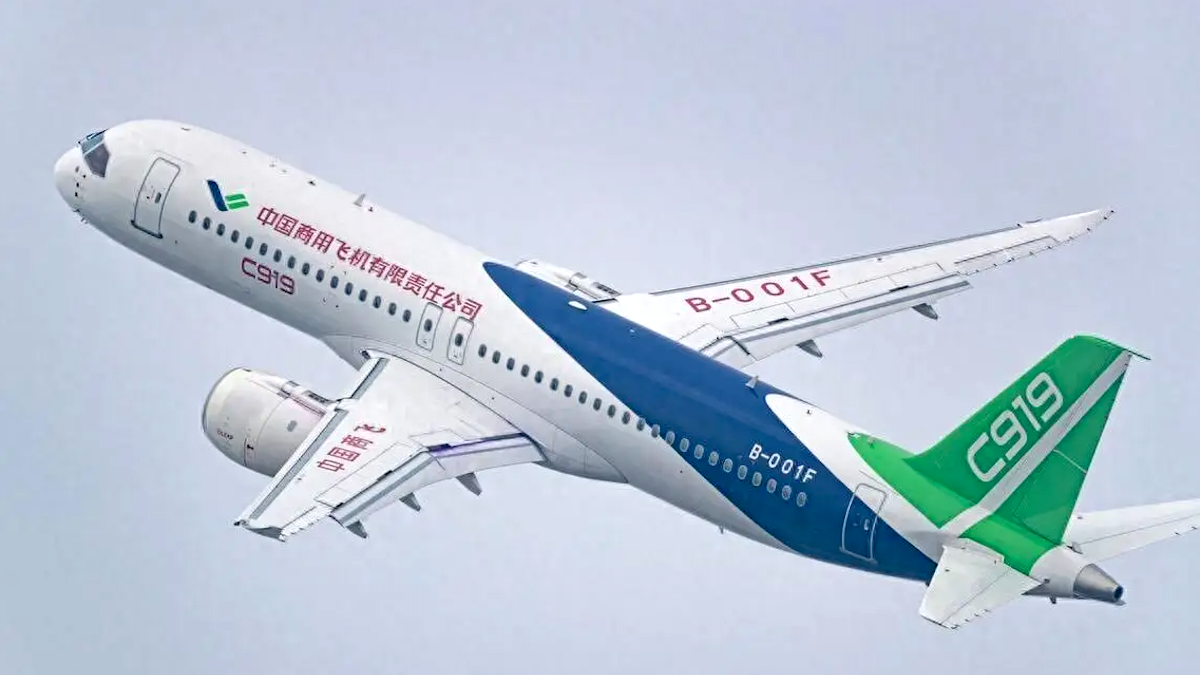
Washington is limiting the parts it licenses to the Commercial Aircraft Corp of China (Comac), the maker of the C919 passenger jet, triggering fears among Chinese pundits that it could ban the US-made engines the jet relies on. The Trump administration has been using China’s reliance on US aviation suppliers as leverage in trade talks, as Washington seeks to loosen Beijing’s grip on rare earth minerals, Reuters reported on October 1, citing people familiar with the matter. The US Commerce Department has capped the parts licensed to Comac to keep the state-owned planemaker from stockpiling, and has slowed export licensing for airplane parts bound for China in recent weeks, the report said. Officials are also weighing a rule that would make it easier to restrict landing gear and other aircraft parts, and a draft included a licensing requirement for aviation hydraulic fluid. Chinese commentators said China would not worry much about curbs on landing gear and hydraulic fluid for its Boeing fleet, as Washington wants Chinese airlines to buy more Boeing jets. They do, however, fear a renewed US ban on the C919’s LEAP-1C engines, which could disrupt Comac’s mass production plans for several years. “China may not need to worry too much about whether the US will use Boeing parts to restrict its aviation industry. The first to panic over such a policy would clearly not be China but Boeing, the pride of American industry,” a Henan-based columnist using the pen name “Global War Dispatch” says in an article. “China’s market is expected to need 8,000 to 9,000 new airliners over the next two decades. Boeing’s lobbyists will naturally try to persuade US lawmakers to change any proposal that so clearly hurts its core interests,” he says. He says a US cutoff of parts for the C919 would be the real problem, as the jet still buys relatively few parts from abroad and is seen as a strong future rival to Boeing, giving Boeing and other firms a motive to strangle it. He adds that if Washington, backed by Boeing’s lobby, did cut off the C919’s LEAP-1C engines and other key US parts, China’s most urgent task would be bringing its own CJ-1000A engine into service, which is unlikely to happen before around 2027. “The CJ-1000A engine still cannot fully replace the LEAP-1C, and there is still a gap before a domestic engine can take over,” a Shaanxi-based columnist using the pen name “Evening Breeze” says. “In the short term, mass production of the C919 will inevitably hit a bottleneck.” “The US chokehold on the C919’s engines is also a process that will force Chinese manufacturing to become fully independent. But the road is long, and China has to endure the pain of the next few years,” he says. He adds that the curbs will only speed up China’s push for home-grown alternatives – trading Washington’s short-term gain for long-term risks, as a Chinese breakthrough would make the next round of aviation competition even fiercer. The C919, a narrow-body rival to the Boeing 737 and Airbus A320, seats 158 to 192 passengers, according to Comac. It won Chinese certification in September 2022 and entered commercial service in May 2023. Comac in 2009 chose the LEAP-1C, made by CFM International, a joint venture of GE Aerospace and France’s Safran, as the C919’s sole Western engine. The engine won US and European certification in December 2016. Washington first used jet engines as a bargaining chip during last year’s tariff war, after Beijing hit back at US tariffs by restricting rare-earth exports. China restricted rare earth exports in April 2025 in response to US tariffs. The two sides agreed in May to cut tariffs for 90 days, but Washington later that month suspended licenses for Comac jet engines and other parts. It lifted the engine suspension in July, after a rare-earth deal in London. The engine suspension lasted only five weeks, but regulators then reviewed licenses engine by engine rather than in batches, with each approval taking two to three months. Comac cut its 2025 delivery target to about 25 jets from an ambitious 75, Bloomberg reported in September 2025. It ultimately delivered 15, missing even the revised goal by 40% and barely improving on the 13 it had delivered in 2024. Rare earth shortfall persists Washington has grown frustrated that China has not restored the flow of critical minerals it promised under last year’s trade truce. US Treasury Secretary Scott Bessent pressed Chinese Vice Premier He Lifeng on the issue in New York on September 20, just days before the Trump-Xi summit in Washington on September 23-25. Chinese customs data show rare earth magnet shipments to the US fell 21% month on month to 512 metric tons in August. Chinese customs also recorded zero US-bound shipments of yttrium, used in heat-resistant coatings on jet engine turbine blades, in January, May and June. Washington is pursuing a two-track strategy. In the long run, it is building supply chains outside China. Since July, Trump has barred defense contractors from using minerals sourced from adversary nations from January 2027, blocked exports of tungsten scrap and battery waste and pledged more than US$2 billion for domestic and allied mineral projects. In the short run, the US is using tariffs and aircraft-part licenses to push Beijing to ship more, while extending the trade truce only two months, to January 10, 2027. Following the Bessent-He meeting in New York, Wang Yanan, editor-in-chief of Aerospace Knowledge magazine, posted a photo online on September 21. Taken on June 30, it shows a Y-20 military transport plane with a CJ-1000A mounted under its left wing, beneath a banner celebrating the engine’s first successful certification test flight. Because people are not allowed to post images of military aircraft online in China without official approval, the release suggested Beijing wanted Washington to see that its engine program was making progress. Some Chinese pundits are upbeat. They say that the engine could win certification in 2027 and that, once it enters mass production, any Western attempt to choke the C919 by cutting off supplies would backfire, costing Western suppliers the world’s largest narrow-body market for the next two decades. Others, however, have poured cold water on hopes that the CJ-1000A can replace the LEAP-1C any time soon. “The CJ-1000A has entered the final stage of airworthiness certification, but that does not mean it will be installed and put into commercial use right away,” says a Hubei-based columnist called David. “Passing tests in the lab is a long way from carrying passengers safely every day.” “The engine has so far completed 6,142 hours of extreme ground testing, simulating 10 years of wear in airline service. The imported LEAP engines, by contrast, have logged 88 million hours in real-world conditions, giving them a reliability rate of 99.95%,” he says. He says the CJ-1000A still has three major hurdles to clear. Type certificate: The engine completed its technical review in May 2026, but no date has been announced for issuing the certificate. Production certificate: This is expected in 2027 at the earliest, as building one qualified prototype differs greatly from mass-producing hundreds of engines. Installation approval: Fitting a new engine to the C919 is the highest level of design change and requires a full supplementary certification. He says a full switch to domestic engines on the C919 is unlikely before 2030, with the CJ-1000A expected to fly alongside imported engines until then. Read: US bans Chinese data center gear as Beijing grounds its AI talent Follow Jeff Pao on X at @jeffpao3
For rare earth leverage, US caps aircraft parts licenses to China
Full Article
Original Source
Read the full article at Asiatimes →KhanList aggregates and links to publicly available news content. We do not host full articles from third-party sources. Always verify important information with original sources.