
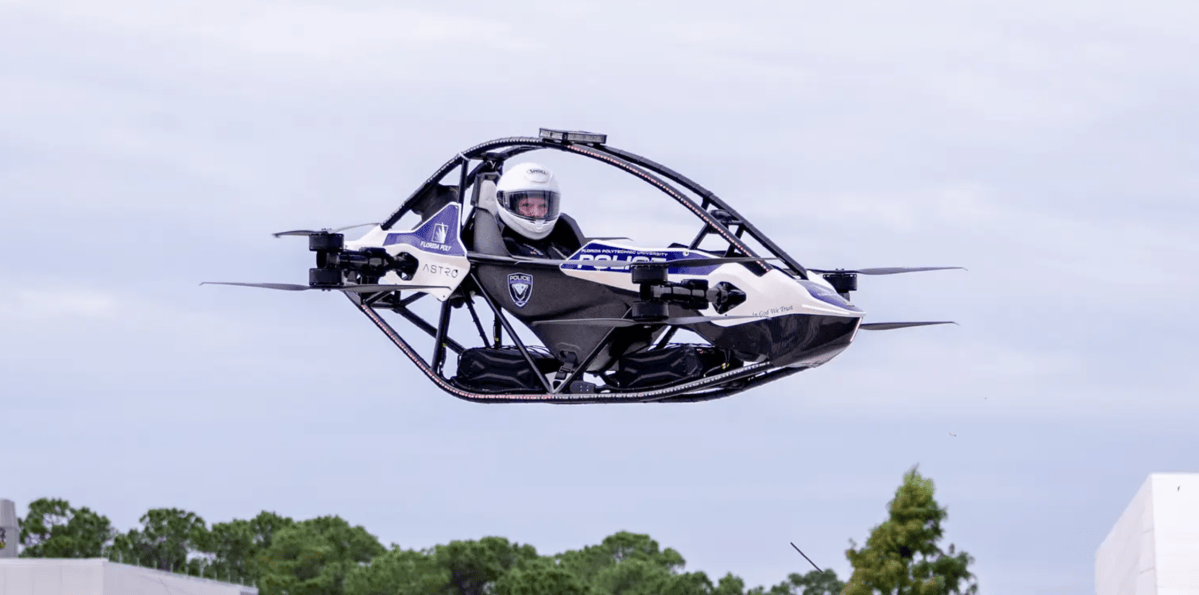
Jetson Thanks to the rise of military-style imaging drones, AI-integrated surveillance towers, and automatic license plate readers, police across the United States have more eyes in the sky than ever before. So why on Earth are university police in Florida spending six figures on a ridiculous-looking quadcopter that fits just one single officer at a time? The answer to that question is harder to find than it appears on the surface. A new collaboration between Florida Polytechnic University, the campus police department, and a Swedish aerospace company called Jetson has birthed the “Astro,” an absurd electric flying machine capable of carrying a payload of exactly one cop in its cramped cockpit. Footage shared by local station Fox13 shows the Astro — originally called the “Jetson ONE” by its creators — in all its glory: a black and white electric vertical take-off and landing (eVOTL) vehicle complete with police decals and a hilariously diminutive light bar. According to the station’s reporting, the Astro cost the university $150,000, and weighs 154 pounds without a battery or pilot. It has a pitiful maximum flight time of just 20 minutes, and its top speed clocks in at just under 65 mph. Though Florida Polytechnic demonstrated the Astro’s flight capabilities to the press, it has yet to win official approval from the Federal Aviation Administration, Fox13 reported. With such a short flight time and obvious limitation in crew capacity, it remains to be seen how helpful the Astro will be for campus police in keeping students safe. Officers at Florida Polytechnic already have access to cutting-edge police technology, like a fleet of at least five surveillance drones, some of which contain thermal imaging sensors. And by the numbers, Florida Polytechnic is hardly a hotbed of high-flying crime. Campus police records show the most common offense in 2025 was “liquor law referral,” which totaled just 13 for the entire year. It didn’t take long for critics on social media to start poking holes in the idea, questioning how useful an eVTOL would actually be for campus security purposes. “Whoever said ‘when pigs fly’ I have great news for you,” one social media user quipped. “I’ll be real I’m lost on the utility of this in any capacity. For searching how is an army of drones with video not better lol.” Others compared it to the US Army’s failed “Hiller Flying Platforms,” an equally-dubious hovercraft vehicle developed in the 1950s. Press statements issued by the groups involved in the Astro didn’t provide much insight, instead falling back on tired public safety sloganeering. “Advanced air mobility is a technology on the rise, and we can either choose to be proactive or reactive as it develops,” Florida Polytechnic’s police chief Aaron Murray said in a blurb published by the university. “We want to stay at the forefront of this technology and understand how it can be used to advance public safety and airspace safety altogether.” Stéphan D’haene, CEO of the device’s manufacturer, Jetson, framed the purchase order as a win for his company, but had little to say about the Astro’s practical utility. “The decision by Florida Polytechnic University to introduce Jetson ONE as a platform for public safety, research and education is a powerful validation of [our] progress,” D’haene enthused in a Jetson blog post. “It brings together operational deployment, institutional acceptance and the development of future aviation talent. These are exactly the foundations required to establish an entirely new category of personal aviation.” More on police: Flock Cameras Are Really Just the Start of Our Dystopian Surveillance Hell, Experts Warn
Florida Police Show Off Incredibly Tiny and Goofy Quadcopter That Fits Exactly One Cop at a Time
Full Article
Original Source
Read the full article at Futurism →KhanList aggregates and links to publicly available news content. We do not host full articles from third-party sources. Always verify important information with original sources.