
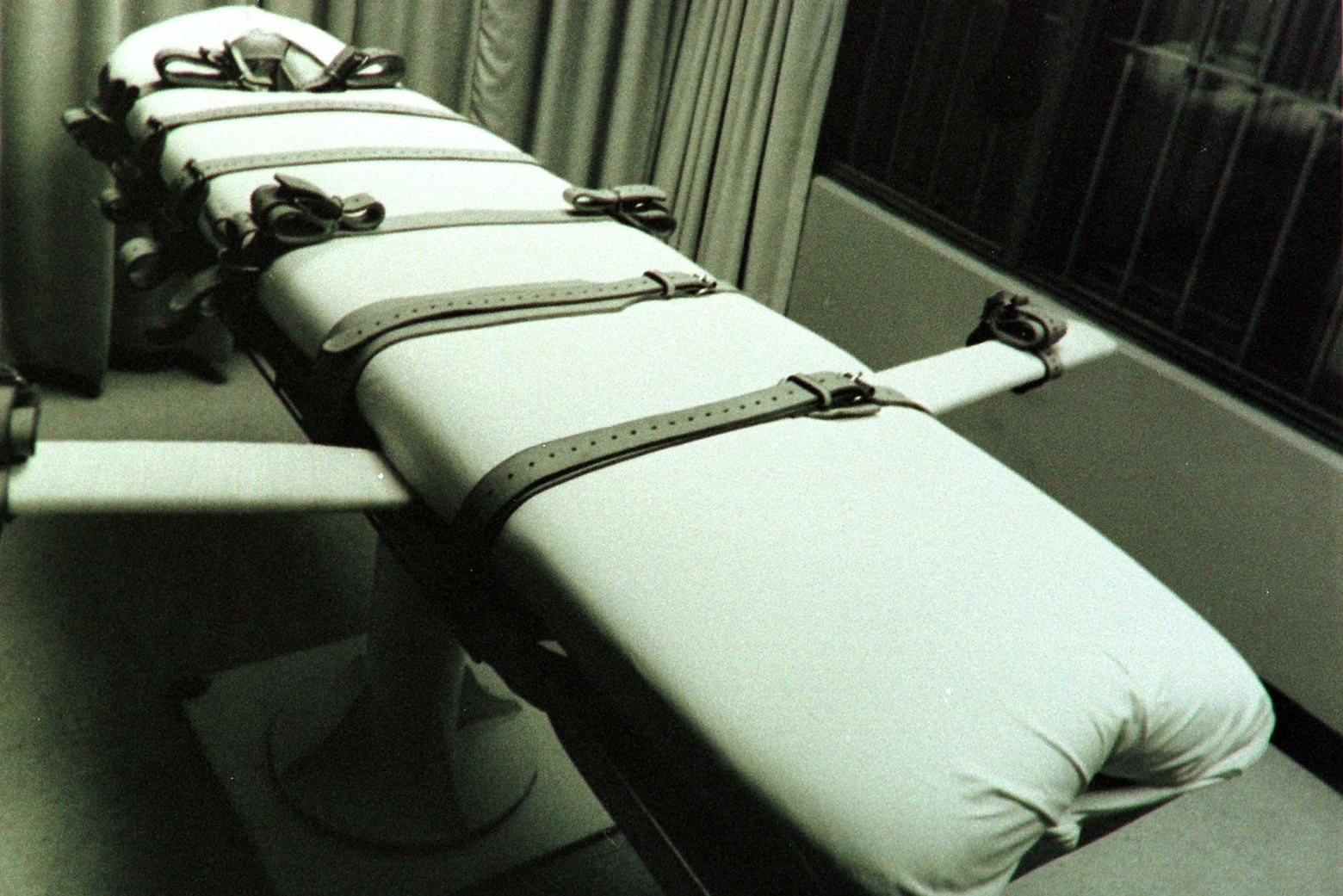
Jurisprudence Photo by Paul K. Buck/Texas Department of Corrections/AFP/ via Getty Images Sign up for Executive Dysfunction, a weekly newsletter that highlights one under-the-radar story about how Trump is changing the law—or how the law is pushing back—and keeps you posted on the latest from Slate’s Jurisprudence team. Years ago I was a lawyer for William Reaves, who will soon be put to death in Florida. He gunned down a police officer in 1986. William is a murderer. He is also a war veteran with combat PTSD and polysubstance use disorder who, on the night of the crime, did only what training and trauma dictated. I got to know him well and care for him as a friend. For years I have wondered what it means to hold all of those clashing truths in my mind at once. As his execution approaches, I’m no closer to understanding. There are two stories of William’s life. In the prevailing narrative, he’s a monster who shot a good cop as the man begged for his life. In the untold story, he’s a victim of circumstance—a sweet kid from a small town who was sent to war, trained to kill in the service of his country, and returned home a psychological ruin. Both stories are true. Only the first has been given moral weight in popular memory. The second—the tale of William the war hero—explains his crime. That story should be heard before it comes to an end on Oct. 20 at 6 p.m. Eastern. That is when William will die by lethal injection. The story most people know unfolded late at night in a Zippy Mart parking lot. William was deep in a cocaine bender, a gun tucked in the waistband of his sweatpants. Unsure how to get home, he had the bright idea to call 911 from a pay phone and ask for a cab. The dispatcher sent Deputy Richard Raczkoski instead. By all accounts, Raczkoski was a good man and a good cop. On that night he was both. He did not arrest William or chase him off. He called for a ride and waited to make sure William got home safely. Everything would have been fine but for a banal twist of fate. As they waited, the gun slipped from William’s waistband and clattered to the pavement. The mishap would have been comical had it not led to Raczkoski’s death and, later this month, William’s. Both men saw the loose weapon. Both lunged for it. William got there first. Raczkoski pleaded for William not to kill him and turned to run, but William shot him four times in the back. When Florida Gov. Ron DeSantis signed the death warrant setting the execution date, he had this story, and it alone, in mind. So did the law enforcement officers who urged DeSantis to choose William for execution from more than 200 inmates on Florida’s death row. So do news outlets that affix the “cop killer” epithet to William in headlines. For most people, the story of William’s crime feels compatible with a state-run ritual to poison him to death. The other true story of his life may not. William grew up in the small community of Gifford, Florida, where folks thought he might become a pastor. He helped out at church and around the neighborhood. Family and friends remember him as a good kid, gentle and kind—not a monster in the making. The man who killed Raczkoski emerged only after circumstances radically altered the course of his life. While still a teenager, William was taken from his community and sent to Vietnam. He went on search-and-destroy missions, spending day after day under the ever-present threat of stumbling into a firefight. A friend who served beside him said they would remind each other, “Don’t half-step,” which meant to stay alert, never to let your guard down. William’s body learned to stay locked in a state of hypervigilance that eventually would not switch off. Older soldiers in Charlie Platoon—men William looked up to—trained him to use heroin and opium-laced marijuana to numb the unrelenting terror. One day as William was soft-stepping through the jungle he found himself looking down his rifle at an enemy soldier. The man was urinating on a tree with his weapon on the ground. Their eyes met, and William saw the man realize he was about to die. But William did not fire. It just felt wrong. When William’s commanding officer found out, he was furious. Never let ’em go! Get them before they get you! Kill or be killed! William learned the lesson well. He killed to survive as friends died around him. He made it home. But the constant panic and the conditioning to use drugs against it came with him. He went to a VA hospital for help but was turned away. Combat post-traumatic stress disorder was not yet understood. So William bought drugs on the street to self-medicate what the VA had not yet named. For protection while he did it, he began carrying a gun in his waistband. As one of William’s lawyers, I sat with mental health experts who evaluated him, and from them I came to understand what really happened on the night of the crime. William, they explained, was in the grip of a flashback. He felt himself again in a firefight in Vietnam and could not—not did not, but could not—govern his impulses. William’s flashbacks were triggered by men in uniform and the sight of guns. When Raczkoski, a uniformed officer, lunged for a fallen weapon, William’s combat training and mortal fear took command. He acted reflexively. Even though Raczkoski only wanted to help him, William thought he was fighting for his life. The last time William had seen a uniformed man standing over a loose weapon, he had done nothing. But that mistake had since been drilled out of him. Never let ’em go! Get them before they get you! Kill or be killed! One fragment of evidence from William’s case always struck me. A witness inside the Zippy Mart testified that after the shooting William ran in a zigzag pattern toward the tree line. No one was firing upon him. No one was around to fire upon him. His actions made no sense in context and thus proved his state of mind. Plain and simple, William thought he was back in Vietnam. Alone in the dark with no one around, his mind was in the jungle, and his body was doing what it had been trained to do when faced with the enemy. In 2017, a federal judge overturned William’s death sentence and ordered a new sentencing because William’s jury had not heard the expert testimony about William’s mental illness. The jurors who decided by a vote of 10 to 2 that William deserved to die did not know that William had PTSD or that he was reliving Vietnam when he killed Raczkoski. The federal judge acknowledged William’s heroic combat service and the tradition of extending leniency to veterans whose crimes bear the wounds of war. At a new sentencing, a jury would finally hear the whole story. But Florida appealed and the 11th U.S. Circuit Court of Appeals reversed the decision—not because the testimony was false or unimportant, but because a procedural rule barred the federal court from considering evidence that had not been presented in state court. The story of William the war hero was deemed legally incognizable. People often complain that defendants escape punishment because clever lawyers get them off on a technicality. William, however, will be executed on one. Murders are often called “senseless.” I understand why. They seem so until someone does the difficult work of presenting the evidence that traces fate’s path from causes to consequence. The truth is there are always reasons. Maybe not good ones, not comforting ones, not ones that lessen the tragedy or grief, and sometimes not ones we can make visible, but there are always reasons. William did what he did for reasons. Those reasons were unknown to his jury. But Florida is going to execute him anyway. I have come to understand that moral outrage abhors understanding. People experience attempts to explain murder as an affront to the victim. They feel that admitting a murder happened for reasons would somehow diminish or dishonor its tragedy. They prefer to blame a monster without history or humanity. To satisfy their need to condemn someone—rather than circumstances, a war, a mental disorder, a tragic coincidence—murder cannot be allowed to make sense. People ask of William’s crime, How could he do something like that? When I reflect on the events of his life, I ask, Is it any wonder that he did? The trauma, the training, the drugs, the incident with the enemy solider all culminated at the Zippy Mart as if the world had arranged itself around William to preordain his actions. When I represented William, we talked about his life. I kept greeting cards from him and his family thanking me for the work I did on his case, even though we lost. In one he wrote, “I LOVE YOU MAN!!” and I treasure that one, because I have love in my heart for William. I think of him as a friend. At the same time, I know he murdered a good man and officer in a horrific tragedy. For me, both are true. For me, William is not reducible to Cop Killer or, for that matter, War Hero, not one or the other. He is both and more—a broken man of complex humanity and contradictions, vulnerable like the rest of us to what the Supreme Court has called in its death penalty jurisprudence “the diverse frailties of humankind.” William’s execution will belong entirely to its time. We live in an age of dichotomous thinking, with social-media algorithms feeding rival camps differing facts, constructing differing worlds of intersubjective reality. Nuance is weakness. We are losing what capacity we had to hold the tension of opposites, to think complexly about a complex world. And so William must be a cop killer only, not also a war hero, not more. For my friend William, I hold the tension of opposites. I engage confusion. I remain with complexity long enough for irreconcilable surface truths to give way to deeper meanings and difficult understanding. The Eighth Amendment prohibits cruel and unusual punishments, which the Supreme Court defines as those that violate the “evolving standards of decency that mark the progress of a maturing society.” Justice Thurgood Marshall argued that most people do not know enough about the death penalty—how it operates, the limits of its reliability, how often it fails—to make an informed judgment about whether it is decent. Some of us view uninformed decency as none at all. William’s story is a case study in the death penalty’s indecency. But Marshall was right. No one sees it, because no one wants to sit with the duality and moral vagaries of William’s life stories long enough for understanding to emerge. Since the moment I heard William will be killed on Oct. 20, I’ve been on edge. I feel guilty for losing his case and, for some reason, scared, as if I along with him am unsafe. I think it has something to do with another unseen outcome of the death penalty—secondary trauma. Years after I represented William, a psychiatrist surprised me by saying we should discuss my work-related PTSD. A lot clicked into place in that moment. I was aware of the studies showing secondary traumatic stress in criminal defense lawyers and, even more so, in capital defense lawyers. We are known to develop PTSD-like symptoms from repeated exposure to the traumas of death work. For instance, we may experience hyperarousal and intrusive recollections. I keep replaying arguments with William’s prosecutors—colleagues who dedicated their careers to killing my friend. They only let themselves see the cop killer. I keep thinking that I share something with William, a trauma derivative of his. I keep checking and rechecking his execution date and time on my Outlook calendar, right there among the work meetings and menial tasks. I teach at a law school now. On the night of Oct. 20 at 6 p.m., I happen to have a class. When they strap William to a gurney and inject him with poison in front of an audience of spectators, I’ll be with a promising group of students who believe in the law. I’ll be teaching them that the law seeks truth, upholds reason, and does justice, while wondering if the state has stopped my friend’s heart yet. I’ll wonder how I can teach faith in the law at the very hour the law fails my friend by ending his life. And once again, I will have no choice but to hold clashing truths together in my mind. Death Penalty Florida Jurisprudence Mental Health War Death Ron DeSantis
Florida Is About to Kill My Friend. I Hope the Executioners Read This First.
Full Article
Original Source
Read the full article at Slate →KhanList aggregates and links to publicly available news content. We do not host full articles from third-party sources. Always verify important information with original sources.