
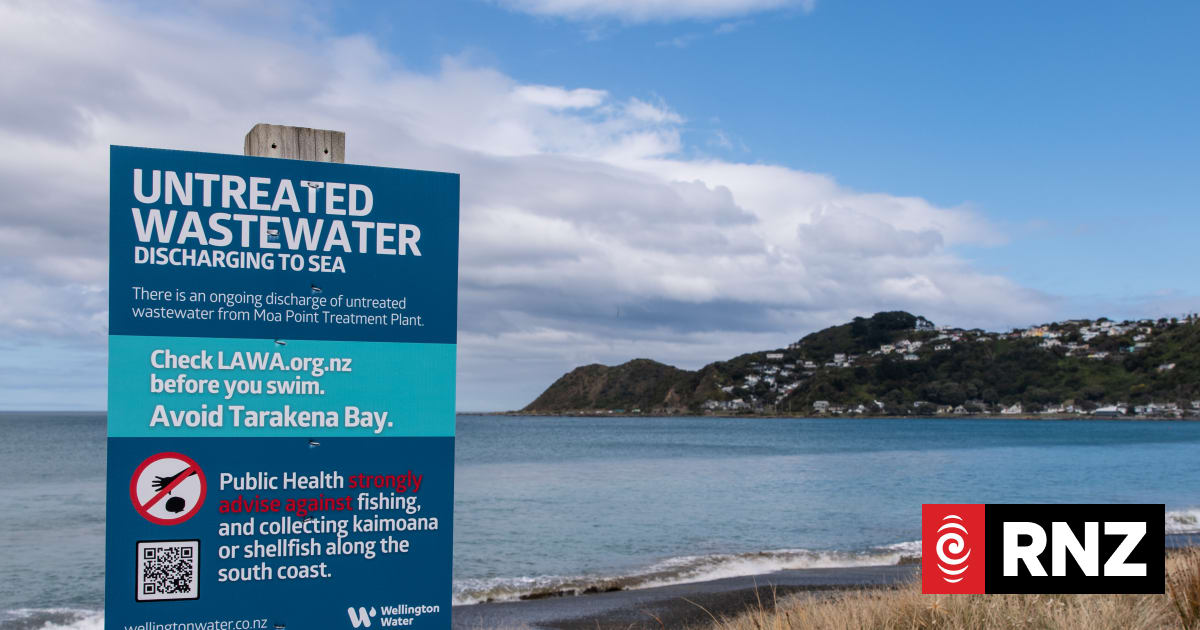
A newly-released report into the Moa Point failure reveals flooding occurred five times at the sewage treatment plant in the months leading up to disaster.It also raises questions about the plant's alarm systems - including whether alarms were sighted but not acted on, and that others weren't programmed to trigger immediate pagers.About 16 billion litres of raw sewage had spilled into the city's south coast since Moa Point catastrophically flooded on February 4.The report from infrastructure consultancy firm AECOM had been withheld until now due to insurance discussions.Its investigation did not identify a single sole cause of the flooding but found it was caused by a combination of technical and organisation factors.The plant was undergoing critical upgrades to its ultra-violet disinfection channels at the time of the flooding. This reduced the plant's capacity to treat sewage from the community.A Moa Point wastewater sign. (File photo)RNZ / Samuel RillstoneWith sewage diverted to a bypass pipe, heavy rain and increased flows on the night caused air bubbles in the bypass pipe choking the wastewater and causing it to flood.But the report said overflows occurred in one of the UV channels twice in October 2025, twice in January and once on February 3 - the day before the disaster.While these did not spill into the wider plant, they did flood one of the offline UV pipes.The report noted by October 22 2025, crews were warned flooding could occur in storm events. In an incident report after the January 15 flooding, Veolia operators warned there was a risk of pumping into the short outfall pipe if flows exceeded 3200 litres per second.A meeting was held between Wellington Water staff, Veolia and Stantec on February 3 to discuss the flooding incidents, where a Veolia staff member said the bypass pipe being used could only take 1500 litres per second, and there was a risk of overflow to the short pipe at Tarakena Bay if sewage flows passed 3000 litres per second.Check LAWA signage on Wellington's South Coast. (File photo)Kate Pereyra/RNZ"Veolia have explored options for ways to mitigate/eliminate this and found limited options", meeting minutes cited in the report said.People raised the potential to limit flow into the pipe, the report said, but this was not taken up because it would result in discharging sewage into the short pipe close to the shore at Tarakena Bay.The report said Fire and Emergency staff were the first to alert operations staff flooding had happened, shortly after 1am on February 4.While two Moa Point alarms appeared to have been sighted by a duty manager at 12.19 am and 12.34 am, the report authors' said they were not aware of staff turning off pumps and equipment remotely.Additionally, several critical alarms triggered before and during the flooding were not pager alarms, and weren't programmed to require immediate operator action.A Veolia spokesperson said unlike the Crown Review, the AECOM report was not independent or a "complete view of the situation".The spokesperson said the report explicitly excluded roles, responsibilities and contractural requirements that Veolia was not the contractor or controller of the UV filtration upgrade.Untreated wastewater signs at Lyall Bay, Wellington. (File photo)RNZ / Krystal Gibbens"The area was isolated and roped off. Our role was to provide advice and operate the broader plant. As noted in the Crown Review, Veolia alerted Wellington Water to concerns about the project."The spokesperson said remote monitoring routines that had worked successfully for 28 years were being followed because the UV upgrade had been classified by Wellington Water as a business-as-usual process."On the night of the Moa Point incident, as soon as Veolia staff were onsite they initiated action in response to the emergency."The AECOM report stated this incident was not the result of a single decision or operational failure, the spokesperson said, but the result of longstanding weaknesses in governance and accountability.Veolia said the plant was on track to be fully operating by February 2027."The well reported underlying issue that led to this event is the chronic underinvestment in water infrastructure that has persisted for up to 30 years."Tiaki Wai chief executive Michael Brewster said AECOM's report had informed the water entity's work in strengthening resilience across the region's sewage network, and the plant's fix is well underway.
Flooding occurred five times at Moa Point in months leading to the failure, new report reveals
Full Article
Original Source
Read the full article at Rnz →KhanList aggregates and links to publicly available news content. We do not host full articles from third-party sources. Always verify important information with original sources.