
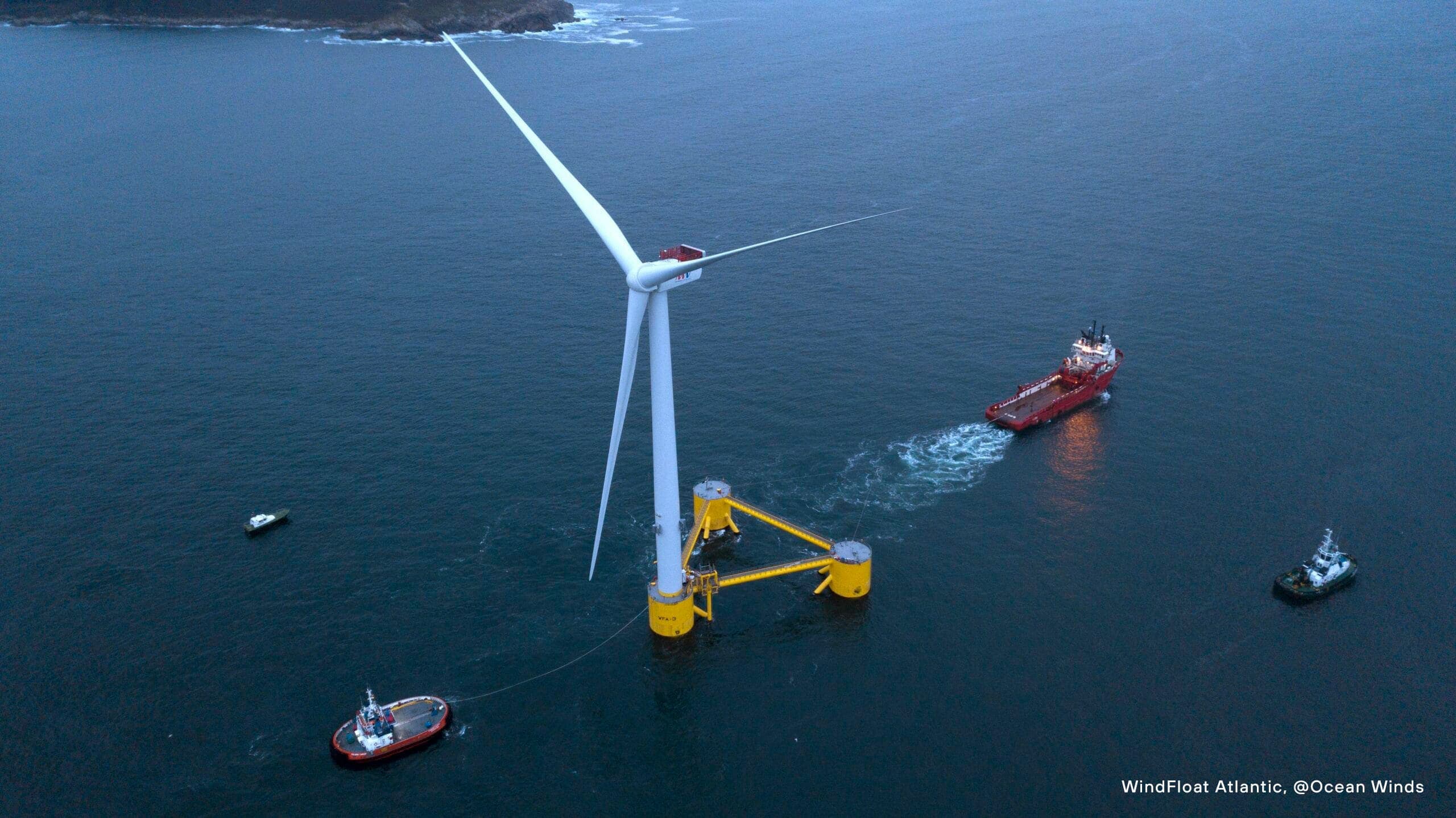
Floating wind farms offer the potential for producing large amounts of clean, renewable energy harvested from deep sea locations. For nations lacking shallow offshore waters, developing this technology could be key to achieving sustainable energy goals.Currently, the industry remains in a pre-commercial state, experts say, though a small, but growing number of pilot projects now dot the world map, with advancements being made in China, Japan, South Korea, the U.K. and EU.Similar to the wider offshore industry, floating wind developers are navigating a number of global and industry-specific challenges, including high costs and lack of developed supply chains.The environmental impacts of floating wind are largely similar to those of fixed-bottom offshore wind turbines. It’s a little-known, nascent sustainable technology on the verge of commercialization: Floating wind turbines deployed across deep ocean waters could unlock vast amounts of renewable energy in the coming decades. For some countries (including China, Japan, South Korea, the U.K. and EU), floating wind is already playing a role in plans to decarbonize national economies, owing either to a lack of viable fixed-bottom offshore wind sites, or due to limited space for land-based renewables. For now, the emerging floating wind industry consists chiefly of small-scale demonstration and pilot projects, totaling around 300 megawatts (MW) of global output, a capacity dwarfed by current worldwide fixed wind generation at nearly 100 gigawatts (GW). The largest floating wind farm currently is Hywind Tampen in Norway with 11 floating turbines producing 94.6 MW for use by oil and gas installations. Despite its current lack of scale, Louise Efthimiou, the floating offshore wind manager at World Forum Offshore Wind, still sees floating wind “as a very strong contender” for decarbonization, albeit on a smaller scale than fixed offshore sites. “We can acknowledge that floating wind will not necessarily represent the bulk of offshore wind,” she told Mongabay in a video interview. “But it does benefit markets who don’t have the choice to do other than floating wind … offshore because of their water depths and their environment.” The major hurdle is getting floating wind up and running at a commercial scale. “The technology works, but it’s still in a phase of innovation, and so that makes it complicated to evaluate properly,” Efthimiou explained. A 2 MW floating wind platform deployed off the coast of Portugal by Ocean Winds. Image by Untrakdrover via Wikimedia Commons (CC BY-SA 3.0). Overcoming a host of challenges Floating wind, like the offshore wind sector in general, faces obstacles that have slowed progress. In 2020, ambitious projections forecast up to 16.5 GW of floating wind installed by 2030. But the industry overall has reached somewhat of a “stalemate,” according to Amisha Patel, executive director of the Global Offshore Wind Alliance. Ongoing global economic setbacks, including rising inflation and high interest rates, have dampened offshore wind efforts in general, slowing floating wind as well, she said. “We’re seeing … a lot of momentum in progressing with the technology and moving towards commercialization, but we need the policy drivers” to achieve scalable buildout, she said in a Mongabay video interview. Some challenges facing floating wind are specific to it, with implementation requiring large-scale port infrastructure with dedicated space to construct, store and move component parts. It also requires more materials, such as steel, than fixed installations. For these reasons, floating wind remains a more expensive endeavor compared to fixed-bottom turbines. “The supply chain is not yet ready for large-scale floating deployment,” Enrico Giglio and Bruno Paduano, researchers at Polytechnic University of Torino, and Riccardo Longo, senior manager of Power System Integration at WindEurope, told Mongabay in a joint email statement. They recently published a paper outlining the potential and challenges to floating wind development in Mediterranean nations such as Italy. The researchers argue that standardization of floating wind production could offer cost reductions and wider economic benefits. But that’s only a partial solution. “The challenge is to … no longer only prove that the technology works,” they wrote. “It is to create the conditions for industrial scale-up: making projects bankable, building suitable ports and supply chains, ensuring grid availability and providing investors and industrial players with sufficient long-term visibility.” A 2025 paper noted that achieving gigawatt-scale floating farms will, as expected, help reduce costs, but will also require “major investments” in ports, construction vessels, undersea cables, grid connections and industrialization. Moves are underway to prepare for a future commercial ramp up. Earlier in 2026, the French government invested 260 million Euros ($286 million) in wind development at five ports, with the intention of supporting floating projects. Similar investments are being made in the U.K., while the U.S. state of California has channeled funds to port development for the floating wind industry. China is positioning itself as a potential world leader in floating wind, while Japan (due to its dependence on imported fossil fuels, and its possession of vast territorial waters), has put major policies in place to foster future public-private partnerships; it aims to produce 15 GW from floating wind installations by 2040. “Economies of scale are going to drive down costs, and the cost of individual systems is going to drive down costs, and then learning is going to drive down costs [even further],” said Amy Robertson, senior advisor at the Technical University of Denmark, in a Mongabay video interview. “I think for sure, getting these large projects in the water is going to create better opportunity for more adoption and cost reduction.” A prototype floating wind platform tested off the coast of Spain in 2020. Image by Floating offshore wind via Wikimedia Commons (CC BY-SA 4.0). Floating wind and the environment Uncertainties remain regarding floating wind’s watery environmental footprint. Research on fixed-bottom wind farms is farther along, with impacts and benefits better understood largely owing to their far bigger global presence. However, many potential floating impacts are shared with fixed projects, such as increased ship traffic, noise pollution and potential for wildlife collisions. But floating wind can also avoid some common fixed-bottom problems, such as seabed disturbance during construction. Floating wind still suffers from considerable environmental research gaps, said Clémentine Mitoyen, whose team is researching floating wind’s potential footprint in the Mediterranean Sea. Research there has found, for example, that proposed floating wind farms would overlap with the habitat of 135 vulnerable species, raising concerns about disturbance, noise and other effects on marine mammals and fish. “We are just starting to investigate the impact of floating wind farms, because it’s really new technology,” Mitoyen told Mongabay in a video interview. “We are still unsure about how [much] better or how worse it is going to be.” One concern that applies solely to floating wind is the potential for marine wildlife collisions or entanglement with mooring cables that attach floating turbine platforms to the seafloor, and with inter-array cables that run between turbines. “I would say the jury is definitely still out on that,” Douglas Nowacek, a professor of conservation technology at Duke University in the U.S. state of North Carolina told Mongabay in a video interview. In his view, the risk of primary wildlife entanglement, or secondary entanglement in fishing gear or other debris wrapped around floating wind cables, will be minimal. “I think it needs looking into, but I [also] think it’s less likely than [people] think.” Efthimiou says that some of the same best practices to avoid environmental impacts employed by fixed offshore wind farms can apply to floating projects, but she agrees more study is needed. “There’s knowledge, but, in short, it’s not enough, especially when we want to understand the longer-term impacts; [research] needs more support [and] coordinating at a higher level.” A 3.6 MW floating turbine at Port of Grenaa, Denmark. Image by Krogfoto. Building a floating future 2026 has seen some positive signs within the floating wind industry. In January, Japan launched its first commercial floating wind farm, generating 16.8 MW. In May, a 30 MW farm run by Ocean Winds began operation off the southern coast of France. Perhaps most significantly, China aims to finish building a 1 GW floating farm as early as 2027. But there have also been setbacks. Italy’s bid to fund floating wind farms stalled in 2025, and a planned 2 GW floating farm in Australia was scrapped that year. A largescale 750 MW floating farm planned for South Korea fell through in 2026, and a U.K. project was canceled when the government blocked use of Mingyang-produced wind turbines in the nation’s waters. “It’s taken a lot of time to get to [the] commercial stage, but all the pieces are there,” Daniel Merino, head of the COWI consultancy’s Offshore Wind Discipline, told Mongabay in a video interview. “Making a gigawatt project is such a huge investment, and right now the conditions are not there for the money to flow into floating wind.” “If we want to meet energy needs in the future with renewable sources, we have to go to floating,” Merino said, though he believes the focus will stay on cheaper fixed-bottom projects for the foreseeable future. “We could see a slow pace for a while” for floating wind, he added. Innovation remains key for advancing and bringing down costs, experts say. Some technologies under development, such as dynamic cables and floating substations could pave the way to quicker roll out. Other analysts propose coupling floating wind with other marine energy technologies, such as wave or tidal electricity generation, to provide increased reliability while also cutting costs. But both floating wind and wave/tidal systems remain in their infancy. In the near term, according to Efthimiou, the achievement of a 250 MW or greater floating wind farm by 2030 is a key industry stepping stone. “Once we get over that hump, further growth would be expected,” she said. Banner image: A floating wind turbine deployed as part of the WindFloat Atlantic project by Ocean Winds. The company now operates a 25 MW floating farm off the coast of Portugal with three platforms. Image courtesy of Ocean Winds. 10 promising ways to ‘green’ offshore wind Offshore wind may be good for the climate but can it be good for the ocean, too? Citations: Acampora, A., Paduano, B., Longo, R., Giglio, E., Fremaux, A., Ramirez, L., … Mattiazzo, G. (2026). Potentials and challenges of floating wind in the Mediterranean Sea: A joint industrial and academic perspective. Renewable and Sustainable Energy Reviews, 241, 117257. doi:10.1016/j.rser.2026.117257 Robertson, A., Musial, W., Shields, M., Aubault, A., Ikari, M., & Kitzing, L. (2025). Considerations for the global commercialization of floating offshore wind energy. Nature Reviews Clean Technology, 1(10), 734-749. doi:10.1038/s44359-025-00093-7 Maxwell, S. M., Kershaw, F., Locke, C. C., Conners, M. G., Dawson, C., Aylesworth, S., … Johnson, A. F. (2022). Potential impacts of floating wind turbine technology for marine species and habitats. Journal of Environmental Management, 307, 114577. doi:10.1016/j.jenvman.2022.114577 FEEDBACK: Use this form to send a message to the author of this post. If you want to post a public comment, you can do that at the bottom of the page. Credits Topics
Floating wind is building ‘A lot of momentum’ toward commercialization
Full Article
Original Source
Read the full article at News →KhanList aggregates and links to publicly available news content. We do not host full articles from third-party sources. Always verify important information with original sources.