
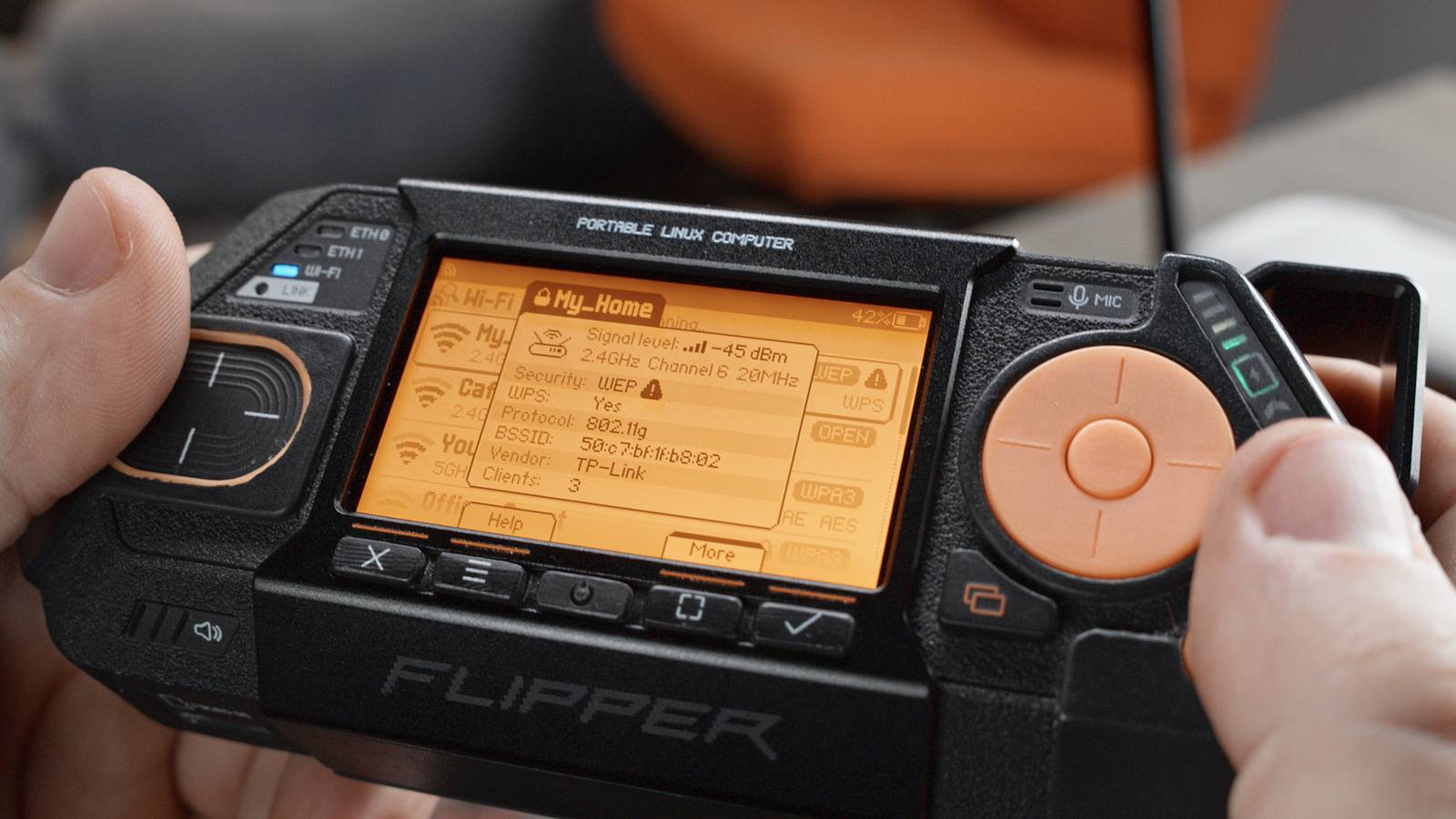
Published Nov 17, 2026, 11:00 AM EST I’m Adam Conway, an Irish technology fanatic with a BSc in Computer Science and I'm XDA’s Lead Technical Editor. My Bachelor’s thesis was conducted on the viability of benchmarking the non-functional elements of Android apps and smartphones such as performance, and I’ve been working in the tech industry in some way or another since 2017. In my spare time, you’ll probably find me playing Counter-Strike or VALORANT, and you can reach out to me at adam@xda-developers.com, on Twitter as @AdamConwayIE, on Instagram as AdamConwayIE, or u/AdamConwayIE on Reddit. The Flipper Zero's successor is finally here as a product you can put money on. Years after its first mention, the company's Kickstarter campaign for the Flipper One is live with an asking price of $399, running until December 17th and shipping in July of 2027. This is the first time that the company has given a price and a date to the Flipper One since it was officially announced back in May, and back then, Flipper told me it would do its best to keep the base configuration at $350 or less without a cellular module. That price has risen by $49, with the blame for that price increase squarely pinned on the ongoing DRAM shortage that the company was worried about. According to Flipper Devices, RAM and UFS storage now account for more than half of the Flipper One's hardware cost, and it tells me that the $399 price covers production costs with no profit margin built in. Pavel Zhovner, Flipper Devices' co-founder and CEO, has been incredibly candid in his Telegram group, though. In a video announcing pre-order coupons earlier this month, he said the company would need to sell the Flipper One for "around 500 bucks" to make production financially sustainable, and that if it can't sell enough units at a price that covers its costs, it will cancel the Kickstarter before it ends. The Flipper One is a Linux computer built for networking It's not just a Flipper Zero sequel Credit: Flipper Devices Flipper Devices insists that this isn't really a "sequel" to the Flipper Zero, and I can see why. The Zero works at what the company calls "Layer 0," talking to NFC, RFID, sub-GHz radio, and infrared. In contrast, the One is an Arm-based Linux computer built for networking and on-device compute. It doesn't have sub-GHz, NFC, or RFID hardware inside, and it's built around a Rockchip RK3576 with 8GB of LPDDR5 and 64GB of UFS 2.2 storage. It also packs an RP2350 microcontroller that runs the 256x144 monochrome display and buttons, Wi-Fi 6E, two Gigabit Ethernet ports, HDMI 2.1, and a 24Wh battery. It comes with Flipper OS, a Debian-based system with switchable profiles, so you can use it as a networking tool one day and a desktop the next. Networking is the biggest focus of the Flipper One, capable of managing up to five connections with failover and load balancing. It can also act as a hotspot, run VPNs and firewalls, and scan wired and wireless networks. An M.2 Key B slot handles expansion along with a GPIO header, and there are three modules available through the campaign, too. At launch, you can get any of the following: A LoRa module that works with MeshCore, Meshtastic, and Reticulum A 5G modem replacing the back cover and adding four SMA ports for external antannas An SDR module with specifications to come later Flipper tells me that the LoRa module costs $59, the SDR module $149, and the 5G modem $219. The Flipper One also has a built-in eSIM that comes pre-provisioned with a Flipper SIM data plan, but you'll need the 5G expansion installed to use it. In other words, you won't be getting online with just the $399 unit by itself, and adding 5G brings the total to $618. As for shipping, Zhovner said that it'll be coming to the US, EU, UK, Canada, and Australia. Those who paid for a pre-order coupon also had the opportunity to vote on an extra color, and Flipper confirmed to me that Moss won, with 36.2% of the vote. Flipper says $399 is a risky price But it's less than what Zhovner said it could cost Credit: Flipper Devices The memory market is the biggest thorn in the side of the Flipper One. As is a familiar story at this stage, Zhovner has highlighted that AI companies are buying up huge amounts of memory, causing RAM prices to skyrocket. On top of that, suppliers are apparently planning negative PC DRAM supply growth next year as they shift capacity to servers. That's a big problem for the Flipper One, as its two most expensive parts are its memory and storage. Flipper has tried to get somewhat ahead of it with a pre-order system before the campaign. Buyers could pay $20 for a refundable coupon that would then unlock a hidden $379 reward tier on Kickstarter, $20 under the public price, and those coupons have since sold out. The pre-order page also made clear that "a price this low is no longer economically sustainable for the full production run" and that the campaign's success "depends on higher-priced sales." Zhovner stated that there were two reasons for the coupons: give the community the lowest possible price, while also enabling Flipper Devices to understand the level of demand before it commits to production. Promising too many cheap units while memory prices keep climbing could leave Flipper unable to actually fulfill those orders. "We don't want to be another scam project that never delivers the product," he said. In his Russian-language Telegram channel, he's been significantly more candid. He described the Kickstarter as essentially charity, with profit at around zero or slightly negative. After that, he said, either memory gets cheaper and Flipper sells the device at a profit, or the company winds down production once this batch has been completed. Flipper is being incredibly open, outlining all of the risks on its own pre-order page while also publishing its task trackers and kernel progress since May. I asked Flipper what's changed since Zhovner's video, and I was told that $399 is an early-backer price meant to fund the first batch rather than make a profit, in the hope that memory prices fall "once the AI bubble bursts." If they don't, it'll raise the retail price later. Either way, $399 is a Kickstarter-only price, and the full retail price will be dependent on component cost. As for the risk of cancellation, the company tells me that things are looking positive for now and the response to pre-orders has been very strong. Kickstarter is all-or-nothing anyway, so backers are only charged if the campaign succeeds. Software is looking good, too It's mostly Linux mainline Credit: Flipper Devices The other big claim Flipper has made about the Flipper One is that it already runs on the mainline Linux kernel, which is pretty significant given that it's meant to avoid being stuck on a vendor's years-old kernel. Right now, the developer documentation states that mainline Linux "mostly works" on the RK3576, with the NPU, video encoding, CSI camera support, and PCIe suspend being exceptions. USB-C DisplayPort Alt Mode works, too, and Collabora, which Flipper has partnered with on RK3576 upstreaming, says the USB controller changes are already in mainline while the PHY and display patches are under review. Collabora also showed it working at the Embedded Linux Conference Europe in Prague last month. "Fully open" is more of an ambition than an accurate assessment of where this project stands, as Flipper is still working on removing "the few closed-source components that remain in the boot process." The DDR memory trainer, which configures the RAM at boot, is still a closed Rockchip binary, and there's no OP-TEE support for the RK3576 yet either. In order to cut power draw as well, Flipper is working on dynamic memory frequency scaling, and its latest dev log puts its power consumption at 0.96W with Linux running and nothing connected. That works out to be about 24 hours on its 24Wh battery, but it obviously drops a lot quicker if you're actually using it. Flipper's own estimate for running it as a Wi-Fi router is 4.5W, or a bit over five hours. Back in 2020, the Flipper Zero hit its Kickstarter goal in eight minutes, going on to raise $4.8 million from more than 37,000 backers. The Flipper One's goal is $350,000, which works out to roughly 880 devices at $399. Purchasing a pre-order coupon let buyers vote on the second color that would be available, and with the two-decimal percentages reported by the voting page at the time of writing, the smallest possible number of voters was 1,056. That means there are at least that many pre-orders, and while these coupons are refundable, it does appear that the company is on track to hit its Kickstarter goal. What the Flipper One costs after the Kickstarter campaign is completed will depend on the memory market, but right now, you can lock in yours for $399.
Flipper One launches on Kickstarter for $399, trading NFC and RFID for Linux and two Ethernet ports
Full Article
Original Source
Read the full article at Xda-developers →KhanList aggregates and links to publicly available news content. We do not host full articles from third-party sources. Always verify important information with original sources.