
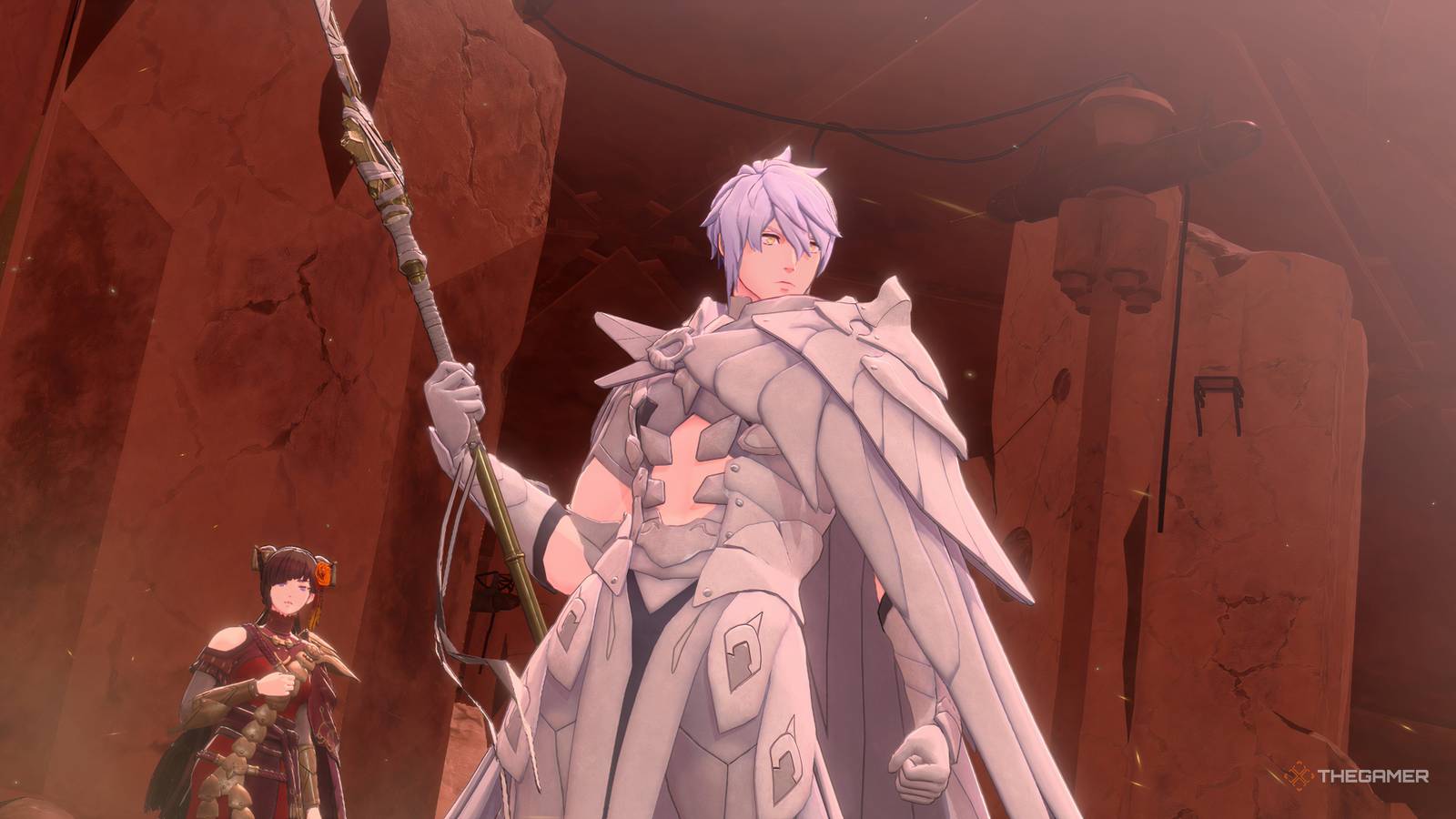
Published Sep 16, 2026, 8:00 AM EDT I still can't quite believe how big this one is. Fire Emblem: Fortune’s Weave Review - An Embarrassment Of Riches Fire Emblem: Fortune's Weave took me 121 hours to finish, and boy, did it feel like a journey. This is an enormous game, one that occasionally seems determined to find the outer limit of just how much Fire Emblem can contain. The remarkable thing is how rarely I resented the time it asked of me. Its scale comes not from endlessly stretching the same ideas, but from a game that keeps finding more things it wants to do with them. Four Roads Through One Conflict That scale is clearest in the way Fortune's Weave structures its campaign. Part One is effectively four separate campaigns, each following one of its playable leads, while Part Two splinters again into something similar. Rather than presenting a long, linear succession of maps, the game repeatedly gives you room to decide how you tackle what is in front of you, encouraging experimentation with route order, characters, and builds. It did not feel like following one very long road so much as repeatedly choosing how I wanted to travel through an unusually broad one. Fortune's Weave gets much of its mileage from repetition with variation. Its four Part One campaigns cover the same stretch of the same year, but Eshmel's presence alters the course of events around whichever Flame Lord you follow; you're not simply replaying one conflict from four camera angles. Leda's story is driven by an intensely personal, comparatively selfish desire for revenge, while Theodora fights for her kingdom and its devotion to a goddess who isn't favoured by the empire's central government. Both are forceful, ambitious people, but those shared qualities produce very different stories. The mechanical separation between routes is less elegant. Each army gets ideas that give it an identity, but Fortune's Weave is oddly strict about keeping them apart. Theodora can recruit Battalions, returning from Three Houses, while Cai's army can care for its mounts to unlock new skills; neither system is available to the other Part One armies. They eventually come together in the end, but playing the routes back-to-back makes their temporary absence conspicuous. Why can't Theodora feed her horse? Why?! Learning an interesting new wrinkle only to lose it for the next several dozen hours can make experimentation feel artificially rationed. Fire Emblem, But Make It Unhinged That structural ambition would mean considerably less if the battles filling those campaigns weren't worth the time. At its core, this is an excellent showing of Fire Emblem's familiar tactical combat, but it is unusually willing to get a little unhinged. One Arena battle gives every unit infinite automatic revivals while two sides race to kill a set number of enormous monsters first. One particularly memorable side quest has you chasing huge birds that steal valuable items while a separate group of thieves tries to beat you to those same prizes and escape. Fortune's Weave understands the satisfaction of carefully moving units around a grid, but rarely mistakes familiarity for a reason to play things safe. For all that experimentation, the difficulty level is mostly fair. Each route offers plenty of straightforward recruits, often pointed out by the game's hint system. This means difficult maps rarely leave you feeling as though you missed some obscure prerequisite for success. Some late-game battles are considerably meaner, particularly from awkward starting positions, and the fondness for reinforcements eventually crosses from pressure into irritation. Even then, breaking through one of its nastier encounters produces exactly the fist-pumping satisfaction Fire Emblem is built for. Its most generous concession can almost become a problem of its own. Fortuna's ability to rewind time has no usage limit, meaning virtually any tactical mistake can be undone without consequence. That removes frustration, but it makes perfectionism dangerously tempting. I caught myself rewinding not because somebody had died or a turn had collapsed, but because one inaccurate attack missed. When every small imperfection can be erased, it becomes remarkably easy to treat anything short of the ideal turn as something that needs correcting. You have plenty of freedom in developing the cast, but rarely need to wonder what any unit is actually for. Characters arrive with affinities and strengths that strongly suggest their intended roles, even if there is room to push some in stranger directions. Class progression works much as it did in Three Houses, with units taking tests to unlock classes they can then freely switch between, while skills offer similar room for fine-tuning. In practice, though, I found the optimisation tools so reliable that I happily let the game handle the minutiae in almost every case. Fortune's Weave is just as interested in what happens between battles. You travel across its world completing quests, gathering resources, delving into dungeons, and strengthening units, while activities such as meals, gifts, temple visits, and the Arena refresh weekly. This creates an effective push and pull between venturing outward and returning to the city, though it can make optimisation feel more important than adventure. Stray too far without enough money for a coach back, and you can lose a week's worth of support-building activities. Get the wrong resource from a gathering node, and it can feel disproportionately annoying when time itself is a resource. I Love It When A Game Comes Together Eventually, all that earlier separation cashes in spectacularly. Part Three is where the game's scale stops feeling merely impressive and starts feeling slightly deranged. After spending dozens of hours with different versions of characters across separate routes, I could choose which incarnation of a unit to carry into the endgame. That alone scratched a very particular part of my brain: the game was asking me to curate my definitive version of a cast I had spent an absurd amount of time getting to know. Then it goes further. Different versions of the same unit can be merged, folding their development into one another and making those earlier route-specific choices tangible. I spent much of the game hoping its structure was building towards exactly this kind of convergence, and when it arrived, it was even more satisfying than I expected. Systems that had felt artificially siloed suddenly became ingredients in a much larger playground. Eshmel, unfortunately, is barely a character at all. Fire Emblem has never been especially consistent with its player avatars, but even Byleth feels richly drawn by comparison, which is not a sentence I expected to write. Eshmel functions more as a causal force than a person, changing the lives of the four Flame Lords without having much interior life of their own. It is disappointing given how central they are to the structure, but matters far less than it probably should. That's because the four Flame Lords themselves are fantastic. Each is driven by something markedly different and is surrounded by retainers and allies who make their route feel distinct. The wider supporting cast is similarly strong, with only a handful of survivors from Fire Emblem's ancient curse of reducing somebody to a single personality trait (Lilian, I promise you can finish one conversation without mentioning money). Across such a large roster, the proportion of characters I genuinely wanted to spend more time with is impressively high. Curiously, it achieves this with a noticeably smaller support network than recent games. Some characters get only one or two chains, sometimes without reaching A rank, while others support nobody but Eshmel. That scarcity initially feels like a loss when I wanted more excuses to hear from so many of them, but it also means the conversations rarely feel obligatory. Rather than manufacturing endless pairings because two units happen to share an army, the game uses supports as selective windows into relationships, cultures, and private concerns. There are fewer of them, but surprisingly little feels like fluff. The story is appropriately grand, juggling several threats and factions across its branching structure. To understand the whole picture, you really do need to play all four Part One campaigns, and I loved watching familiar events acquire new context from another perspective. It asks a lot of the player to experience virtually everything, remember plenty of it, and stay attentive throughout a campaign that comfortably exceeds 100 hours, but the story repeatedly rewarded me for doing so. Just when I thought I understood the shape of its familiar fantasy tale about an apocalyptic future, it pulled off genuine shocks that forced me to reconsider where things were heading. Fire Emblem: Fortune's Weave is excessive in almost every conceivable direction. It has more story than it strictly needs, more characters than most players will fully explore, systems that disappear for dozens of hours before returning in wonderfully ridiculous combinations, and a campaign long enough that reaching its ending felt like completing an actual journey. Yet almost none of that excess feels careless. After 121 hours, I was exhausted, but I wouldn't wish away any meaningful portion of that time. Fortune's Weave takes the foundations of modern Fire Emblem, stretches them further than I could have ever expected, and somehow makes that enormous ambition feel justified. I wanted it to be the absurdly comprehensive Fire Emblem game its premise promised me. Somehow, it was. Systems Released September 17, 2026 ESRB Teen / Fantasy Violence, Mild Language, Suggestive Themes, Use of Alcohol, In-Game Purchases Developer(s) Intelligent Systems Publisher(s) Nintendo Pros & Cons Vast, ambitious campaign structure Excellent tactical combat with inventive maps and satisfying experimentation Strong main characters and a strong supporting cast Route separation is frustrating during the early hours Infinite rewinds are welcome but remove strategy in favour of optimisation Eshmel is disappointingly underwritten
Fire Emblem: Fortune's Weave Review - An Ambitious Tactical Epic
Full Article
Original Source
Read the full article at Thegamer →KhanList aggregates and links to publicly available news content. We do not host full articles from third-party sources. Always verify important information with original sources.