
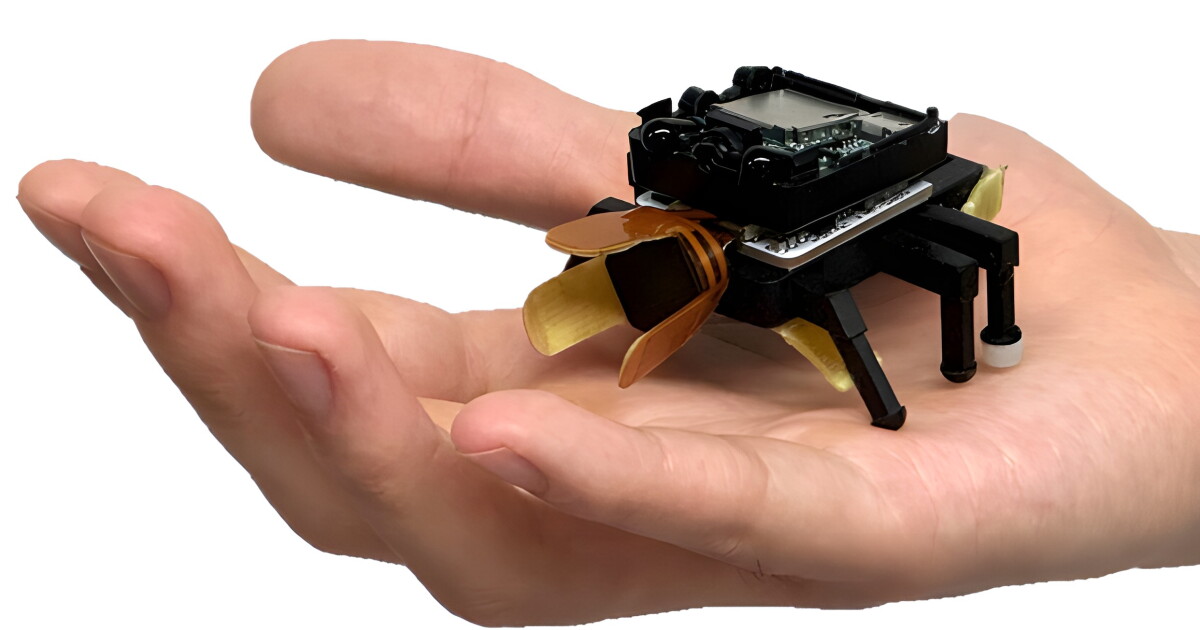
Insects have long been a source of inspiration for robotics engineers. They are small, agile, and can squeeze into spaces where people can’t. Such robots are very useful for space exploration, inspecting industrial equipment, and even carrying out search-and-rescue operations. For certain purposes, researchers turn real insects into cyborgs – which raises some ethical concerns – so sometimes, they build beetle-inspired robots from scratch.A team at the Korea Advanced Institute of Science and Technology (KAIST) has been working on a new robot called BeetleBot, and its appearance isn't even the most interesting thing about it.To design BeetleBot, researchers drew inspiration from a real beetle called Mecynorrhina torquata – one of the largest insects in the world, native to the Congo, Cameroon and Uganda. The scientists studied the positioning of its leg muscles and joints, and how they work as the beetle moves. Then, they applied those principles to their robot. BeetleBot's basic componentsKAIST BeetleBot’s artificial muscles are 3D-printed from a liquid crystal elastomer (LCE). What makes this material special is that it can contract and shorten by 45% when heated, and then return to its original shape as it cools down. That’s how the natural, muscle-like movement of the robot is achieved.The heating mechanism is pretty interesting because those LCE muscles need to reach 110 °C (230 °F) in order to contract. So, where does this heat come from? It’s generated by passing an electric current through the wires integrated into the muscles. Even though only those muscles need to be heated rather than the whole robot, such a mechanism still requires quite a bit of energy to generate that heat. And that is currently one of the biggest challenges of the project.Of course, BeetleBot also needs a human operator to control it. To make that possible, the researchers developed a flexible sensor patch that can be worn on a person’s finger. When the finger moves or bends, it stretches the patch, which, in turn, changes the electrical resistance. The control system is pretty straightforward and has only four commands: move forward, turn left, turn right, and grip an object. BeetleBot's finger command gesturesKAIST The gripping mechanism is pretty interesting too. It was inspired by beetle mandibles – the jaw-like mouthparts that insects use to grab and hold their prey. BeetleBot’s gripper has the same artificial LCE muscles as its legs, but also a pressure sensor. When the muscles contract, the gripper closes around the object, while the sensors help to determine the applied pressure. The robot is additionally equipped with a camera that enables so-called bidirectional feedback, which the researchers are particularly proud of.Prof. Inho Kim of Sungkyunkwan University, the study’s first author, explains, “A key feature of this work is the bidirectional feedback, which links the information detected by the robot to the user’s next action.”In other words, the robot and the operator are constantly exchanging information. The robot sends visual information from the camera to the human in real time, the human responds with a certain gesture, the robot follows the command and sends immediate feedback.In laboratory tests, BeetleBot was able to navigate turns, reach an object, grip it and transport it to another location. In the future, the research team aims to improve the robot’s response speed and energy efficiency, and eventually develop BeetleBot into a fully soft-bodied robot to make it suitable for various environments.Source: KAIST
Finger-controlled robo beetle sports artificial muscles & two-way feedback
Full Article
Original Source
Read the full article at Newatlas →KhanList aggregates and links to publicly available news content. We do not host full articles from third-party sources. Always verify important information with original sources.