
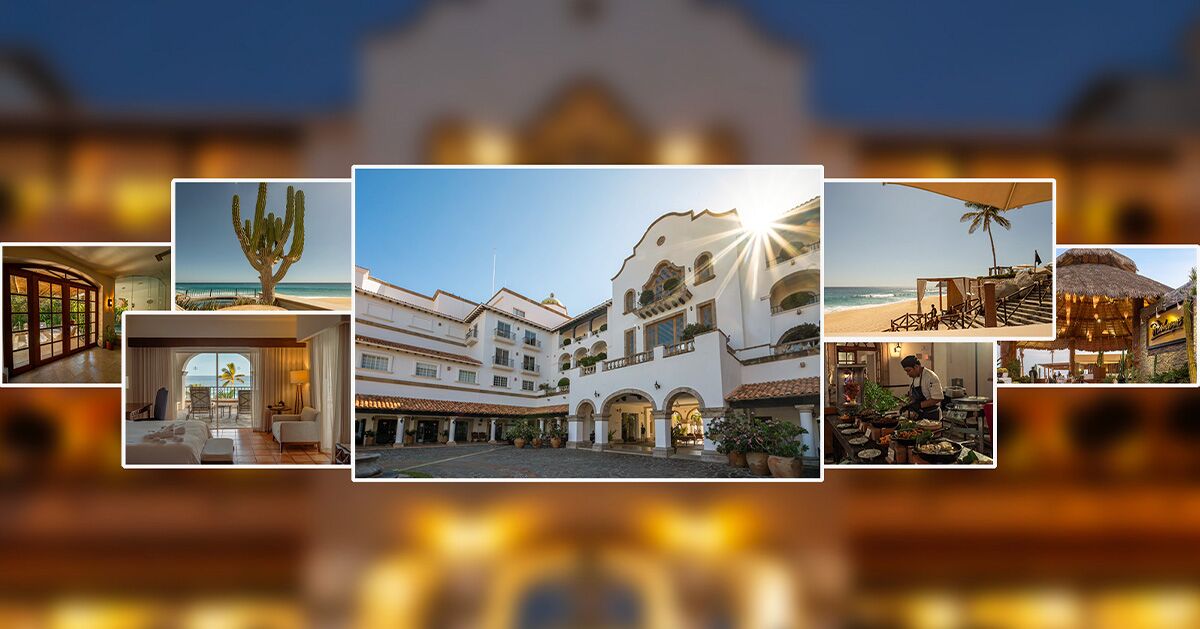
The setting matched the food. Pitahayas sits under a large palapa overlooking the ocean, with high ceilings and dim lighting that make it feel like you’re dining on the beach. I could hear the surf breaking nearby and watched a couple of cruise ships departing Cabo San Lucas disappear into the distance. But Pitahayas isn’t an independent fine-dining restaurant: it’s part of Hacienda del Mar Los Cabos, an all-inclusive resort. We paid extra for the upgraded bottles of wine, but the multi-course dinner and attentive service were included in our hotel rate. Photo: Rulo Luna Ramos Walking back to my room, I passed a now-empty pool where guests spent their mornings playing volleyball and joining fitness classes. Past the pools, a younger crowd was still dancing to a DJ at an outdoor kiosk, making good use of the all-inclusive drinks. Farther along, the main hotel buildings looked like something straight out of an old movie about a glamorous Mexican vacation. In the main patio, a band playing Queen covers launched into Bohemian Rhapsody, to the delight of the few guests still watching. I reached my room just in time to hear Freddie Mercury sing the final notes of the night. It was an unlikely combination of old-school resort charm, lively entertainment, and surprisingly sophisticated dining — but one that seemed to capture how Hacienda del Mar has evolved since opening more than 30 years ago, when it was part of the first wave of upscale beachfront resorts that helped transform Los Cabos into an international luxury destination. From a classic Los Cabos resort to an all-inclusive Photo: Rulo Luna Ramos At first, Hacienda del Mar seems like a traditional Mexican resort — the kind of hotel my parents took me to when I was a kid growing up in Mexico City. Large, white villa-style buildings surround interior courtyards and gardens, while hand-painted tiles, stone passageways, and an extensive collection of religious art lend the property an old-fashioned charm without making it feel neglected. That traditional character extends to the rooms, which skew more toward hacienda-style details than the modern contemporary minimalism seen in newer properties. My room was spacious, with an enormous balcony overlooking the ocean furnished with a lounger, a dining area, and a separate sitting area. Inside, heavy wooden furnishings and terracotta tile floors reflect the resort’s original design, complemented by some contemporary touches like glass-walled showers. You can tell it’s been renovated, but it hasn’t lost the feel of Los Cabos of yesteryear, either. Photos: Rulo Luna Ramos Hacienda del Mar’s history began in the mid-1990s as a timeshare project in Cabo del Sol, when Los Cabos was just emerging as one of Mexico’s premier luxury resort destinations. Developed during an early wave of upscale beachfront construction along the tourist corridor, the property joined Sheraton in 2000 and became part of an early generation of large beachfront resorts competing for the growing luxury tourism market in Los Cabos. Its architecture drew on traditional Mexican haciendas, with villas arranged around courtyards, gardens, and fountains. These features, along with its expansive grounds and multiple pools, give Hacienda del Mar a distinct personality that sets it apart from many nearby properties. The longtime Los Cabos staple was a Sheraton for 20 years, but joined Marriott’s Autograph Collection in 2020. Since July 2025, it’s been an all-inclusive. However, unlike newer resorts designed around the all-inclusive model, Hacienda del Mar hasn’t forgotten it’s a property with three decades of history, famed restaurants, and a distinctly old-school character. The result is an unusual mix of traditional Los Cabos luxury and the lively atmosphere of a modern all-inclusive. It’s a combination that doesn’t always mesh, but gives the resort an inviting, distinct character of its own. Not your typical all-inclusive dining Photos: Rulo Luna Ramos When I asked Fatyma Camacho, the hotel’s social media manager, what made Hacienda del Mar different from other all-inclusives in Los Cabos, she didn’t hesitate: “It’s all about the food.” The property has seven different restaurants, an extensive breakfast buffet, a coffee shop, a juice bar, a sports bar, and even an ice-cream shop, though that last one costs extra. The food program is led by chef José Lazcarro, originally from Puebla, Mexico. Pitahayas is perhaps the best example of what distinguishes Hacienda del Mar’s dining program. The restaurant opened in 1995, before the resort became a Sheraton, and built a reputation for its Pacific Rim cuisine and oceanfront setting. Today, its menu emphasizes Mexican ingredients and regional flavors. That a restaurant with this kind of history is included in an all-inclusive package shows that the hotel’s leadership places a strong emphasis on quality dining. Even the breakfast buffet goes beyond the usual resort staples, with regional Mexican specialties such as molotes (fried masa pockets typically stuffed with potatoes, cheese, or meat), tetelas (triangular masa filled with beans), and panuchos, a Yucatán specialty of tortillas stuffed with refried beans and topped with meat and vegetables. Some experiences, like wine tastings or upscale bottles of wine, have an extra charge, but it didn’t feel like a requirement to enjoy the resort. My simple flat white at Molino Coffee Shop was better than most coffee shops near my home. The different sides of Hacienda del Mar Photo: Rulo Luna Ramos From my room’s balcony, I had a sweeping view of the Gulf of California and Faro El Encanto in the distance, along with the resort’s pools and gardens below. By late afternoon, the swimming pools were full of guests enjoying drinks from the bars or ordering from servers moving constantly between loungers. Farther away, a group had gathered around what looked like a board game competition, cheering whenever the host made an announcement. Live music drifted across the grounds. Almost everywhere I looked, people were taking part in some kind of activity. This is the other side of Hacienda del Mar: a busy, family-oriented all-inclusive where much of the day revolves around the pools, organized activities, and entertainment. But mornings begin more quietly. I joined an early outdoor yoga class with about a dozen guests, stretching to the sounds of the ocean while the rest of the resort was still waking up. But by the time we finished, loungers were already being claimed and a speaker was announcing the next pool activity, all before 10 AM. For those looking to escape the poolside commotion, Cactus Spa shows that the resort does have a quiet side. I arrived early for a massage and found myself wishing I’d discovered the hydrotherapy area sooner. The indoor courtyard, filled with tropical plants and covered by a wood mesh ceiling, was one of my favorite spa spaces I’ve visited in all my years traveling. Both male and female guests can relax before or after their treatments, soaking in small hot and cold pools. I was surprised by how much more intimate this space felt compared with some of the boutique hotel spas I’ve seen. Photo: Rulo Luna Ramos The entertainment program also includes a weekly Mexican celebration, with mariachi music, folkloric dances, and an enormous dinner buffet. The event features a ceremony centered around the hotel’s patron figure, an upside-down representation of St. Anthony, followed by colorful performances drawing cultural traditions from different parts of Mexico. It’s exactly the sort of evening I’d expect at a traditional Mexican resort, and judging by the number of guests watching and participating, others felt the same. My view of the performances from my balcony overlooked the entrance to the spa, and it was a reminder of how different the two experiences felt -– and how much I appreciated that a resort of this size still had a quieter side. I also appreciated that it wasn’t trying to be another cookie-cutter experience you’d find at any all-inclusive in the world. An all-inclusive that doesn’t fit the mold Photo: Rulo Luna Ramos Hacienda del Mar is hard to categorize. It’s not the kind of resort where every corner feels luxurious. And despite the quiet spaces, those looking for a quiet getaway could find the pools and entertainment a little too busy. But after three days there, I didn’t feel like I’d stayed at a resort trying to change what it was, and appreciated that it retained the old-school architecture and character that have defined the property since the 1990s. The different sides of the resort don’t always feel cohesive, but they give guests the freedom to choose the kind of Los Cabos experience they want. And in a destination increasingly defined by sleek, meticulously designed luxury resorts, there’s something refreshing about a hotel that doesn’t seem particularly interested in being another one of them. More like this
Finding a Different Kind of All-Inclusive in Los Cabos
Full Article
Original Source
Read the full article at Matadornetwork →KhanList aggregates and links to publicly available news content. We do not host full articles from third-party sources. Always verify important information with original sources.