
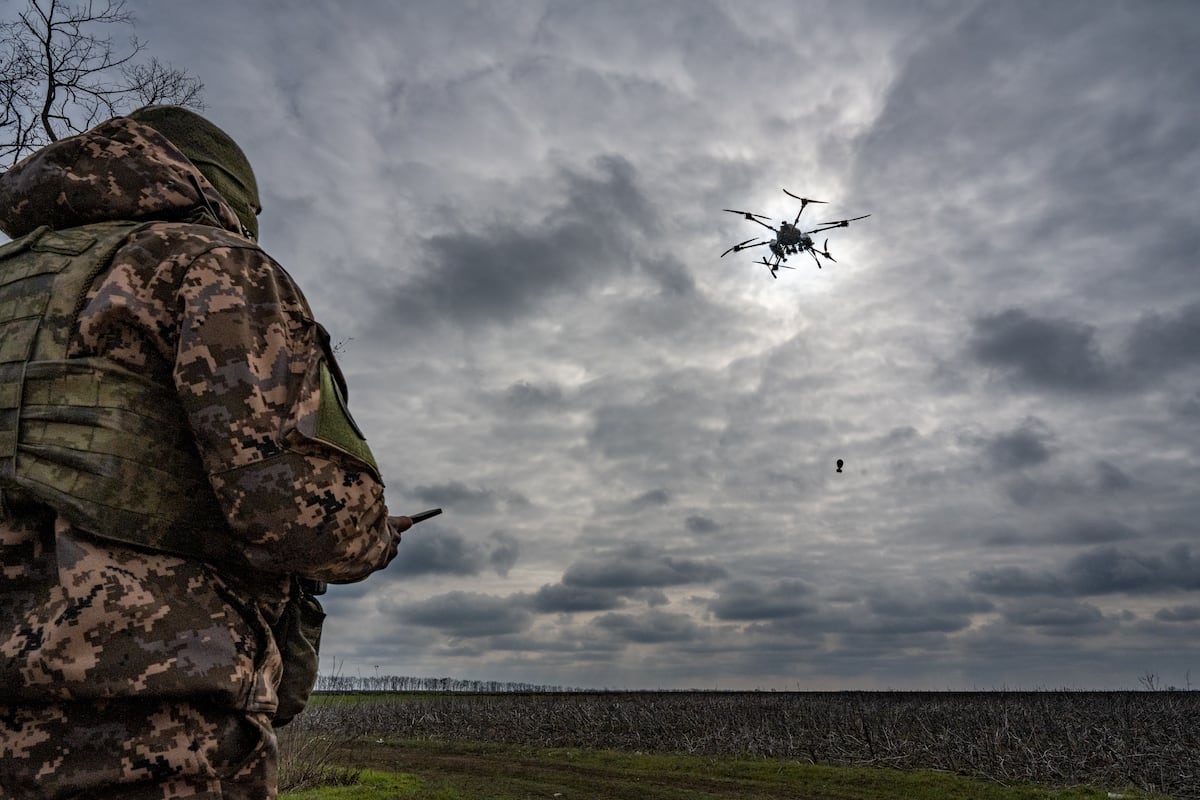
The video released by Al Jazeera lasts just 25 seconds but has once again reignited public debate. The footage shows at least 10 fighters in a forest, “coming back from a mission,” as one of them can be heard saying. The group of soldiers, who are Mexican, Colombian, and Panamanian — as acknowledged by the person filming — is allegedly part of Ukraine’s front line in the war launched by Russia.Strikingly, one of them, who appears in front of the camera, admits to being a member of the Jalisco New Generation Cartel (CJNG) and says that the person holding the phone was a member of Los Chapitos, the faction of the Sinaloa Cartel led by the sons of former kingpin Joaquín “El Chapo” Guzmán. Questions about the authenticity of the footage quickly reached the daily press conference of Mexican President Claudia Sheinbaum, who said the government would investigate the alleged presence of members of Mexican organized crime among the forces involved in Kyiv’s counteroffensive against Moscow.The infiltration of organized crime into the trenches of Russia’s war against Ukraine is becoming a concern for governments across the Americas. The issue is particularly sensitive for Mexico and the United States, which share a border and, since the start of Donald Trump’s second term, have made the fight against drugs and criminal cartels a top priority. However, the footprint of Mexican cartels and the lessons its members may have absorbed on the battlefields in Ukraine is not a new phenomenon.In December last year, warnings that criminal cartels were infiltrating the conflict and seeking to learn how to operate kamikaze-style unmanned aircraft in Ukraine were still being dismissed as a “fringe theory.” Now, according to Henry Ziemer, an associate fellow in the Americas Program at the Center for Strategic and International Studies (CSIS), it can be described as a “real recruitment channel” to expand the arsenals of criminal organizations in their wars against rival groups.The enlistment of mercenaries, former guerrillas, or people with criminal records into the Ukrainian Foreign Legion is not new. Recruitment is carried out not only through official government channels but also through elite military groups with no direct contact with Kyiv’s authorities. “They operate like clandestine recruitment networks,” Ernesto Zárate told EL PAÍS concerning a relative of his, a former Mexican federal police officer who enlisted in the war and died in combat.“Ukraine faces a severe shortage of military personnel on the front, and foreign fighters function as a pressure valve to avoid overburdening its own population. That creates tension between keeping entry channels open and vetting applicants. Although Ukraine has worked with Mexico and Colombia to identify criminal actors, selection processes remain deficient,” Ziemer explains by phone.Tactics taken from the frontThe security specialist at CSIS, affiliated with Georgetown University in the U.S., states that there were reports of isolated cases in the summer of 2025 in which Mexican and Ukrainian authorities had collaborated to monitor potential drone recruits for the cartels. “There are several people traveling to Ukraine with the intention of acquiring skills to bring back home, or who are already serving there and are being explicitly contacted by criminal groups. It is becoming an increasingly institutionalized method for the proliferation of drone expertise in the Americas,” he explains.Ziemer adds that criminal groups seek two fundamental things from a war where drone use has been prominent. First, how to fly a drone in complex terrain such as forests or urban environments, which is harder than one might expect. Second, the technical details and modifications of the devices. “How to wire a commercial drone with an explosive payload to detonate on contact, how the fuse system works, how to equip it, and how to modify it to resist electromagnetic jamming. Since most commercial unmanned aircraft use fixed frequencies that are easy to disrupt with a jammer, maintenance and technical adaptation skills are also required,” he notes.According to information published by The Intelligence, first-person view (FPV) remote-vision drone flight schools associated with the Ukrainian Foreign Legion — a unit created by Volodymyr Zelenskiy — were initially reserved for Ukrainian operators but gradually opened to foreign volunteers, among whom people of Mexican and Colombian origin predominated.Armed FPV “narco-drones” typically use an explosive that detonates on contact with the target, hence the term kamikaze. Any of these devices, which cost between $400 and $700 — although groups are now opting for cheaper Chinese drones — are fitted with galvanized steel tubes of about 10 centimeters packed with gunpowder, ball bearings, or metal parts such as nails or screws that serve as shrapnel. In more advanced models, they are even loaded with C4 detonators. Autonomous flight allows greater accuracy to overcome obstacles and to strike infrastructure.The U.S. government detected a total of 34,682 drone flights near its southern border in fiscal year 2025, according to records published in an ACLED report.Faced with the aerial offensive by organized crime, the U.S. and Mexico have invested in technology and devices that act as portable drone signal jammers. These systems can interrupt links, causing a drone to return to its origin, crash, or fall to the ground. However, according to Ziemer, this has pushed cartels to consider countermeasures such as using fiber-optic drones, which are immune to jammers. Another tactic taken from the playbook of the war in Russia and Ukraine.The knowledge channel between Ukraine and MexicoOne example is the seizure made on October 4 in El Rosario, in the municipality of Mazatlán, Sinaloa: 15 FPV drones, 15 rolls of fiber-optic cable (used for cable-guided piloting instead of radio frequency), seven drone goggles, 15 handheld controllers, three monitors and 14 batteries for the equipment. This seizure was the first official record in Mexico of this type of technology being adapted by organized crime groups.Ziemer says this demonstrates how vital the knowledge channel from Ukraine to Mexico is. Although, according to Ziemer, cartels were using drones long before Russia’s full-scale invasion in 2022. Operating this type of fiber-optic aircraft requires solving complex problems, such as preventing the cable from snagging in trees or dealing with adverse environmental conditions. “In Ukraine, where jamming on the front is massive, the use of fiber-optic drones is widespread. We would hardly see cartels in Mexico adopt these resources so quickly without the experience fighters are bringing back from the front,” the specialist says.The CSIS researcher points out that criminal groups have taken the lead and innovated at a rapid pace in just a couple of years: they moved from rudimentary munitions dropped from the air to unidirectional attack drones (like short-range precision missiles) and now to fiber-optic models. “Governments are only just trying to acquire signal jammers or air defense systems to protect key sites, while innovation inside the cartels advances quickly. The slow recognition of the Ukrainian front as a training center shows that governments such as Mexico’s have not yet calibrated the magnitude of the threat,” Ziemer concludes.Sign up for our weekly newsletter to get more English-language news coverage from EL PAÍS USA Edition
Fiber-optic drones and cartel members at the front: Ukraine’s imprint on Mexico’s narco groups
Full Article
Original Source
Read the full article at English →KhanList aggregates and links to publicly available news content. We do not host full articles from third-party sources. Always verify important information with original sources.