
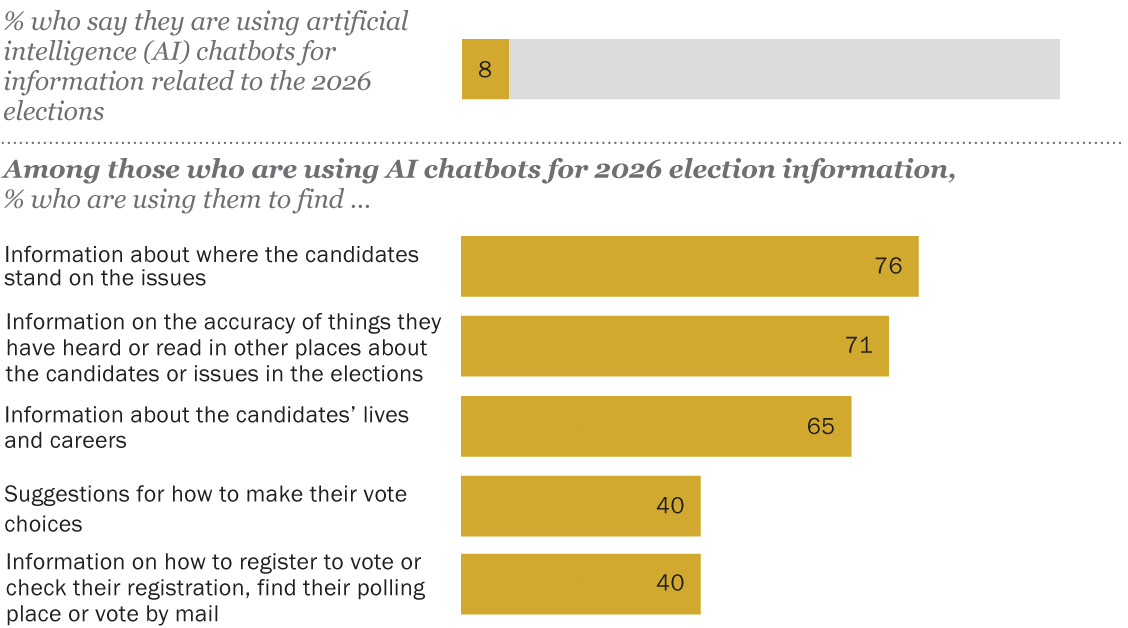
About this research We did this survey to understand whether and how Americans are using chatbots to find election-related information ahead of the 2026 midterm elections. Why did we do this? Pew Research Center does research to help the public, media and decision-makers understand important topics. We have studied Americans’ views of politics for decades, and we’ve also explored their views of artificial intelligence and chatbots in recent years.Learn more about Pew Research Center and our politics research. How did we do this? We surveyed 5,273 U.S. adults from Oct. 12 to 18, 2026. Everyone who took part in this survey is a member of the Center’s American Trends Panel. The survey represents the views of the full U.S. adult population. Here are the survey questions used for this analysis, the detailed responses and the survey methodology. Americans’ use of artificial intelligence chatbots like ChatGPT, Copilot and Gemini has increased substantially in recent years. Today, about half of U.S. adults use them for various tasks. But, as the midterm elections approach, few people say are using these tools to find information about the 2026 elections. Few are using AI chatbots for midterm election info, but those who do mainly want info about candidates, fact checks % who say they are using artificial intelligence (AI) chatbots for information related to the 2026 elections Among those who are using AI chatbots for 2026 election information, % who are using them to find … Source: Survey of U.S. adults conducted Oct. 12-18, 2026. PEW RESEARCH CENTER Few are using AI chatbots for midterm election info, but those who do mainly want info about candidates, fact checks % who say they are using artificial intelligence (AI) chatbots for information related to the 2026 elections %% who say they are using artificial intelligence (AI) chatbots to find out information related to the 2026 elections 8Among those who are using AI chatbots for 2026 election information, % who are using them to find …Information about where the candidates stand on the issues76Information on the accuracy of things they have heard or read in other places about the candidates or issues in the elections71Information about the candidates’ lives and careers65Suggestions for how to make their vote choices40Information on how to register to vote or check their registration, find their polling place or vote by mail40 Source: Survey of U.S. adults conducted Oct. 12-18, 2026. PEW RESEARCH CENTER About one-in-ten adults (8%) say they are using AI chatbots to find election-related information this year, according to a Pew Research Center survey of 5,273 adults conducted from Oct. 12 to 18, 2026. Among those who use chatbots, searching for information is at the top of the list of ways they are using them. For people who are using chatbots for the election this fall, most have specifically done so to get information about: Where the candidates stand on the issues (76%) The accuracy of things they have heard or read elsewhere about the candidates or issues (71%) The candidates’ lives and careers (65%) Smaller shares say they are using chatbots for suggestions about how to make their vote choices (40%) or to find information on voter registration, polling places or voting by mail (40%). Use of chatbots for election information by different demographic groups largely parallels whether and how those groups use chatbots at all. For instance, adults under age 50 are more likely than those 50 and older to use chatbots generally. Similarly, 11% of those under 50 are using chatbots for election information, compared with 4% of those 50 and older. Note: Here are the survey questions used for this analysis, the detailed responses and the survey methodology. Ted Van Green is a research analyst focusing on U.S. politics and policy at Pew Research Center.
Few Americans Say They Are Asking AI Chatbots for 2026 Election Information
Full Article
Original Source
Read the full article at Pewresearch →KhanList aggregates and links to publicly available news content. We do not host full articles from third-party sources. Always verify important information with original sources.