
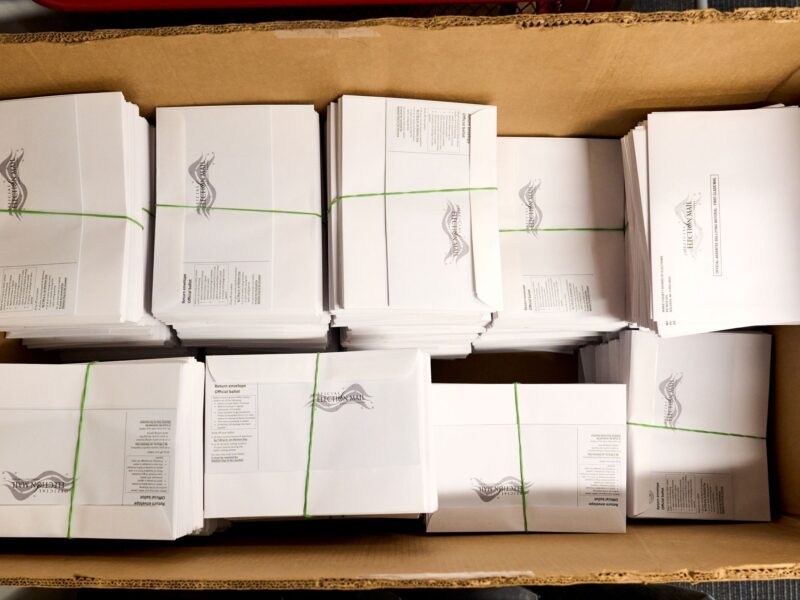
With less than two months until the midterms, the Supreme Court is considering a separate challenge to changes Democrats claim would sow chaos.WASHINGTON (CN) — A federal judge blocked the Trump administration late Sunday night from implementing changes to mail-in voting that would create new design requirements and only send ballots to voters on a national list.U.S. District Judge Carl Nichols, a Donald Trump appointee, had denied a bid by Democratic leaders in Congress and the Democratic National Committee in May after finding their case was not ripe until the U.S. Postal Service finalized the election changes — which it did Aug. 27.“The public has a ‘strong interest in exercising the fundamental political right to vote,’” Nichols wrote in Sunday’s 24-page opinion, citing the 2006 case Purcell v. Gonzalez.“Plaintiffs have demonstrated that, absent an injunction, there is an increased risk that a significant number of otherwise appropriate absentee or mail-in ballots will ultimately not be counted in the upcoming elections. The public has a strong interest in ensuring that doesn’t happen.”The Supreme Court is considering another case in Massachusetts where the president’s proposed changes were blocked by U.S. District Judge Indira Talwani.On May 28, Nichols rejected the request for a preliminary injunction due to a lack of irreparable harm suffered by Democrats and civil rights organizations like the League of United Latin American Citizens and the National Association for the Advancement of Colored People without an official rule to analyze.On July 28, the D.C. Circuit rejected the Democrats’ appeal on the same grounds and the Supreme Court rejected an identical case brought by a multistate coalition in a 6-3 decision on Aug. 24.The Postal Service published the final rule three days later, enacting two major changes. There are three new design requirements for election officials: Ballots must be “automation compatible” and contain the Election Mail logo and a voter’s unique “Intelligent Mail” barcode; plus, officials must register eligible voters in a new “Federal Ballot Mail Portal” before they can receive a ballot.“As the government concedes, the Postal Service could issue (and enforce) the rule only if Congress gave it the authority to do so, but here no statute grants the Postal Service the power to issue key parts of the rule,” Nichols wrote. “Plaintiffs have therefore demonstrated that they are likely to succeed on their claim that the issuance of the rule was ultra vires, and the record otherwise weighs in favor of preliminary injunctive relief.”Democrats argue it would be impossible for states to design, reprint and review election envelopes to meet the new requirements before the November elections. They also say there would likely be delays counting the approximately 50 million ballot mail expected this election cycle.Nichols determined such consequences could clearly lead to irreparable damage, as the “harm of untransmitted ballots — both to voters and candidates — is irreversible.”In *Purcell,*the Supreme Court established the so-called Purcell Principle, which generally holds that courts should not change election rules too close to an election to avoid causing confusion.Nichols rejected the government’s concerns about election fraud, noting the Justice Department did not provide any evidence there would be significant fraud in the midterm elections.Nichols determined the Purcell Principle did not bar him from issuing the injunction, highlighting the D.C Circuit’s suggestion that, while it could not act before the Postal Service, if the changes turned out to be unlawful it would support an injunction to “preserve the states’ existing electoral status quo.”“That is precisely the situation here,” Nichols wrote. “If anything, the extremely short timeframe between issuance of the final rule and the midterm elections cuts strongly in favor of preliminary injunctive relief.”On March 31, Trump signed the executive order “Ensuring Citizenship Verification and Integrity in Federal Elections,” which would create lists of U.S. citizens eligible to vote in each state and instructs the U.S. Postal Service to send mail ballots only to verified voters.Under the order, the Department of Homeland Security and the Social Security Administration must compile and transmit to each state a list of voters “confirmed to be U.S. citizens." The order also instructs the U.S. Postal Service to create a rule requiring voters to opt into a state’s mail-in voting list.Trump’s executive order came as the Senate was debating the Safeguard American Voter Eligibility Act, which would have enacted many of the same provisions along with others. The legislation stalled in April.Subscribe to our free newslettersOur weekly newsletter Closing Arguments offers the latest about ongoing trials, major litigation and rulings in courthouses around the U.S. and the world, while the monthly Under the Lights dishes the legal dirt from Hollywood, sports, Big Tech and the arts.Additional Reads
Federal judge freezes Trump overhaul of mail-in voting as SCOTUS awaits
Full Article
Original Source
Read the full article at Courthousenews →KhanList aggregates and links to publicly available news content. We do not host full articles from third-party sources. Always verify important information with original sources.