
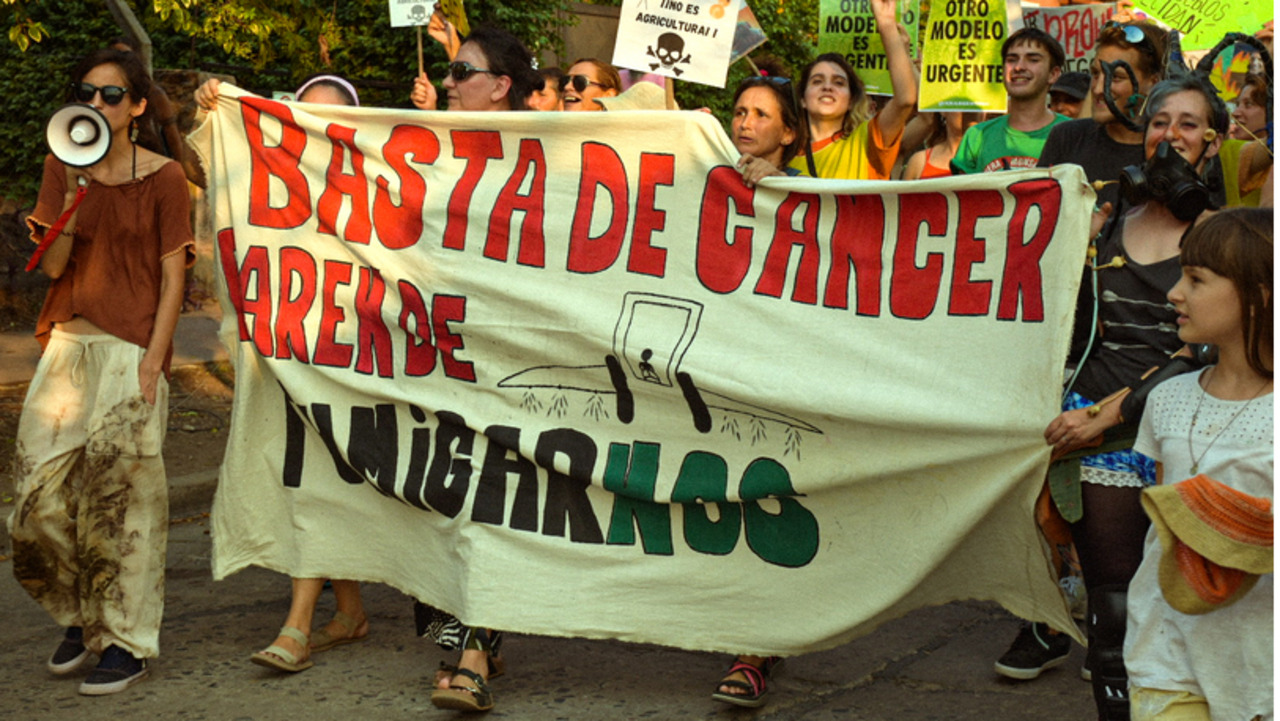
Farmers and activists around the world are mobilising on Saturday for an international day of action against pesticides – denouncing products sold by major agrochemical companies that they say are damaging their health and destroying their livelihoods. “Pesticides are manufactured in France and exported to the Global South by companies who know full well that these pesticides contain molecules banned here," said Fleur Breteau, founder of Cancer Colère, one of four French organisations behind Saturday’s campaign. "They are making money in breach of French regulations and in defiance of human rights laws.” Farmers and organisations from countries including Pakistan and Argentina have joined the mobilisation, sharing what Breteau describes as the same anger over “chemical colonisation”. “We, farmers, need to unite because of chemical colonialism by these very powerful agrochemical firms. As a Western person, as a French person, it is a big no because they are making money while breaching French laws,” said Breteau, who is battling breast cancer for a second time. Illegal spraying of pesticides in Parada La Lata (Exaltación de la Cruz) in 2020, less than 1 km from a house and a rural school. © RFI/Agustín Brun Health concerns in Argentina In Argentina, Agustín Brun, an activist with Exaltacion Salud, a group fighting the use of chemical pesticides, also supports the campaign. He lives in Exaltacion de la Cruz in Buenos Aires province, a town closely surrounded by fields heavily sprayed with pesticides. “The European Union and China, big buyers of our grains, export pesticides – some of which are banned in their own countries – while importing commodities at a cheaper price without having to face the socio-environmental costs and health issues of pesticide contamination at home,” Brun told RFI. “In other words, those countries are outsourcing their problems.” Developed countries “extract” products from Argentina that mostly benefit large pharmaceutical and agrochemical companies such as Bayer-Monsanto and Syngenta, Brun said. “In my town we have found several agrochemicals molecules, including atrazine, in the soil, water and human blood samples. There is a high rate of cancer and other chronic diseases, higher in Exaltación de la Cruz than in nearby cities,” he said. A landmark study by researchers at the National University of Rosario Faculty of Medical Sciences found that young people living in agricultural villages exposed to pesticide fumigation were 2.5 times more likely to develop and die from cancer than those living in areas unexposed to agrochemicals. “We can feel it in our own bodies, you know?” Brun said. “Several members of our groups died of cancer.” We need to unite to fight against chemical colonialism. As a Western person, we say that we refuse that firms produce forbidden pesticides in our country and send them to the global south. It's a big no. It's against the French laws. Fleur Breteau from Cancer Colère association in FranceZeenat Hansrod Scientific evidence has linked atrazine exposure to cancer. Scientists have described atrazine as an endocrine disruptor and said it can have neurotoxic, teratogenic and genotoxic effects, as well as harming the liver and kidneys. Atrazine was first developed by agrochemical company Syngenta, Brun said. Syngenta is one of four global giants in the seed and pesticide sector, alongside BASF, Bayer and Corteva, and is also one of Argentina’s biggest pesticide suppliers. Atrazine has been banned in 60 countries, including across the European Union. In 2019, a small aircraft illegally sprayed pesticides over a school near Brun’s town. “The children and school staff were poisoned and suffered health damage,” Brun said. “A ban against aerial spraying of pesticides was then introduced throughout our municipality, not the province, but we’ve been campaigning for such a ban since 2012.” Global mobilisation Exaltacion Salud is among the organisations taking part in Saturday’s global protest. Actions are also planned in countries including Costa Rica, Pakistan, the United States, Belgium and Indonesia, as well as Hawaii. “We’ve realised that anger is healthy,” Breteau told RFI. “And it’s led us to come together and unite our forces. There are millions of us and we’re right to be angry. When we bring all this helplessness and distress together, we can become very powerful. And this is what we will demonstrate on Saturday 3 October.” France’s emergency agriculture bill passed, amid divisions over pesticides In France, protesters will march outside one of Syngenta’s pesticide manufacturing plants in Saint-Pierre-la-Garenne, about 100 kilometres north-west of Paris, with several actions also planned in a neighbouring field. Farmers, cancer patients, people affected by pesticide contamination, health workers, cancer researchers and lawyers are expected to join the demonstration. “Four giants of pesticide and seed manufacturing industry, BASF, Bayer, Corteva and Syngenta, have formed a sort of oligopoly where they wield immense power worldwide,” Breteau said. “They are patenting living organisms and are making farmers dependent on their pesticides, seeds and technology to grow food.” Syngenta was acquired in 2017 by Chinese state-owned ChemChina, itself a subsidiary of Sinochem Holdings. “A seed from Syngenta won’t grow if you simply put it in the ground on its own, it needs pesticides to thrive,” Breteau said. “It’s as if you were putting pesticides in a child’s feeding bottle and saying, ‘It will make them grow faster’. It’s madness.” Syngenta's response Syngenta told RFI that farmers must be able to rely on a range of solutions and technologies to address the interconnected challenges of agricultural production, climate change and food security. It said it strives to develop innovative solutions for all farmers and farming models. “We fully respect the right to assemble and protest,” a Syngenta spokesperson said. “However, organising a protest at the Saint-Pierre-la-Garenne site seems ill-founded given the reality of its current operations: 70 percent of the site’s current output is suitable for use in organic farming.” In Kenya, Susan Owiti of the Kenyan Peasants League told RFI that most pesticides used in the country are banned in the United Kingdom. She also described their sale in poorer countries as a form of chemical colonisation. “Whoever feeds you, controls you,” she said. “Food sovereignty is about taking control and ownership. Control over what you are growing. So, by dumping their banned products onto us, the Global South, they want to take control of our food systems.” The Kenyan Peasants League, a social organisation representing around 5,000 peasant farmers transitioning to agroecology, is taking part in the 3 October mobilisation on social media. It plans a “Twitter storm” and Facebook posts to raise awareness about pesticides and showcase the experiences of its farmers. Owiti, a small farmer and activist from Migori in western Kenya, said she has farmed all her life. “Agroecology farming has been a family tradition for as long as I can remember,” she said. “It means that we work closely with nature. I use my own seeds, make my own manure and develop my own pesticides based on knowledge passed on from my grand-mother and our elders.” “We do not rely on agrochemical companies.” In Kenya where the majority of farmers are women, they regularly help each other when there is a lot of work. Here in Apuoyo village, female farmers are weeding a maize and beans field, September 2025. © RFI/Kenyan Peasants League Pesticides sold by major agrochemical companies, some of which may contain banned molecules, are degrading soil, affecting the health of farmers and their families and trapping them in debt, Owiti said. “Because they need the pesticides for the seeds purchased from these companies, the farmers find themselves borrowing money from banks to pay loans to pesticide companies,” she said. Owiti said she had seen many women – who make up most farmers in Kenya – suffering from skin and pulmonary diseases because they do not use protective equipment when handling pesticides. “The government needs to implement the Agroecological strategic plan launched by the ministry of Agriculture in 2024,” she said. The National Agroecology Strategy for Food System Transformation covers the period from 2024 to 2033. Sharing the ancestral knowledge of older farmers is another way to “fight the big companies”, Owiti said. “The older farmers, they are like libraries holding years and years of research,” she said. She said passing this knowledge between generations and on to younger farmers would help preserve it and allow them to move away from agribusiness practices. Why France's agriculture law may not help the farmers it claims to defend Political battle Breteau also accuses lawmakers of being influenced by major agrochemical companies. “Today the red line has been crossed and ethics trampled over,” she said. “Lawmakers, mostly from the centre to the far-right, are casting doubts over the scientific evidence between some pesticides and the diseases they cause. “Laws are being passed that reintroduce pesticides which were previously banned due to their toxicity to human health.” Breteau became known in July 2025 when she shouted from the public gallery of the French parliament: “You are in league with cancer and we will make sure everyone knows it.” French MPs were debating the Duplomb Bill, which included lifting restrictions on the use of pesticides, including acetamiprid. “There’s a political ploy to force even more pesticides upon us, not to make the life easier for farmers or food sovereignty, it is simply matter of profit,” Breteau said. “Pesticides are designed to boost production and increase yields at the expense of our health, biodiversity, clean water whilst using as few workers as possible.” The European Parliament will examine the Food and Feed Safety Simplification Omnibus in October. It aims to streamline food and feed legislation, while its proposal for “efficient renewal procedures for pesticides” has come under criticism. “It will authorise more than 90 percent of the pesticides currently in circulation, even if scientific studies show they are toxic,” Breteau said. “In other words, once voted we won’t be able to take them off the market, despite their proven toxicity. So, this is very serious because it creates an unrestricted European market for these pesticide manufacturers. “Any Member of the European Parliament who vote for this Omnibus law, we’ll regard them as criminals. “How are we all supposed to get better in a world that poisons us a little more every day?”
Farmers unite worldwide against what they call ‘chemical colonisation’
Full Article
Original Source
Read the full article at Rfi →KhanList aggregates and links to publicly available news content. We do not host full articles from third-party sources. Always verify important information with original sources.