
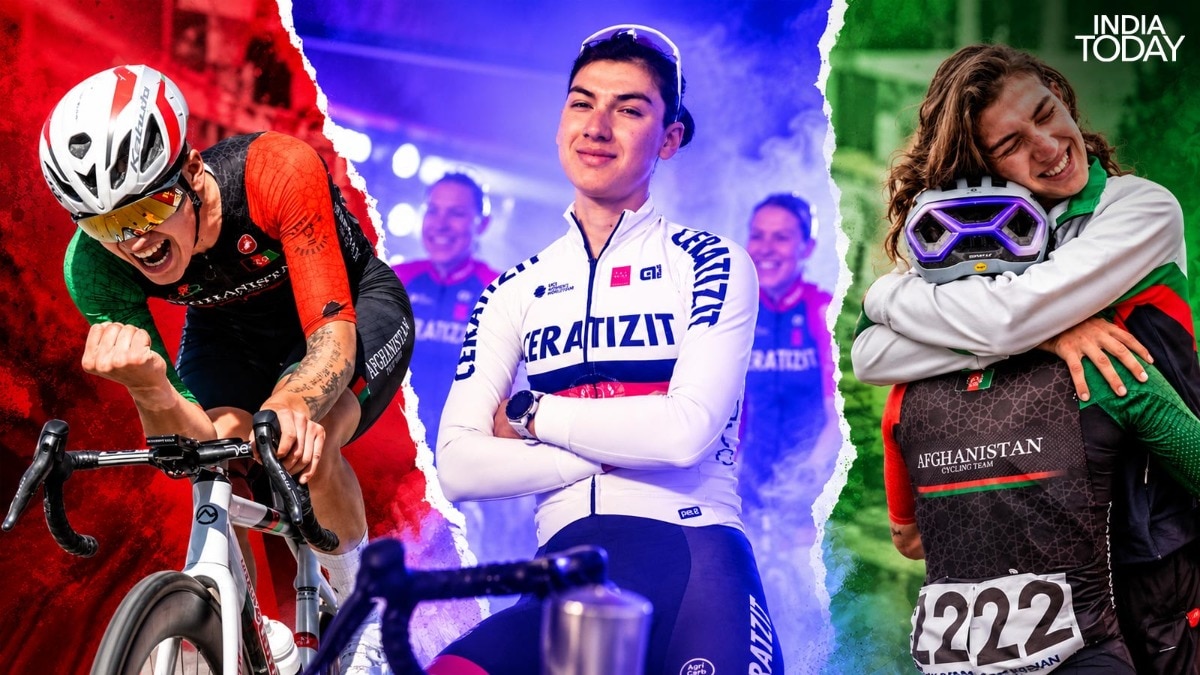
Faryab Province in Afghanistan has long been known for its place along the ancient Silk Road, its carpets and the legendary horseback sport of Buzkashi. But from this remote and conservative corner of Afghanistan has emerged a very different sporting story. One written with courage, sacrifice, heartbreak and an unbreakable dream.Fariba Hashimi dared to chase that dream in a country where women have been denied the freedom to play sport under Taliban rule. Somewhere along the way, her bicycle became more than a means of competition. It became her way of holding on to freedom that her homeland could no longer give her.Born in Maimana, the capital of Faryab, Fariba has travelled a long way from the restrictions of her homeland to the biggest stages in sport. At the Asian Games in Aichi-Nagoya, she won silver in the women's road race, finishing behind China's Guo Li.24 years earlier, Roia Zamani had won Afghanistan a taekwondo bronze at the Asian Games in Busan. She too had lived through Taliban rule, fleeing Afghanistan in 1996 before returning in 2002 as an English teacher in Kabul. Now, more than two decades later, Fariba had put her hands up and said, in her own way: I am still here. When Fariba crossed the finish line in Japan, perhaps all the years of fear, uncertainty and longing disappeared for a moment. She celebrated with her Afghan teammates before taking her place on the podium, the silver medal around her neck and the Afghan flag beside her.5 years after fleeing her country as a teenager, she had reached a place she had once only dared to imagine. And at that moment, the silver medal seemed to carry every tear she had shed along the way. "Every athlete dreams of performing at their best and achieving a good result. But coming from a country that is one of the worst in the world for women, this was a dream come true for me. That podium was more than a medal. It was the voice of millions of women living in the dark and facing the same situation, not only in Afghanistan,” Fariba told India Today in an exclusive interview."When you come from such a place with a difficult history for women and reach that level, it is unbelievable."She had not always been able to ride like this.At one point, Fariba had to dress as a man simply to get on a bicycle and ride outside.A BORROWED BICYCLE Fariba Hashimi started cycling when she was 14. Courtesy: Getty Images Cycling entered Fariba's life almost by accident. In 2017, when she was around 14, she and her elder sister Yulduz saw an advertisement for a local race in Faryab. Neither of them knew how to ride properly. They borrowed a neighbour's bicycle and had only a few hours to prepare.They lined up anyway.Fariba won. Yulduz finished second.It should have been an ordinary local sporting moment. Instead, it opened a door that neither of the sisters knew existed. Cycling was barely considered an acceptable pursuit for girls in their conservative part of Afghanistan, but the sisters had discovered something that felt intoxicating: movement.For Fariba, she felt "like a bird who could fly."But freedom came with a price.The sisters trained secretly. They covered their faces, concealed their identities and tried to avoid attention. Stones and bottles were thrown at them. People insulted them. At times, motorists tried to force them off the road. Yulduz once suffered a broken wrist after a rickshaw driver rammed into her.Still, they kept riding.Fariba explained how she had watched her brother enjoy freedoms that were unavailable to her."I remember my brother would go outside with his bicycle and nobody would say anything to him. So I thought, 'If I wear men's clothes and go outside, will people still recognise me?' At first, it almost felt like a game. I would wear my brother's clothes, ride my bicycle and try to experience the same freedom he had," Fariba said.The game did not remain for long."But when people recognised me, I had really difficult moments. Sometimes they would stop me and say terrible things, even threatening to kill me."FREEDOM ON TWO WHEELS Fariba Hashimi left Afghanistan in 2021 after the Taliban takeover. Courtesy: Getty Images Fariba was not alone in feeling trapped by the boundaries around her."When you live in a country where there is no support for women, you are always thinking about how you can go outside without anyone hurting you. Many Afghan women were living the same way. I was not the only one," Fariba said.She had watched women leave their homes dressed as men because their families had no man who could go outside to buy food or take care of basic responsibilities."When I was riding my bike, I would see women leaving their homes to get food. They would wear men's clothes because there were families without a man in the house, so the women had to go outside and take care of things themselves."For Fariba, the bicycle became a small act of defiance. It gave her something that was otherwise being denied to her: the ability to decide where she wanted to go."I always hoped that one day the situation would change. At least we could ride our bikes freely and choose our own freedom instead of having other people choose it for us," Fariba said.That hope would eventually take her far beyond Faryab.HERO OF THE STORY Fariba and her sister Yulduz Hashimi participated together at the Paris Olympics. Courtesy: Getty Images Yulduz was more than Fariba's elder sister. She was the person who had entered the sport first, the first teammate, the training partner and the one person who understood exactly what every kilometre meant.The sisters trained and suffered together and pushed each other when the roads became dangerous. Their relationship was tested by competition too. At the 2022 Afghan Road Championships, staged in Switzerland because athletes could no longer safely compete inside Afghanistan, they rode together for much of the 57km race before Fariba edged Yulduz in the sprint. Fariba herself had expected her sister to win.In 2024, the sisters reached another historic milestone when they competed at the Paris Olympics. They were no longer two girls hiding their faces on the roads of Faryab. They were Olympic cyclists representing Afghanistan.Yet even at the Asian Games, when Fariba stood among athletes from some of the biggest cycling nations in Asia, Yulduz remained the person she needed most."I think my sister is the hero of this story. If she wasn't there, winning this silver medal would not have been possible," Fariba said.THE NIGHT BEFORE SILVER Fariba Hashimi (middle) celebrates with her teammates after Asian Games silver. Courtesy: Reuters The night before the race, Yulduz reminded her that they needed to work together."She believed in me and trusted that I could do something special. She was my only teammate, but she was also my sister and a part of my family. She was racing alongside me and sharing the same dream. We also had another Afghan woman, Zahra Rezayee, who shared the same belief," Fariba said.That belief mattered because Fariba knew she was arriving at the start line with fewer resources than many of her rivals.The night before the race, she washed her own bicycle while larger teams prepared theirs."There were big teams from Japan, China, Hong Kong, the UAE and Kazakhstan preparing their bikes for the next day. Some of them laughed at me and asked, 'You're a rider? Why are you washing your own bike?'"Her answer was simple."I don't trust anyone with my bike. I want to fix it myself so I know it will be ready tomorrow."Later, she told Yulduz what had happened."She spoke to me and gave me more motivation. She reminded me, 'You are not alone. We are three or four athletes from the same country and in the same situation.'"Fariba pauses when she speaks about what her sister has meant to her."Having her beside me helped me so much. I don't know how to put into words how grateful I am for everything my sister has done for me. There are no words big enough to thank her," Fariba added.WHEN HOME BECAME DANGEROUS Fariba Hashimi dressed as a man to pursue her passion for cycling. Courtesy: Getty Images The Taliban's return to power in August 2021 changed the meaning of the bicycle once again.Before that, cycling had represented freedom. Suddenly, continuing to cycle meant that the sisters' lives were at risk."When I escaped my country, I left in a situation that I would not wish on any human being. You are scared, you are being attacked, and you are constantly afraid that someone will stop you or even kill you," Fariba said.The Taliban has maintained restrictions on women and girls participating in sport, with the wider restrictions extending to sporting facilities and public spaces. Afghan women athletes living abroad were able to continue competing internationally, including at the Paris Olympics and Paralympics.Fariba remembers what it was like when cycling itself could make her vulnerable."I remember when I started cycling in 2017. When I went to training, I had to wear men's clothes so that people would not recognise me. I was afraid that if they realised I was a woman, they might attack or hurt me. It happened many times," Fariba said.She has also watched restrictions on women become a much larger part of everyday life."Throughout Afghanistan's history, women have faced the same problems. Many governments have come and gone, but the situation for women did not change."For Fariba, sport was never simply about winning races.It was about whether women could be allowed to dream.THE ESCAPE FROM KABUL Fariba Hashimi celebrates with her sister after her Asian Games silver. Courtesy: Yulduz Hashimi Instagram When the Taliban returned, the sisters went into hiding. Their involvement in women's cycling had made them vulnerable, and remaining in Afghanistan was no longer a viable option.Help eventually came from Alessandra Cappellotto, the former Italian world champion who founded Road to Equality and worked to help Afghan women cyclists escape. Fariba’s teammates Nooria Mohammadi, Zahra Rezayee and Arezo Sarwari also escaped alongside the Hashimi sisters.Fariba still remembers how uncertain everything felt."When the Taliban came, the first thing they did was close all activities for women. When I wore men's clothes and going outside to train, I always thought, 'What if they recognise me? What if something happens to me?' I had a dream I wanted to make come true, but under the Taliban government, that was impossible," Fariba said."From 2021 until now, nothing has changed for women. In many ways, it has become even worse. The only choice we had was to escape the country in any way we could."The journey out was frightening. The sisters travelled towards Kabul airport, were stopped and forced to continue on foot. They spent days trying to find a way into the airport compound amid the chaos surrounding the evacuation.They made it through to safety just five minutes before a massive suicide bomb tore through the crowd at the airport’s Abbey Gate. The attack, claimed by the Islamic State affiliate in Afghanistan, killed almost 200 Afghans and 13 US troops."I remember spending three days outside the airport, trying to get inside and reach the people who were supposed to pick us up from the gate. We spent three or four days in dirty clothes and terrible conditions before we finally found the right people who helped us leave the country," Fariba said.Cappellotto was among those who helped connect the cyclists with the Italian evacuation effort. Italy's Aquila Omnia operation evacuated thousands of people from Afghanistan during the 2021 airlift.For Fariba, however, the flight was only the beginning of another uncertain journey."That was when Alessandra found us. Sometimes, when you are in a dark place, someone comes to support and help you. Alessandra was one of those people. She found me in a very difficult situation and helped me.""At the beginning, I didn't know where I was going or which country I would go to. I had never even heard of Italy. It was a completely different culture and a completely different situation," Fariba saidThen she arrived."Finally, we arrived in Italy. When you come to a country where you don't know the language or culture, everything is new. On my first day, I saw women working outside freely and nobody was saying anything to them. It was completely different.""For me, it felt like being somewhere I had only ever imagined in my dreams."THE FAMILY SHE LEFT BEHIND Fariba Hashimi has explained how difficult life can be for women in Afghanistan. Courtesy: Reuters Leaving Afghanistan gave Fariba a future in cycling, but it took away something she still aches for: ordinary family life.Her parents, siblings and relatives remained behind. The family has had to move repeatedly for safety, while Fariba built her life thousands of kilometres away."Since 2021, I have been living far from my family. They are still in Afghanistan, living in a very difficult situation. Whenever I speak about my family, I become very emotional because I cannot control my feelings," Fariba said.She was still only a teenager when she left."At 17, children are usually with their families, taking care of each other, joking around and simply enjoying being kids. For me, it was different. I have always missed my family."Her mother's words have become a source of strength."I think this is the sacrifice we are making today, with the hope that one day we can live freely. I want to be able to see my family freely. When I speak to my mother, she always tells me, 'Think about tomorrow, not only today. Today's situation is like this, but think about how many things can change tomorrow.'"And then there is her father."I have a wonderful family, and they have supported me throughout everything I have done. I have an incredible father who has stood by me every day. He gives me new ideas and motivation," Fariba said."I wish every child could have a father like mine — someone who believes in their children and supports them. The situation for women in our country has been very difficult, and I believe the culture needs to change from within the home. My father was the person who started that change in our home."A DREAM BEYOND HERSELF Fariba Hashimi said she wants Afghanistan women to not give up on their dreams. Courtesy: Reuters Fariba's family story becomes more painful when she talks about the sisters who remain in Afghanistan."At the moment, women are not allowed to take part in any activities inside the country. My family lives in one of the more remote parts of Afghanistan, where even going to a supermarket can be difficult. My mother and sisters cannot go outside freely, and they are still afraid of what is happening inside the country," Fariba said.She has three sisters and four brothers. One sister calls her with a question that is almost impossible for Fariba to answer."My sister calls me all the time and asks, 'Fariba, when can I go outside like you? When can I live freely in Italy? At least I want to go to school.' That hurts me."That sentence explains why the Asian Games medal means so much to her."But it is not only about my family. Millions of women are suffering and facing the same situation. That is why my victory at the Asian Games was not just a victory for me. It was a dream for millions of women in my country who are fighting for their basic freedom — a freedom they cannot even have today," Fariba said.Fariba does not talk about herself as someone who has escaped and moved on."I want to represent my country and, hopefully, create something that can make a difference, not only for my generation but for the next generation as well."FROM EXILE TO CARRYING AFGHANISTAN'S FLAG Fariba Hashimi was one of the flagbearers of Afghanistan at Paris Olympics. Courtesy: Getty Images Once in Europe, Fariba had to learn how to be a professional cyclist while simultaneously learning how to build a new life.Her 2022 Afghan national road race championship title, won in Switzerland, was an important breakthrough. She subsequently moved into professional European cycling, racing for teams including Israel Premier Tech Roland Development and the WCC Team before joining Ceratizit Pro Cycling Team in 2025.Her results steadily reflected her growth. In 2024, she won a stage of the Tour Cycliste Fminin International de l'Ardche, finished eighth overall at the Tour de l'Avenir Femmes and was 10th overall at the Giro Mediterraneo Rosa.That year also brought another defining moment when she represented Afghanistan at the Paris Olympics alongside Yulduz. Fariba was one of Afghanistan's two flag bearers at the Opening Ceremony, carrying the country's pre-Taliban tricolour flag alongside sprinter Sha Mahmood Noor Zahi.Those achievements matter because Fariba's story cannot be reduced to what happened to her.She is not only a refugee athlete. She is not only an Afghan woman who escaped the Taliban. She is a professional cyclist who has spent years building the ability to compete at the highest level.And then came Aichi-Nagoya.The silver medal did not erase her past. It gave that past a new meaning.OTHERS WHO KEPT RIDING Zakia Khudadadi won bronze in para-taekwondo at the Paralympics in 2024. Courtesy: Reuters Fariba's story exists within a much larger story of Afghan women athletes rebuilding their lives outside their homeland.Zakia Khudadadi was evacuated from Kabul to France in August 2021 and went on to compete at the Tokyo Paralympics. At Paris 2024, competing for the Refugee Paralympic Team, she won bronze in para-taekwondo, becoming the team's first Paralympic medallist. In 2026, she won gold at the European Para Taekwondo Championships while representing France.Cyclist Masomah Ali Zada fled Afghanistan in 2016 after facing hostility over cycling. She competed for the Refugee Olympic Team at Tokyo 2020 and returned to Paris 2024 as Chef de Mission of the Refugee Olympic Team.Cricketer Firooza Amiri fled Afghanistan after the Taliban takeover and rebuilt her career in Australia. Nilofar Bayat, captain of Afghanistan's women's wheelchair basketball team, escaped Kabul and eventually established herself in Spanish wheelchair basketball.Footballer Fatima Yousufi and her Afghan teammates have also continued their sporting lives abroad after fleeing Afghanistan.Their paths are different, but the common thread is unmistakable: the athletes were forced to leave home to continue doing something that should never have required them to leave it.For Fariba, the dream is that future generations will not have to make the same choice.A VOICE FOR AFGHAN WOMEN Fariba Hashimi has stayed away from her family since shifting to Italy. Courtesy: Fariba Hashimi Instagram Fariba knows that winning a medal will not suddenly change Afghanistan.She knows that the women in her family are still living with restrictions. She knows that millions of Afghan women remain unable to experience the freedom she now has in Italy.She also knows that a sporting moment can carry a message beyond the race itself."I'm really hoping this can change something inside the country. There are millions of women with the same dream, and I hope they can fight for their dreams and create a better future for the next generation — not only in Afghanistan, but all over the world," Fariba said.Her message is rooted in memory."I don't want the next generation to live in fear the way I did. Every day, I faced different risks. I was afraid that someone might stop me or hurt me. I don't want them to experience that."And then comes the philosophy that has carried her through every stage of her journey."I want them to understand that you have to fight for your dreams. Nothing comes as a gift; you have to fight for what you want."She does not want the next generation to repeat her escape."I would never wish for anyone to leave their homeland simply because they have a dream, or to escape because they are afraid of being attacked by people in their own country," Fariba added.STILL RIDING FORWARD Fariba Hashimi finished the Asian Games road race with a timing of 2:50.5. Courtesy: Getty Images Perhaps that is why the Asian Games medal means so much to Fariba and her sister.Fariba holds the silver medal, and she deserves every bit of recognition for what she achieved. But behind that medal is a journey the sisters have shared for years. They trained together, travelled together, struggled together, fell, got back up, cried, laughed and told each other to keep going when one of them had no strength left.They knew many of the problems they had before the race would still be there after it.Yet they still stood on the start line and fought — for themselves, for the dreams they had carried for years, for Afghanistan and for Afghan women.The words Fariba used after the race were simple: "We did it. We did not do it alone."The road was never straight. It was never safe. But she kept moving.In Aichi-Nagoya, Fariba stood on a podium as herself.The medal belongs to Fariba. The journey belongs to both sisters.And perhaps, years from now, when the noise around the silver has faded, what will remain is not simply the colour of the medal, but what it represented: two Afghan sisters who kept riding when the road told them to stop — and showed that the story of their dreams was not over yet.- Ends
Fariba Hashimi: The Afghan cyclist who broke free from prison and learned to fly
Full Article
Original Source
Read the full article at Indiatoday →KhanList aggregates and links to publicly available news content. We do not host full articles from third-party sources. Always verify important information with original sources.