
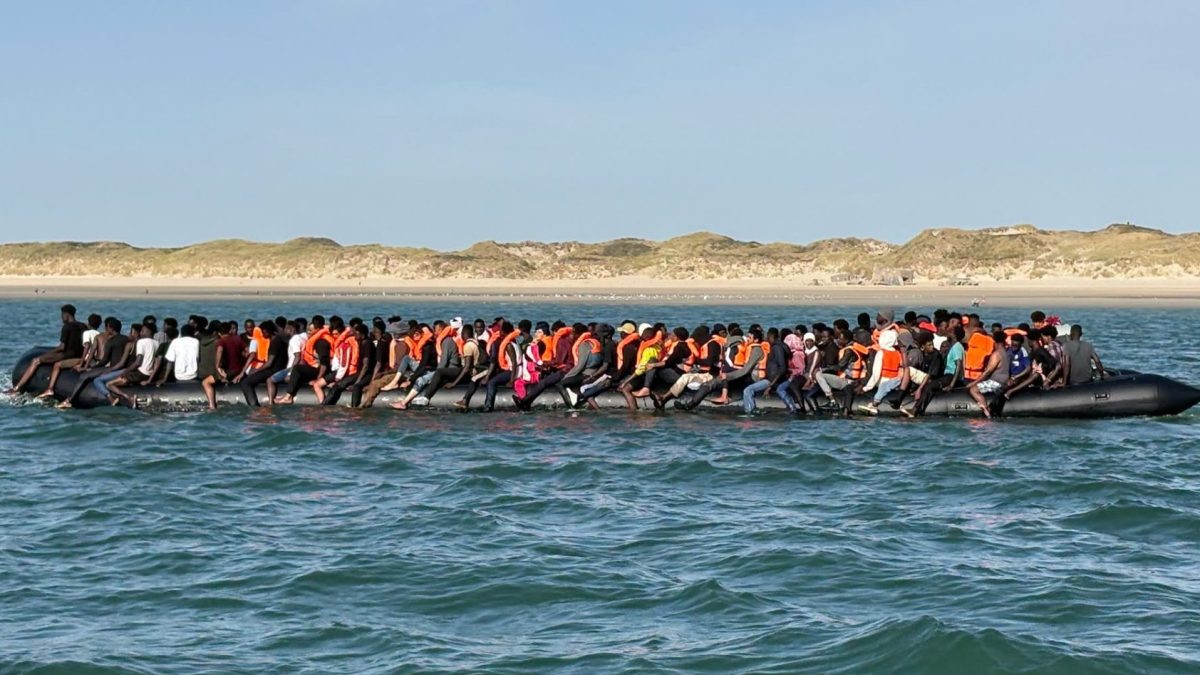
The year is 2035. Prime minister Nigel Farage’s hard-right coalition government has reduced net immigration to a trickle. Most people credit rigid quotas and ICE-style repatriation policies. Working with president Marine Le Pen of France, the British have also stopped the not-so-small boats carrying asylum seekers across the Channel. On the surface, everything is going to plan. But appearances deceive. Britain’s “indigenous” population is static and ageing. There are increasing reports of staff shortages in hospitals and social care homes. The City of London – once a magnet for banking talent from around the world – is complaining about a shortage of cleaners in Canary Wharf and a dearth of quant traders from France and Italy. Restaurants cannot find waiters. Jay Rayner, the celebrated food critic, has just proclaimed the death of the two-seating system for the nation’s top eateries. I could go on with this playful fantasy about the future, but let’s return to today’s hard reality. The UK needs immigrants. The demographics point one way. We may not be in as dire straits as Japan, South Korea or, for that matter, China, where the cost of the coercive and deeply misguided one-child policy has come due. But in the absence of immigration, the relatively low birth “replacement” rate means that the total number of people living in the UK will shrink, as projected by the Office for National Statistics. The consequences for economic growth, jobs and tax receipts cannot be magicked away. Despite the present hype, AI-managed robots won’t plug all the gaps in the labour market. That said, the immigration debate in Britain has revolved for far too long around economics and numbers. Fifteen years ago, David Cameron promised to reduce immigration to “tens of thousands”. He failed. Boris Johnson pledged to adopt an Australian-points system to cut the number of low-skilled immigrants and their families. He failed. Now Andy Burnham’s Government is engaged in a data war with the Conservatives and Reform UK over net migration and the number (and size) of small boat crossings. His Government is making progress – latest figures show UK net migration has fallen to 171,000 from a historic high of 944,000 – but still our new Prime Minister risks being boxed in by his own rhetoric. Don’t misunderstand me. Numbers do matter. Maintaining control over borders matters even more, especially for an island like the UK. The surge in Eastern European immigration as a result of EU enlargement in 2004 proved destabilising for certain communities because of the strains on public services. Wars in Afghanistan, Syria and Ukraine also triggered large-scale movements of refugees. And let’s not forget Brexit which ended the UK’s membership of the EU’s single market, leading to a shift in the supply of cheap labour from Europe to South Asia. For better or worse, governments are not always in control of events. Yet while the focus on net immigration is necessary, it is hardly sufficient. We need a more enlightened debate about the benefits migrants bring to the life of the nation. Newcomers bring energy and vitality. By any measure, their impact across the arts, culture, education, politics and sport is impressive. We can measure the influence in terms of groups: East European Jews fleeing the pogroms of Tsarist Russia and Nazi persecution who contributed so much to the intellectual vibrancy of the country; the Windrush generation who helped rebuild post-war Britain and staff the NHS; Ugandan Asians who gave fresh lustre to England’s reputation as a nation of shopkeepers. Then there is a natural osmosis in aspects of our daily life which we now take for granted: the emergence of elite European managers (Guardiola, Klopp, and Mourinho) in the Premier League; reggae and Afro-Caribbean music; and the arrival of tandoori curry adding to the spice of English cuisine. In 2015 a Daily Telegraph feature portraying 20 famous immigrants to the UK, top of the list in terms of chronology was the German painter Hans Holbein, famously of the royal court of Henry VIII. George Frideric Handel, the German composer, came second. Space was found for Karl Marx, hardly an ideological bedfellow. Henry James, the American novelist made the cut but sadly not Joseph Conrad, the seafarer born in Ukraine, who mastered the English language and produced classics such as Heart of Darkness and Lord Jim. Equally eye-catching is the galaxy of talent in the 21st century: Sir Mo Farah, Olympic gold medallist and middle distance runner, originally from Somalia; Dame Zaha Hadid, the Iraqi-born architect known for her fluid, futuristic style which has graced buildings from the Riverside Museum in Glasgow to the aquatic centre in Stratford; Sir Anish Kapoor, the Mumbai-born artist and sculptor; Kazuo Ishiguro, the Japanese author of Remains of the Day; and, last but not least, Prince Philip, Duke of Edinburgh, who was born prince of Greece and Denmark in 1921 in Corfu. Funnily enough, Prince Philip featured in the news the other day. Rupert Lowe, head of Restore Britain, the hard-right splinter party, declined to say whether he considered King Charles, Prince Philip’s eldest son, “a white Briton”. Lowe had previously asserted that white Britons would be a minority by 2063. His definition was as strict as a drill sergeant: truly indigenous white Britons required both parents to have been born in the UK. By that reasoning, as the BBC’s Nick Robinson pointed out, Charles would have failed to make the grade. Lowe accused Robinson of “splitting hairs” and, fittingly, “a whitewash”. The idea that there is anything such as “100 per cent English” was brilliantly debunked in the eponymous Channel 4 documentary in November 2006. Using the latest DNA, the presenter Andrew Graham-Dixon interviewed a handful of proudly English individuals convinced of their pure Anglo-Saxon lineage. Among the group was Norman Tebbit, Mrs Thatcher’s famously combative employment minister; and the prime minister’s daughter Carol. Thatcher Jr, it turned out, was 24 per cent Middle Eastern in origin. “Do you mean Mediterranean?” she asked hopefully. Well, no, the presenter said. More like Saudi Arabia, Iraq and Libya. So we know our national fixation with immigration and what it means for our society is skewed by political rhetoric with little thought about the facts or certainly the broader benefits. Looking to the future, in 2035, I will take a bet that Farage will not be prime minister. I doubt he will enter Downing Street in 2027, 28 or 29 either, depending on the timing of the next general election. But Faragism will continue to be a political force, playing on the public’s unease about immigration. This is why the case for controlled immigration must continue to be made.
Farage’s immigration fantasy will break Britain
Full Article
Original Source
Read the full article at Inews →KhanList aggregates and links to publicly available news content. We do not host full articles from third-party sources. Always verify important information with original sources.