
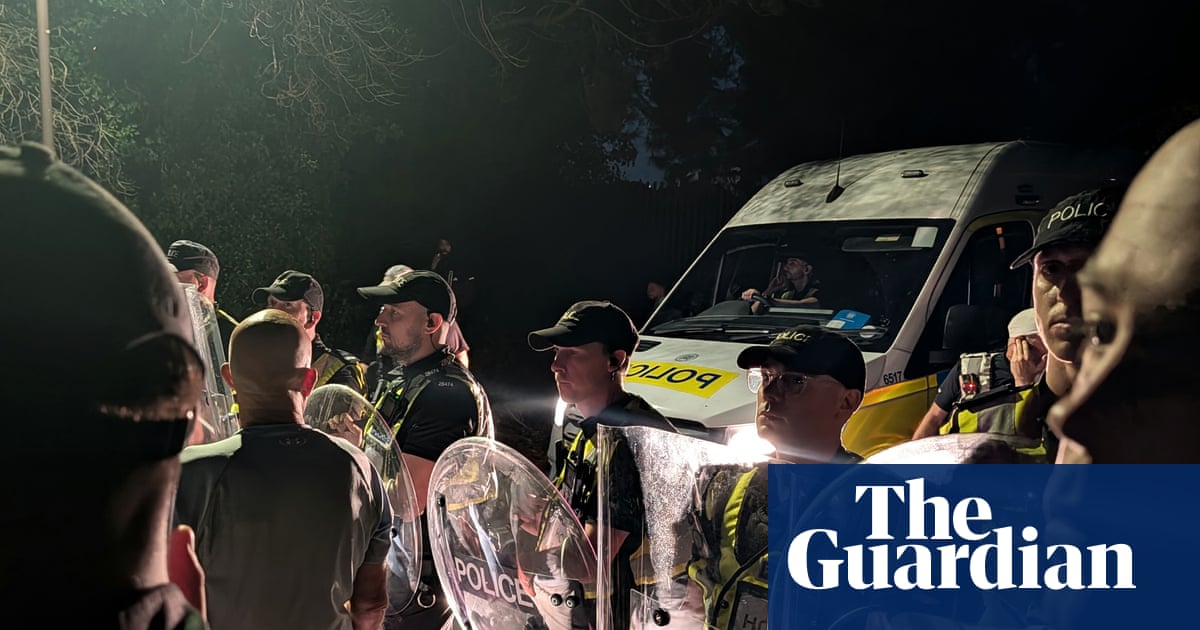
Police have been told by the government they expect better intelligence gathering after masked far-right groups took to the streets at the weekend, the Guardian has learned, as the Kent force admitted mishandling warnings of potential trouble.Police in Kent on Saturday and then Portsmouth, Hampshire, on Sunday said they were taken by surprise when hundreds massed to oppose what they say is illegal immigration via small boats.Both protests are believed by police to have been far-right inspired, with evidence emerging that those behind them were determined to avoid detection.Claims by Kent police since Saturday that they had no warning fell apart on Tuesday when the force admitted there were warning calls to police on Friday evening which were not acted upon.Kent police said: “The force had received non-emergency information late on Friday evening that a protest could take place in the town the following day. This information was not fully assessed.”The government’s view is that police actions once officers were faced by hundreds of men was reasonable.But there is dismay at how Kent police explained their decision making afterwards, for instance viewing the gathered masked men outside the port of Dover as peaceful protesters, with one source describing it as “fucking crackers”.On Tuesday evening the prime minister, Andy Burnham, met police chiefs to discuss what had happened and preparedness for any further unrest.In Dover on Saturday, where hundreds of masked men in black converged undetected, police believe those taking to the streets used walkie-talkies to coordinate their actions.Police on the ground report the masked men had lawyers’ phone numbers and cited public order case law and were well briefed on how far they could go: “They toed the line perfectly to avoid arrest”, one source said.In Hampshire police are investigating whether vehicles were deliberately left behind to block access roads.Police said the Dover gathering passed peacefully, while in Hampshire there were clashes, with the local Police Federation saying anger and violence was directed at officers.The Guardian understands that part of Hampshire police’s investigation will examine whether the gathering of 200 people was meant to harass or intimidate.A spokesperson added they are also hunting for those behind the violence, conducting “a thorough review of the body-worn video” to look for offenders.The protests are believed to have been co-ordinated on closed social media networks and not publicly advertised.Police are considering whether the threshold for warrants for covert tactics has been met, with one source warning that police were wary of criticism of using “police state tactics” against people portraying themselves as peaceful protesters motivated by a legitimate issue.The National Police Coordination Centre has intensified its monitoring.The action in Kent was organised by Daniel Thomas, a long-term associate of the far-right activist Stephen Yaxley-Lennon, known as Tommy Robinson. Thomas, who has established an umbrella grouping called Patriot Platform, was also linked to the blockade in Portsmouth the following day.Whitehall officials have asked police why tougher laws in place since last year meant to clamp down on the wearing of face masks at protests were not used.The police view was that at Dover those gathered complied with requests from officers and dispersed after three hours. In Portsmouth, which was more heated, police prioritised a formal dispersal order which they think worked.Both police and government sources say the “optics”, of masked men in black thronging the streets, looked “intimidating”.Also on Tuesday it emerged that lifeboat staff who picked up 120 asylum seekers from a large dinghy in the Channel on Sunday were refused entry to two ports shortly before being harangued by right-wing protesters.Crew on two RNLI vessels were also threatened with legal action if they approached Southampton Port and tried to bring the claimants ashore.They were forced to take the migrants several miles away to Eastney, where police, firefighters, Border Force and other officials faced protests by up to 200 people, most of whom wore balaclavas and black clothing.Peter Sparkes, the chief executive of the RNLI, said abuse of its volunteers is “wholly unacceptable in a civilised society”.He said recent protests had “generated deliberate misinformation and a misunderstanding” about the charity, and condemned threats by “those who would hide behind a balaclava or a keyboard”.Officials confirmed that a broadcast on an open marine VHF radio said that Southampton Vessel Traffic Service and King’s Harbour Master Portsmouth denied the RNLI permission to enter their ports.The two RNLI rescue boats from Bembridge and Yarmouth had intercepted a “mega-dinghy” that had left Utah beach near Cherbourg in Normandy.A spokesperson for Associated British Ports (ABP), which operates the port of Southampton, told the Guardian: “ABP did receive an inquiry about landing recovered migrants at the port of Southampton. We had to decline the inquiry as the port did not have suitable reception facilities available. If there had been a safety of life at sea issue where Southampton was the closest port or if we had received a formal direction from the relevant authority then we would have played a role. Neither was the case in this situation.”On Tuesday, anti-illegal-migrant protesters attempted to identify RNLI volunteers involved in rescuing those onboard the dinghy. Demonstrators named and shared pictures on X of two people they said were volunteers, claiming they had tracked down an address for one of the men.Sparkes’s words come after footage posted on social media showed volunteers labelled as “traitors”. In a statement issued on Tuesday, Sparkes said the misinformation led to “some of our volunteers and staff [being] the subject of online and, in the worst cases, physical abuse.“The RNLI’s people represent the very best in our society. They selflessly give up their time to keep others safe.“Yet they and their families are being threatened by those who would hide behind a balaclava or a keyboard.“Their action, in contrast, is wholly unacceptable in a civilised society.“We will take whatever steps we can to care for and protect our people and their families.”
Far-right port protests: police told to improve intelligence gathering
Full Article
Original Source
Read the full article at Theguardian →KhanList aggregates and links to publicly available news content. We do not host full articles from third-party sources. Always verify important information with original sources.