
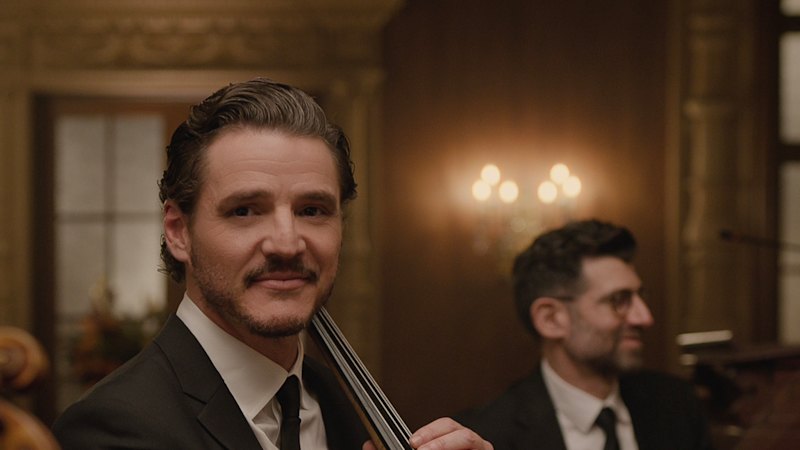
Before they started work on the film Behemoth!, Pedro Pascal and his co-star, Eva Victor, studied the musical instruments the film would require them to play in excruciating detail. Pascal plays Alex Serian, a renowned cello player, while Victor is violinist Nadia Hynes – Alex’s colleague and former lover.They were always going to be saved by a professional orchestra, which would record the music needed in the film during post-production. But director Tony Gilroy felt it was critical that both actors wielded their instruments with the kind of professional ease that would help them pass in a room full of career musicians, recruited to play the rest of the orchestra.“What it is, more than anything, is a lip sync,” Pascal explains. “And the only way to achieve the lip sync is to actually learn the pieces of Mozart, Bach, Tchaikovsky, Haydn … but they were so thoughtful and prepared that they weren’t going to let me waste any calories in places that weren’t going to be used.”The beautiful, impossible illusion is that both performances look technically flawless in the film. But the thing nobody warned them about was that it would come with a cruel choice. They could play the instruments to visual perfection, or they could effectively perform the music, but they were never going to get away with both.Eva Victor as violinist Nadia and Pedro Pascal as cellist Alex in Behemoth!.SEARCHLIGHT PICTURESVictor recalls going “through this sort of excited thing where I was like, well, I’m going to not only look amazing, I’m going to play really well and everyone’s going to be like, wow. And then the sadness that came with learning that wouldn’t be possible, [so] my focus had to move to something else.”Luckily, she adds, Gilroy had the playback music in the studio set to a high enough volume to mask any bumps in the performances, “and the musicians next to us pretended they couldn’t hear us in a nice way. So there was a lot of squeaking, but at some point it changed to a bit of a heist. So, it became, I get to look amazing, and I didn’t even do 20 years of work.”It all paid off. Behemoth! is a rich and complex assembly. A credit to both Pascal and Victor’s work as actors, and also to Gilroy’s genius as a writer and director. The capsule plot – Alex Serian returns to Los Angeles at a crossroads in his career, and begins to reconcile with his past – is executed with such precision that the film’s most taut sequences are suffused with an almost unbearable tension.Behemoth! is the first film where Pascal takes the lead role unencumbered by either mask or costume. In The Mandalorian and Grogu he wears the iconic Mandalorian battle armour (and mask), and in The Fantastic Four: First Steps, he plays Reed Richards, alias Mister Fantastic – who of course wears a superhero costume.Alone in a scene, and without a mask to hide behind, he acknowledges the deeply vulnerable place waiting there for an actor. “I can’t do it if I don’t have a human story always going on, just as there is for all of us in life,” he says. “The difference with this one is that it’s exposed to the camera all the time.”With no mask and no superhero costume, Pascal has nothing to hide behind in Behemoth!. Justin LubinThe genesis of the film began during post-production for the Star Wars film Rogue One, which Gilroy co-wrote. The soundtrack was being recorded on the iconic Streisand scoring stage and, gradually, Gilroy became fascinated by the comings and goings of the orchestra. Here was an “unseen ecosystem of 70 session musicians casually putting down their knitting or sudoku at the bell to instantly perform the soundtracks audiences consume every day,” he says. “Every night I would go back to the hotel and say, man, there’s got to be a movie in that room. There has to be.”Coming off the political intensity of the Rogue One prequel Andor, arguably the most significant Star Wars television series ever made, Gilroy found a kind of mental sanctuary in sketching scenes from this imagined orchestra-set film. “I’m hoping that, as I do it, there’s enough navigational truth in what I’m doing that something larger is gonna happen,” Gilroy says.“My fear [is] that you’re not going to turn the page, that [the audience is] going to get bored or turn away,” Gilroy adds. “And it’s probably served me really well, that anxiety. There are other filmmakers and storytellers that I look at and go, wow, I wish I could be that relaxed.”As a character, Pascal says the film is not really the story of a musician, but rather one of regret, family conditioning, and the courage needed to let someone go. As the story progresses, we flash back to fragments of Alex’s family life, and we are also introduced to his dysfunctional brother Andy (Will Arnett).“Part of loving him and understanding him is sort of a healing thing for me,” Pascal says. “Because it’s turning the lens around on yourself and your own vulnerabilities and your own capacity for this or failure to meet expectations, and just kind of forgiving yourself. [Ending] a cycle of psychological violence, even if that means not having the relationship you didn’t even realise you’ve been dreaming about your whole life.”In one crucial scene, the details of which we won’t go into for the sake of spoilers, Gilroy decided to let the cameras stay rolling without calling cut, when he realised that the accumulation of emotion would likely puncture a hole in Pascal’s resolve. The decision paid off, and in the scene Pascal broke down in tears.Pascal likens faking his cello playing in the film to lip-syncing.SEARCHLIGHT PICTURES“He didn’t tell me, and so I just got there [in the scene] and he was letting me stay in the moment,” Pascal says. “I went over to the piano … and he tricked me. I was [thinking], he’s going be so pissed that I’m losing it, but let me just get this out of my system because otherwise I’m going to throw up in the next take.”The movie’s complex concert rehearsal settings were filmed on two of Hollywood’s most iconic sound stages. Pascal and his co-star Eva Victor both confess to believing in ghosts of the artistic kind, and the notion that in the near-century that these spaces have been used to record the music for iconic motion pictures, some echo of what happened there – let’s call it stardust – has been sprinkled in its wake.The first location, the Barbra Streisand Scoring Stage, at Sony Pictures Studios, is where the soundtracks to golden age MGM classics such as The Wizard of Oz (1939), Singin’ in the Rain (1952), Ben-Hur (1959) and Doctor Zhivago (1965) were recorded. More recently, the soundtracks to E.T. the Extra-Terrestrial (1982), Jurassic Park (1993), War Horse (2011) and Rogue One: A Star Wars Story (2016) were recorded there,The second, the Newman Scoring Stage, on the 20th Century Studios lot, is where The King and I (1956), The Sound of Music (1965), Star Trek: The Motion Picture (1979), The Towering Inferno (1974) and Jaws (1975) were recorded, along with WALL-E (2008), Pearl Harbor (2001), The Simpsons Movie (2007), The Bourne Identity (2002), The Devil Wears Prada (2006) and Avatar (2009).“It can be in the architecture of a home and a building, even if you tear it down, its personality will sort of linger,” Pascal says. “One of the first sessions I sat in on before we even started shooting, they let me sit within the orchestra and without an instrument because it was a real scoring session for a very, very big movie and the musician in second chair in the cello section started his career on The Exorcist.”Both Pascal and Victor listened to movie soundtracks as children. Victor obsessively listened to the music from Shirley Temple movies, and Cirque du Soleil’s invented-language albums, while Pascal described himself as a “film score nerd” who begged his parents for soundtracks when his birthday and Christmas came around.“Movies, movies, movies, movies, movies, movies, movies,” Pascal says. “As soon as you could sort of say what you wanted for your birthday, I was asking for a movie soundtrack. I expressly asked, for my eighth birthday, for the soundtrack to Footloose and Flashdance and Purple Rain, and then started to go and buy my own soundtracks that were based on music scores.“The first [soundtrack that I bought] would be The Color Purple,” Pascal adds. “I was a Spielberg kid because the one after that was Empire of the Sun. And then I was obsessed with [composers] Thomas Newman [American Beauty, The Shawshank Redemption], Rachel Portman [The Cider House Rules, Chocolat], Ry Cooder [Paris, Texas; The Long Riders]. I’m a big film nerd.”Behemoth! opens nationally on December 3.
Fake it ’til you make it? Pedro Pascal’s sleight of hand in Behemoth
Full Article
Original Source
Read the full article at Smh →KhanList aggregates and links to publicly available news content. We do not host full articles from third-party sources. Always verify important information with original sources.