
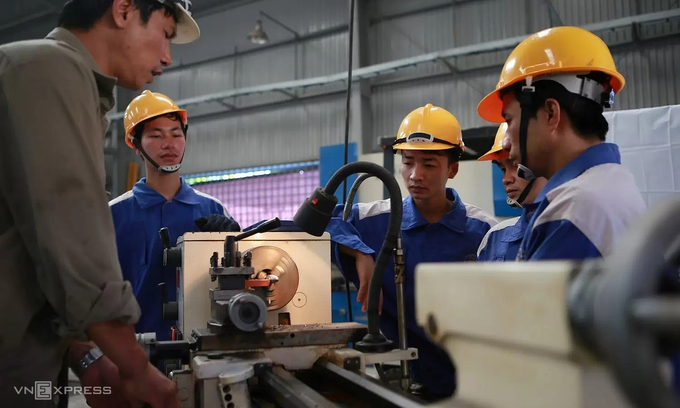
Facing wage shocks and a shortage of suitable domestic jobs, many Vietnamese workers are choosing to head back overseas after their initial contracts end. For 26-year-old Lam, the struggle to reintegrate into the domestic workforce ultimately drove him back abroad.His journey highlights a common cycle for young returnees.Believing a university degree wouldn't guarantee a good salary, he registered for the Japanese government’s technical trainee program after high school.He spent VND160 million (US$6,174) to learn the language and skills required to work in Japan as an auto-body painter for three years, during which time he continued to study the language on his own.When the contract ended, he returned home to northern Vietnam and enrolled in an information technology program.But he struggled with the coursework and eventually dropped out.However, armed with an N3 Japanese proficiency certificate and familiarity with Japanese workplace etiquette, he found a job at a Japanese restaurant.This offered a brief period of stability until a business slump forced the restaurant to close.After several months of unemployment and struggling to find suitable work, he left Vietnam again for Japan to work late last year, while studying medical interpretation. Laborers attend a Japanese language class in Hanoi to get ready for working in Japan, May 2023. Photo by VnExpress/Ngoc Thanh A major report on overseas contract workers, published by the General Statistics Office (GSO) in September, found 27% of 3,600 surveyed returnees, like Lam, wanting to leave Vietnam again.Most choose to go back to their previous countries of working, drawn by familiar environments, existing diaspora networks, and visible job opportunities that offer high incomes.The reality of the domestic job market can be discouraging: Among returnees, 95% end up in manual jobs or roles requiring low technical qualifications.The jobs they find often are in craft and related trades, which account for nearly 31%.It is followed by service, security, and sales personnel jobs at around 25%.Merely 5% of returnees get jobs that require technical or professional qualifications. Tuyen, a worker from central Vietnam, experienced this friction firsthand.When he returned home in 2019, he was confident he could find suitable work. With conversational Korean skills and nearly five years of experience in overseas factories, he landed a job at a South Korean electronics company in Bac Ninh.He worked on the production line and interpreted for Vietnamese colleagues, but lasted only a year before registering to go back to South Korea.The job paid only about 40% of his overseas income, and the environment fell short of his expectations. While his language skills were useful, he lacked the technical expertise to transition into higher-level roles."I found it very hard to adapt," Tuyen says."Since I was already used to the environment over there and had no family commitments yet, I chose to leave again."During his second stint in South Korea, he moved to a plastic recycling workshop and obtained truck and forklift driving licenses.By the time he returned to Vietnam for good at the end of 2022, he had spent a decade working abroad.Though eligible for a higher-tier work visa to extend his stay, Tuyen chose to return for his family’s sake. Many of his peers opted to stay, converting to skilled worker visas."In the same field, jobs in Vietnam pay only 40 to 50% of what workers can earn abroad," Tuyen says."Many choose to stay overseas for a few more years to save money, knowing that it can be difficult to find a job if they return [to Vietnam] at the age of 35 to 40."Despite the difficult transition, 72% of GSO survey respondents said the skills and experience gained abroad were useful for their current jobs.Nguyen Quy, a branch manager at an agency supplying labor to Japan, says years spent working abroad deeply shape a young worker's habits. Upon returning, they not only have to adjust to much lower wages but also require a lot of time to adjust to a vastly different work culture and client baseline."Expecting to find an identical job with an equivalent income as abroad is nearly impossible."As a result, many either head back overseas or attempt to start their own business, he says. Workers join a metal cutting and welding practice class organized by Sona International Manpower Supply & Trading JSC to get ready for working in Lithuania and Rumania. Photo by VnExpress/An Phuong Many guest workers initially plan to learn the language and upskill when they are overseas, but the grueling reality of their job often derails it, he says.In Japan, a worker's base monthly income is around 180,000 yen (US$1,140). Working 60 hours of overtime a month can increase income by 1.2 – 1.5 times.Exhausted from this, many rarely have the energy for online courses."When they return home, they have little else besides the cash they bring back," Quy says.Those intending to settle in Vietnam should learn specialized technical skills rather than just doing general labor, he says.Thus, elder care workers should learn advanced techniques, manufacturing workers should learn line management, and administrative staff should upgrade their language proficiency, he suggests.He himself followed this exact path.After working in a Japanese elderly care facility and food manufacturing plant in 2017, he used his language skills to move into administration.He returned to Vietnam in 2019 to work for his dispatch agency, and four years later, returned to Japan as a branch manager. For older workers, the stakes are different.When Tuyen returned to Vietnam in 2022 at age 40, his priority shifted from maximizing income to spending time with his family.He initially took a job at a foreign garment company. The shifts were from 7:00 a.m. to 9:00 p.m. for a salary of just over VND10 million a month, leaving him exhausted.A year later, he switched to working as an apartment maintenance technician on eight-hour shifts. He rarely uses Korean now.While he occasionally thinks about South Korea, returning is no longer an option, as recruitment programs typically cap candidates at age 39.Meanwhile, in Japan, Lam is focused on his new path. He is balancing work with his studies in medical interpretation—a field projected to face significant manpower shortages in the coming years."Returning to Vietnam might happen in five to seven years," he says. "Or maybe even later."
Failing to find work at home, Vietnamese guest workers choose to leave again
Full Article
Original Source
Read the full article at E →KhanList aggregates and links to publicly available news content. We do not host full articles from third-party sources. Always verify important information with original sources.