
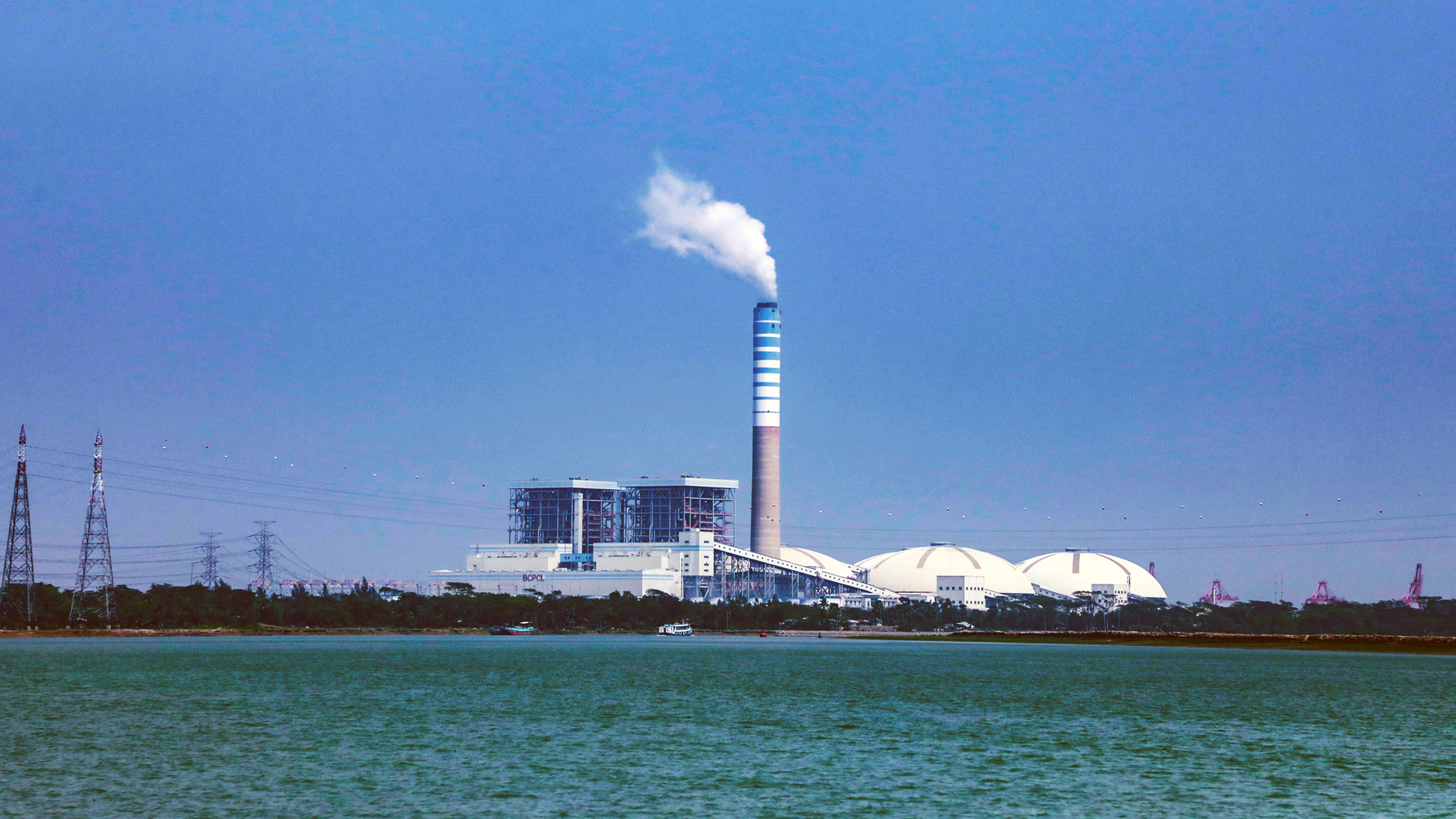
A major thermal power plant, located in coastal Bangladesh, has been operating without regular air-quality testing, allegedly causing suffering among nearby residents.A recent study also found a significant decline in air and water quality around the coal-fired thermal power plant.Meanwhile, the government recently exempted the power plant authority from conducting air-quality tests, as officials say they believe such plants do not generate significant air pollution.In addition, the plant’s chimney is shorter than the height approved in the initial Environmental Impact Assessment (EIA). Riaz Panchayet used to farm papaya, cucumber, okra and bananas on his land in Madhupur village, located in southern Bangladesh’s coastal Patuakhali district. These days, he runs a small tea stall near one of the gates of the Payra Power Plant, and worry has replaced the seasonal rhythm of harvests. “I notice a layer of ash on the leaves of the plants and low production,” he says. “There are coconut trees on my farm; I climb them for pruning or collecting coconuts, and my shirt turns black due to the ash. We are used to bathing in an open pond, but for the last several years there has been an itching problem. My eyesight is affected, too. It is all happening because of the coal power plant.” Panchayet says he lost almost 1 hectare (2.4 acres) of land to the plant. The reaming 1 hectare, he says, is waterlogged by an ill-planned drainage system that leaves the power station’s discharge sitting stagnant on his fields. Across a large area of Kalapara subdistrict in Patuakhali, where the coal-fired Payra Power Plant is located, residents tell versions of the same story. A recent study linked local suffering related to air quality and fly ash to the power plant authority’s failure to maintain proper environmental guidelines for protecting the local environment and ecology. The Payra 1320 MW Thermal Power Plant, operated by Bangladesh-China Power Company Ltd., a joint venture between Bangladesh and China, started operations in 2020. The plant consumes 10,000 to 12,000 tons of coal every day to generate electricity. The study also noted that the atmosphere of the villages surrounding the power plant has been heavily damaged by toxic outputs such as carbon dioxide, sulfur dioxide, lead and fly ash. The excessive presence of these elements in the area is harming public health, agriculture, fisheries and livelihoods, echoing what residents describe on the ground. Village area that surrounds Payra Power Plant. Image by Rashidul Hasan. Operating without testing the air quality Under Bangladesh’s Environment Conservation Rules of 1997, industries, including power plants, are required to have their ambient air and stack emissions tested for sulfur dioxide, nitrogen oxides, suspended particulate matter, carbon dioxide and carbon monoxide before their environmental clearances are renewed each year. A review of Payra’s stack emissions test documents from 2021 to 2025 shows the Department of Environment’s (DoE) Barishal Divisional Office never once carried out a stack emission test. For ambient air quality, only suspended particulate matter was checked with any regularity; sulfur dioxide and nitrogen oxides were tested just once, in 2021. And that year’s results were hardly reassuring: One reading put particulate matter at 310 micrograms per cubic meter, well above the 200- μg/m³ standard. A second test on Oct. 24, 2021, recorded 188.12 μg/m³ — still close to the limit — with officials noting the test had been conducted in “half-rainy weather”. The reason for the gap, according to the Barishal office’s senior chemist, Md Golam Kibria, is straightforward: “The office simply cannot do the work.” “We have a mandate for air, sound and liquid quality tests. But in our laboratory in Barishal, we cannot test air and liquid, though it is mandatory to test them twice a year,” Kibria says. However, Mohammad Abdul Motalib, deputy director for air quality at the DoE, has a different view of what is required. “We monitor Payra 1320 MW Thermal Power Plant, Rampal 1320 MW Coal Power Plant and Banshkhali 1320 MW Coal Power Plant through online systems, but whenever we doubt the accuracy of a report, we engage a third-party testing agency,” Motalib says. “We engaged a third party for Rampal. However, we did not conduct any test for Payra, but we have seen that the air is within the standard. For the ambient air quality of an industry, the industry is not responsible, as there are many stakeholders.” He points to Rule 8(5) of the Air Pollution (Control) Rules, 2022, which places responsibility for emissions reporting on the operator, saying, “We are also trying to attain our capacity to test the emission for our offices where the facilities are absent.” On the ambient air question specifically, he bluntly says, “When we are testing emissions, we don’t need to check ambient air quality. Besides, the standards of ambient air components were not fixed in the latest air pollution control rules. Those who are advocating for ambient air tests lack knowledge. If anything happens outside the stack, emission can be detected in the physical inspection by our inspectors.” However, the Barishal Divisional Office’s own director, Muhammad Mujahidul Islam, disagrees. “We need to test ambient air because there are other activities rather than emissions, like coal transportation and handling,” he says. The Payra 1320 MW Thermal Power Plant consumes 10,000 to 12,000 tons of coal every day to generate electricity. Image by Muhammad Mostafigur Rahman. Chimneys much shorter than approved height When the DoE approved Payra’s Environmental Impact Assessment on Aug. 10, 2015, and issued site clearance, it came with 57 conditions. Condition 56 was unambiguous: The plant could not begin operating without, among other things, a 275-meter (902-feet) chimney, an effluent treatment plant, wastewater treatment, and a raft of pollution-control equipment. That figure was not arbitrary. Schedule 11 of the Environment Conservation Rules, 1997, sets 275 m as the minimum stack height for dispersing sulfuric acid emissions from coal plants of 500 MW capacity or above, and the approved Environmental Impact Assessment (EIA) itself confirmed that the 275-m requirement had been factored into the design. The environmental clearance itself came late in more ways than one. The plant’s first 660 MW unit began its trial run on Jan. 12, 2020, and entered commercial operation on May 15 that year. Its second unit began trial generation on Aug. 26 the same year. The environmental clearance certificate wasn’t issued until Oct. 20, 2020 — meaning both units were already running, both trial and commercial, months before approval was granted. On March 2, 2020, the DoE carried out the first inspection to issue the Environmental Clearance Certification (ECC) and found both units’ chimneys stood at 220 m (720 ft) — 55 m (180 ft) below the approved height. Later, on May 17, 2020, the joint venture company operating the plant submitted a revised EIA to the DoE headquarters, recording the chimney height as 220 m. Based on the company’s revised EIA and its request, DoE later that year formed an expert committee to review the appropriate chimney height and practices in such kinds of power plants. Tanvir Ahmed, a professor of civil engineering at the Bangladesh University of Engineering and Technology (BUET) and a member of the committee, tells Mongabay, “The stack height of 275 m was not mandatory. The height never guarantees better quality. If the flue gas desulfurization [FGD] machine successfully retains the gases properly, then 220 m is enough.” FGD is a group of technologies used to remove sulfur dioxide (SO₂) from exhaust gases of fossil-fuel power plants, waste incinerators and industrial boilers. However, Ahmed says, the DoE is responsible for checking the machinery the plant has been using. DoE director Masud Iqbal Md Shameem, who sat on the clearance committee, defends the revision. “A taller chimney was suggested on the notion that it helps disperse pollutants over a broader geographic area to reduce ground-level toxicity, but modern policies intentionally restrict companies from using excessive stack heights as a substitute for installing a filtration system,” he says. The decision to allow shorter chimneys was based on an expert committee meeting, Shameem says. Exempted from testing ambient air, quietly On May 27, 2025, an “urgent and confidential” order signed by then-additional director general of DoE, Sohrab Ali, exempted several categories of industry, power plants among them, from submitting ambient air quality monitoring results. “The decision was taken because the Air Pollution (Control) Rules, 2022, prescribe fugitive emission standards for only five sectors: cement, steel, spinning mills, brick kilns and stone crushing,” the order reads. Therefore, heavy industries such as power plants are receiving exemptions from ambient air quality testing. In addition, Bangladesh runs two separate emission regimes depending on when a plant came into operation. Facilities built before 2020 — Payra among them — are held to 400 milligram per normal cubic meter for sulfur dioxide, 400 mg/Nm³ for nitrogen oxides, and 150 mg/Nm³ for particulate matter. Plants built after 2020 face tighter limits: 200 mg/Nm³, 200 mg/Nm³ and 50 mg/Nm³, respectively. Abdus Salam, a chemistry professor at the University of Dhaka and a researcher on air pollution, says, “A coal power plant is always hazardous to the environment, and it has an impact on the environment and communities even if you have efficient equipment to capture toxic materials. This is why European countries have shifted power production away from coal.” He adds, “Emissions and ambient air should be monitored extensively, but if monitoring or tests are not done regularly, it is concerning. The exemption from ambient air tests is a blunder.” Black poluted water discharge near the Payra gate. Image by Rashidul Hasan. What evidence shows on the ground The 2025 study conducted in 16 villages within a 9-kilometer (5.6-mile) radius of the plant found the presence of sulfur dioxide averaged 65 µg/m³ near the site, against a national standard of 50 µg/m³. Similarly, nitrogen oxides reached 80 µg/m³, against a threshold of 53 µg/m³. Both particulate matters, PM2.5 and PM10, exceeded WHO limits, indicating a risk of respiratory diseases among locals. Water quality fared no better. The plant was established in the estuary of the Andharmanik and Golachipa rivers, and the study found contamination from thermal discharge and heavy metals, with river water temperatures up 3.5° Celsius (6.3° Fahrenheit) from pre-operation levels — well past the International Energy Agency’s (IEA) 2°C (3.6° F) thermal pollution threshold. Arsenic, mercury and cadmium were all found above WHO drinking water limits. Soil told a similar story. Average pH dropped from 6.2 to 4.8, consistent with acidification from sulfur dioxide and nitrogen oxide emissions, while arsenic, cadmium and lead levels in soil samples exceeded FAO limits for agricultural land. The general manager and company secretary of Bangladesh-China Power Company Limited, Muhammad Mahmud Hasan, says, “We emit gases below the standard of the government and in full compliance of the rules. I don’t know what the researchers have found; there may be some mismatches. They may have a deficit of information.” Banner image: The coal-fired Payra Power Plant. Image by Muhammad Mostafigur Rahman. In Bangladesh, Ecologically Critical Areas exist only on paper Despite energy crisis, Bangladesh’s factories are slow to adopt solar power: Study Citation: Asaduzzman, M., Hayder, M. A., Hosen, M. R., Rahman, S., Sifa, N. J., Rahman, M., & Alam, M. K. (2025). Environmental and Socio-Economic Impacts of Coal-Fired Payra Thermal Power Plant. Bangladesh Journal of Physics 32(1): 1-12. DOI:10.3329/bjphy.v32i1.82343 Feedback: Use this form to send a message to the author of this post. If you want to post a public comment, you can do that at the bottom of the page. Credits Topics
Failed environmental safeguards leave coastal Bangladesh facing coal pollution
Full Article
Original Source
Read the full article at News →KhanList aggregates and links to publicly available news content. We do not host full articles from third-party sources. Always verify important information with original sources.