
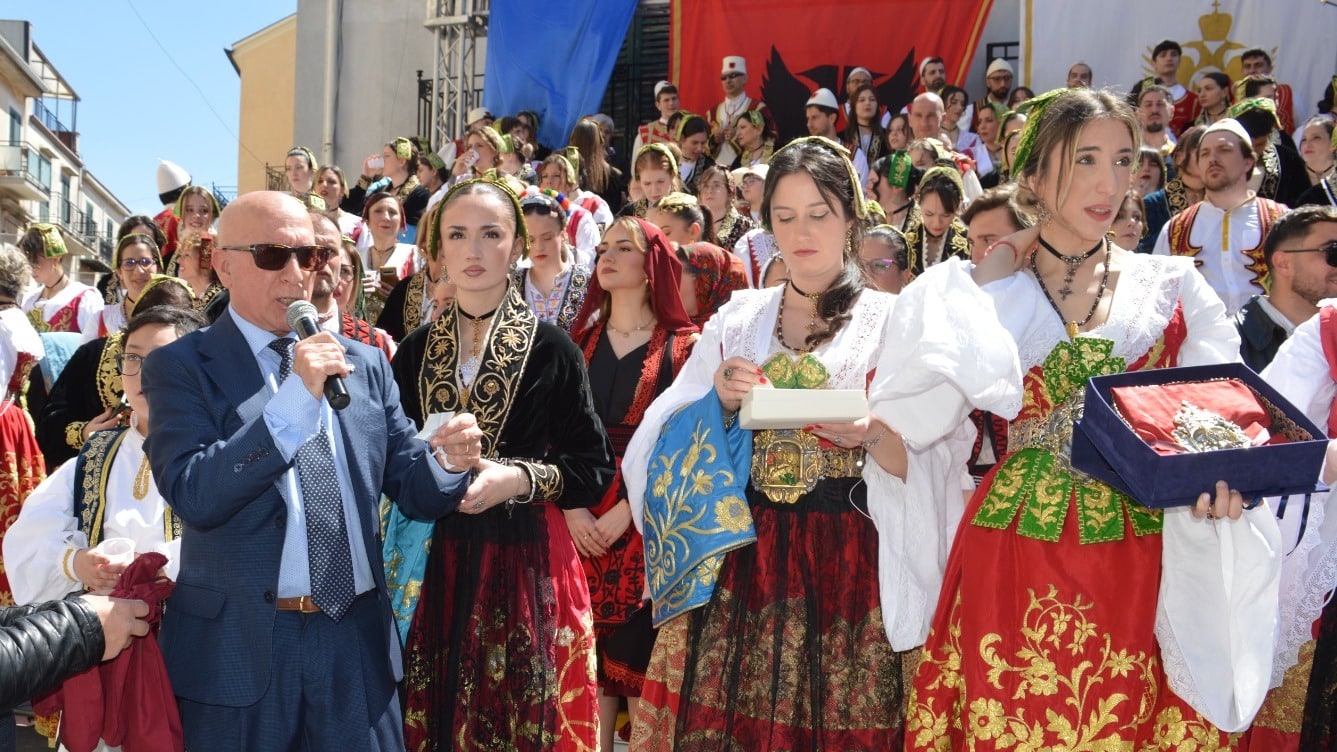
The little, bumpy countryside lane leading to Officine Kaggiotto, an organic farm outside Piana degli Albanesi in Sicily winds through the hills 24 kilometres south of the island’s capital Palermo. Along the way, bilingual road signs appear in Italian and an ancient form of Albanian. For a moment, it looks less like Sicily than a foreign exclave. At the farm, siblings Claudio Scalia, 33, and Chiara Scalia, 29, tend their 50 hectares of olive groves and beehives, giving their products names drawn from the ancient Albanian language spoken by their ancestors and that they still speak. Although their last names are Italian, this was not the language of their upbringing. The two are among the 100,000 Arbereshe in Italy, an Albanian-speaking ethnic minority that has lived in the southern regions of Italy for roughly five centuries. But today, the community’s future is at risk, threatened by climate change ripping through their farmland, increasing emigration and few work opportunities. “We don’t want to be erased because it would mean that an important piece of overlooked European history could be lost forever,” Claudio told Balkan Insight. “We are fighting daily for our survival with all the means we have.” Five centuries in Sicily Claudio Scalia and Chiara Scalia, who run the Officine Kaggiotto organic farm. Photo courtesy of Claudio Scalia and Chiara Scalia.The Arbereshe are descendants of Albanian-speaking people who migrated to Italy in waves between the 15th and 18th centuries, following the expansion of the Ottoman Empire into the Balkans. Many of those who arrived in Sicily came after the death of Albanian hero Gjergj Kastrioti Skanderbeg in 1468 and the collapse of the resistance he had led against the Ottomans. According to the community’s oral history, families crossed the Adriatic and Ionian seas in small wooden boats before establishing settlements across southern Italy. They arrived in a land that would eventually become part of modern Italy, but did not abandon their language, customs or religious traditions. Today, Arbereshe communities are scattered across southern Italy, from Sicily to Calabria, Basilicata, Puglia, Campania and Molise. In Sicily, around five historic settlements remain around the hills south of Palermo, but Piana remains the community’s main cultural hub. Its name – changed to “Piana dei Greci” (literally “Valley of the Greeks”, for its Byzantine religious traditions) under Mussolini – was switched back to its original “Piana degli Albanesi” (“Valley of the Albanians”) after World War II. Their survival for centuries is remarkable, but their future is far less certain. Depopulation, the disappearance of traditional rural jobs, the weakening transmission of the Arbërisht language and increasingly severe climate pressures are converging on communities that have already spent generations trying to preserve a fragile identity. Claudio Scalia knows what it means to leave. Several years ago, he moved from Piana to southern Spain to find a new life away from his homeland, like thousands of other Sicilians have done over the past decades. But he eventually returned, he said, partly out of nostalgia and partly because he wanted to contribute to the revival of his community. “We grew up as farmers and always identified as such, but this identity is disappearing along with ours,” he said. “That’s why it’s important to keep our traditions alive among the youth.” For him, farming is not simply an economic activity. It is part of the identity that made the Arbereshe what they are. Reminders of an ‘old’ version of Albania Rosario Petta (centre, speaking), the mayor of Piana degli Albanesi, oversees a weekly city council meeting. Photo courtesy of Rosario Petta.Piana degli Albanesi sits among the fertile mountains of western Sicily, overlooking farmland and a lake whose waters have receded dramatically. Its Arbereshe name is “Hora e Arbereshevet”, or, “Town of the Arbereshe”, the only one among the several other Italian towns to maintain a distinct name connected to the ethnic group that inhabits it. The word “Hora”, explains Mayor Rosario Petta, as he walks through the town’s cobbled streets, is an old Albanian word for a town or homeland that is no longer commonly used in modern Albanian. In Piana, however, the name is everywhere. It appears on street signs, public buildings and local businesses, a reminder that this is not simply a Sicilian town with an unusual history. It is the centre of one of Italy’s most important ethnolinguistic communities. Petta says that in Albania, the Arbereshe are almost mythical figures –reminders of a version of Albania that disappeared centuries ago but still exists in these communities. There is a strange historical relationship between the two sides. The people of Piana look towards Albania as the ancestral land from which their communities emerged. Meanwhile, in Albania, the Arbereshe represent a living connection to an older version of Albanian language and culture that they can no longer experience in their homeland. But the community in Piana is shrinking. Over the past five years, according to Petta, the town has lost more than 20 per cent of its population. Its official population is now below 6,000, although the actual number of people living there is believed to be lower. “The more people we lose, the more our ancient heritage is threatened,” Petta said. The reasons are familiar across rural southern Italy: limited employment, young people leaving for larger cities or abroad, and the decline of traditional agriculture. In Piana, climate change is adding another layer to the crisis. The olive groves around Piana are increasingly exposed to drought, extreme temperatures and wildfires. In 2023, wildfires destroyed several hectares of land around the town. The water crisis is also affecting farmers directly. “We have felt the water crisis a lot and it is reflected in the quantity, quality and timing of our produce,” Claudio said. Harvests have been brought forward as summers become longer and hotter. Trees are showing signs of stress that were previously unusual. “The summer season is longer,” he added. “This year the grape harvesting season came earlier because of weather changes.” The climate crisis, therefore, threatens more than individual farms. Agriculture has historically been one of the ways Arbereshe communities have remained rooted in their villages and integrated within Italian and Sicilian society. If farming becomes economically unsustainable, one of the remaining reasons for younger people to stay also disappears. The Scalia siblings are trying to make agriculture part of the solution. Their company was established in 2022, building on an olive grove planted in 1998. Their aim is to combine modern agricultural practices with the cultural heritage of Piana. Their products are organic, with the longer-term ambition of securing territorial recognition such as the IGP designation. Alongside olive oil, they produce honey and other agricultural products, including plums. The names of their products pay homage to their Arbereshe heritage. One of them, “Filari”, refers to the rows of olive trees while evoking “fili d’oro”, the golden threads used in traditional Arbereshe clothing. The point is to make the connection between agriculture and culture more visible. “Few people invest in agriculture and innovation in these historical times,” Claudio Scalia said. “Those who do struggle to live exclusively from it these days. To keep our farming culture alive, we are also taking on other jobs to financially sustain ourselves in a more stable way.” Children no longer speak the language The 50 hectares of organic farmland of Officine Kaggiotto seen from above. Photo courtesy of Officine Kaggiotto.If agriculture is the physical foundation of the community, language is its most vulnerable cultural one. Arberisht has survived for centuries in the villages of southern Italy, developing separately from modern Albanian and absorbing influences from Italian and local dialects. But its transmission between generations is weakening. “Languages are preserved by parents, through family connections passed on from one generation to the other,” said Giorgio Cuccia, 67, president of Piana’s Pro Loco, an association supporting the town’s cultural events. “When they are no longer spoken, they are lost.” The church has played a major role in preserving the community’s language and identity, Cuccia added. The churches in Piana are Catholic but use the Byzantine rite, another important element of Arbereshe heritage. Religious ceremonies, hymns and festivals have helped maintain a language and traditions that might otherwise have disappeared. But the younger generation is increasingly distant from the language. “The five-to-20-year-old age group no longer speaks [it],”Cuccia said. Young people may encounter Arberisht at school or during religious and cultural events, but that is different from using it naturally with friends and family. The amount of time devoted to teaching the language is also limited, he said, while the number of teachers able to teach it remains insufficient. The distinction matters, because a language taught as a subject can be preserved for a while. A language spoken at home becomes part of everyday life and can be kept alive. “We don’t speak Sicilian,” Cuccia said. “But my country is not Albania either, even if they see us as patriots.” It is a succinct description of the Arbereshe dilemma. They are not Albanians living in Italy in the conventional sense. They are an Italian minority whose history is Albanian. Efforts are being made to prevent that history from becoming simply folklore. Theatre and other cultural initiatives are being used to attract younger residents, although organisers say it remains difficult to persuade young people that their heritage can provide a future rather than simply a connection to the past. Alessandra Lo Cascio, 30, has been organising workshops as a member of Zgjimi, a local theatre group reenacting famous plays in Arberisht, to keep the language alive in daily interactions, and motivate young people to return to Piana at least once a week to practice, with the hopes this might motivate them to permanently return. “It is more than just a hobby, it’s a tool to help our survival,” Lo Cascio said. Petta is taking a different approach: tourism. While overtourism has been impacting Sicily, rural towns in the interior that need the economic benefits of tourism often remain overlooked. Piana already has a calendar of festivals that provide an unusually vivid expression of Arbereshe identity. Every August 30, the town commemorates its 16th-century foundation. Other major celebrations take place throughout the year, including the April festival of Shen Gjergji, the Byzantine-rite Easter celebrations and traditional weddings in which brides wear centuries-old costumes decorated with gold thread and elaborate embroidered headdresses. The events are becoming a draw for visitors from outside Sicily, especially the Balkans. This April, according to Petta, around 400 tourists travelled specifically to Piana for the Shen Gjergji festival. Many came from elsewhere in Italy, as well as Albania and Kosovo. The number was significantly higher than in previous years. For Piana, that matters. “For the first time in five centuries, these towns are openly inviting Albanians and Kosovars to come and see what’s left of us there,” Petta said. The language and traditions that once helped distinguish the Arbereshe from their neighbours are now becoming the basis for attracting visitors. Albanians ‘owe them something’ Chiara Scalia. Photo courtesy of Chiara Scalia.Albania itself is becoming part of that revival. Since the collapse of communism in the early 1990s, Albanian migration to Italy has created new connections between the historic Arbereshe communities and a much larger, contemporary Albanian diaspora. Some Albanians who migrated to Italy in the 1990s eventually settled in Arbereshe villages, including Piana, creating an unexpected bridge between two very different waves of migration. For younger Albanians, discovering the Arbereshe communities can also mean discovering a part of Albanian history that remained outside the modern state for centuries. One Albanian entrepreneur, Geri Ballo, has taken that connection further, spending around six months every year in Arbereshe villages across southern Italy – an area she jokingly calls “Arberia”, a name for the imagined cultural territory formed by the scattered communities. “The Arbereshe people are very important to us. They have preserved our language. We owe them something; we want to give back what we can,” she said. Her project aims to turn that sense of connection into economic activity. “As Albanians of Albania, when you connect with Arbereshe people, you realise the problems they face. So I had to do something to find opportunities for social enterprise to keep them from leaving,” she said. In 2025, she launched Made in Arberia, a digital shop to promote Arbereshe culture through e-commerce, allowing artisan and agri-food products to reach customers beyond the villages. Today it’s possible to buy hand-embroidered bags, woven baskets and other locally made products, while agricultural businesses can be given a digital marketplace. Arbereshe bed-and-breakfasts can be promoted to visitors from Albania and the wider Albanian diaspora, and cultural walks connect visitors with villages, churches, food and traditional crafts. “The interest is enormous, but the challenge is to turn curiosity into sustained engagement and, eventually, into jobs,” Ballo said. “As currently there are no concrete projects to keep residents in their towns, we try to help each other as we can.” From preservation to reinvention A view of Piana’s countryside overlooking the shrinking lake. Photo courtesy of Giorgio Cuccia.The Arbereshe story is often told as a story of preservation: a people who crossed the sea 500 years ago and somehow kept their language and traditions alive. But that description may no longer be enough. The question today is not simply whether the Arbereshe can preserve what their ancestors brought from the Balkans but whether they can build a reason for the next generation to remain. That means finding ways for an ancient language to coexist with Italian, for farming to remain viable despite a changing climate and for festivals to attract visitors without turning the community into a museum. It also means convincing institutions that protecting a minority language requires more than formal recognition. European and Italian institutions have recognised the importance of linguistic minorities, but activists and community representatives argue that implementation remains inadequate. For Cuccia, the stakes extend beyond the Arbereshe themselves. He sees the environmental crisis as part of the same failure to protect what people inherited. “Mankind has worsened nature. We should have paid more attention and taken more care of our farmland,” he said. In Piana, those two forms of loss – cultural and environmental – are increasingly difficult to separate. As olive groves suffer and water becomes scarcer since Piana’s famous lake almost dried up in 2024, young people are still leaving, while the language is disappearing from everyday conversations. Yet the town is also experimenting with a different future. After five centuries of looking back towards an ancestral homeland, Piana is beginning to look outward again. “We simply don’t want our culture and lifestyle to disappear forever, and for that we must adapt to survive, and be recognised,” Claudio added. Reporting for this story was made possible by Magma Magazine’s environmental journalism fellowship, supported by Journalismfund Europe.
Fading Away: Sicily’s Ancient Albanian Community Fears its Identity Risks Erasure
Full Article
Original Source
Read the full article at Balkaninsight →KhanList aggregates and links to publicly available news content. We do not host full articles from third-party sources. Always verify important information with original sources.