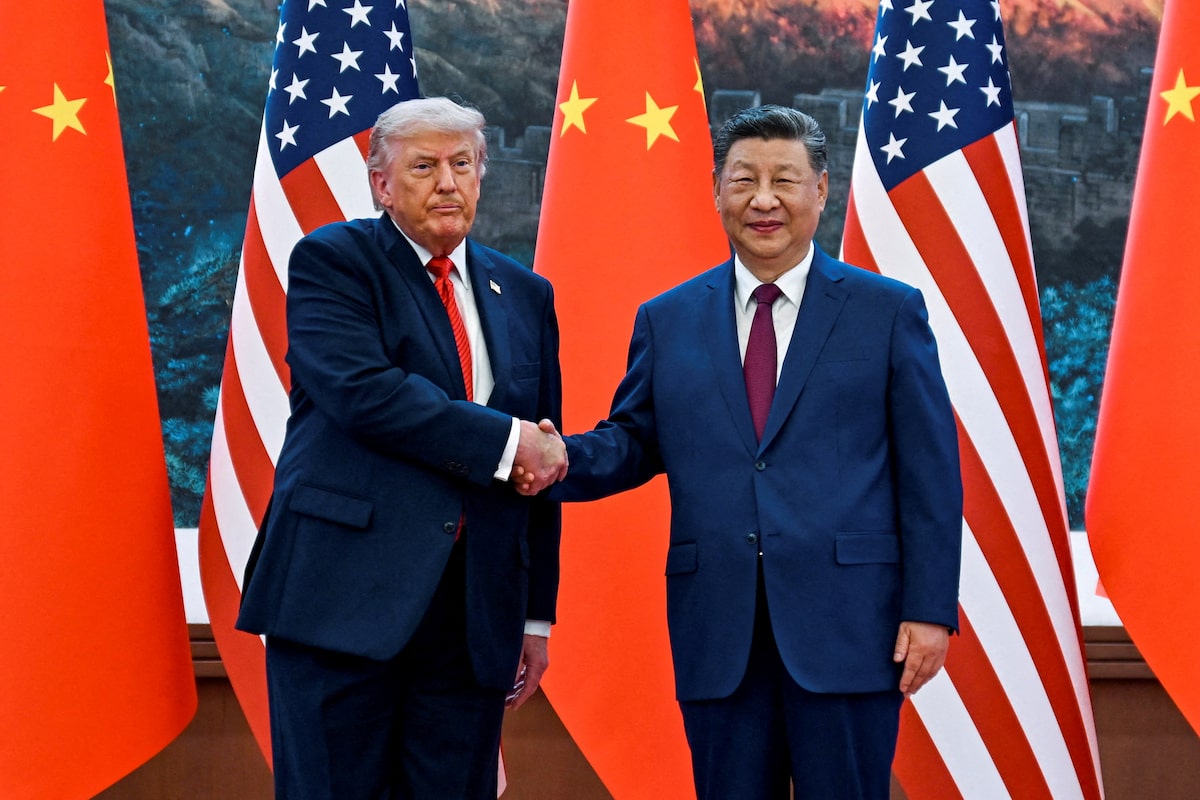
Open this photo in gallery:U.S. President Donald Trump and Chinese President Xi Jinping in Beijing on May 14. Trump promised U.S.-China ties would be 'better than ever before' during the trip.Kenny Holston/ReutersThe roller coaster that is the U.S.-China relationship took another dip this week after President Donald Trump accused Beijing of meddling in the 2020 election he lost to Joe Biden, casting doubt over a September state visit by Chinese President Xi Jinping.Just two months after he called Mr. Xi “my friend” and gushed about the rose gardens in Beijing, Mr. Trump claimed in a televised speech Thursday night that China was responsible for “the largest compromise of election data in history,” as the White House published redacted documents that failed to back up any assertion this swung the 2020 race. Beijing pushed back Friday, saying Mr. Trump’s allegations “are entirely fabricated and aimed at vilifying China.” “We have no interest in interfering in U.S. elections and have never done so,” Foreign Affairs Ministry spokesman Lin Jian said, urging the White House “to stop making an issue of China in its elections and do something conducive to China-U.S. relations.”Trump uses White House speech to renew claims of election fraud, accusing China of stealing voter filesUntil the speech, that’s what Mr. Trump appeared to be focused on, shoring up the world’s most important bilateral relationship after Beijing surprised Washington by fighting it to a draw in a trade war last year. Tit-for-tat tariffs threatened to decouple trade between the two economies entirely before both sides backed off. In Beijing in May, Mr. Trump promised ties would be “better than ever before” and hailed his “fantastic relationship” with Mr. Xi, saying of negotiations, “even when there were difficulties, we worked it out.” Both sides were looking ahead to a reciprocal visit by Mr. Xi in the summer. That trip is still on, officially: CNN cited an unnamed White House official as saying plans were “continuing apace,” and the day after his speech, Mr. Trump was musing about China and the U.S. co-hosting a future World Cup together. But the uncertainty cast over the visit − and the entire relationship − by the President’s latest outburst demonstrates the danger of Mr. Trump’s unpredictable brand of politics, at a time when his equally seesawing policy toward Iran has wreaked havoc on the global economy. China rejects Trump’s election interference claim as ‘fabricated’“Both Trump and Xi have brutally shaken up their respective political systems and centralized power in their hands, mangling the institutions, communication channels, and bureaucracies essential to avoiding or de-escalating crises,” analysts Andrew Scobell and Andrea Ghiselli wrote in Foreign Policy magazine this week. “This erosion of both process and predictability has decimated the diplomatic guardrails that, in the past, prevented the two superpowers from reaching the brink.” The lack of clarity in the state and direction of the relationship was evident elsewhere this week. In a matter of two days, the U.S. removed many sanctions and trade restrictions on Hong Kong − imposed after a sweeping national security crackdown in the semi-autonomous Chinese territory − and said it was slashing the number of visas granted to Chinese state media employees in the U.S., a move that prompted Beijing to threaten reciprocal action. So far, the response to Mr. Trump’s election claims has been limited to the Foreign Affairs Ministry statement and an editorial in the official newswire Xinhua, which noted, “Blaming China won’t fix America’s election woes.” Other state media coverage of his comments has been minimal, and more nationalist outlets have not weighed in, suggesting an official desire to keep any backlash restrained. Ryan Hass, the director of the John L. Thornton China Center at the Brookings Institution, predicted that Mr. Trump’s comments “will have less of a thunderclap on the U.S.-China relationship than many expect or wish for.” China warns of reciprocal measures after U.S. cuts foreign journalist visas to 240 days, 90 for Chinese reporters“Beijing will interpret Trump’s accusations as reflecting the actions of a diminishing president of a declining country,” he wrote Friday, noting that Chinese leaders “can read U.S. polling and know that Trump’s approval rating is stuck in the 30s and that his desired election legislation is stuck in the Senate.” “Beijing will aim to treat Trump’s comments as a passing storm cloud,” Mr. Hass said. “Beijing prefers the current fragile calm in the U.S.-China relationship to head-on confrontation. Beijing also has an incentive to refute Trump’s allegations while keeping its eye on the larger prize of sustaining the U.S.-China relationship on its current course.”That does not mean China is relying on permanently stable relations. Nor will Beijing back down from a fight if the U.S. brings it. Rather, most analysts believe China is aiming to buy time with the current détente to shore up its economy from external threats and reduce its reliance on the U.S. when it comes to technology, supply chains and finance. Beijing also benefits from appearing to be the adult in the room in the superpower showdown. Survey results released by the Pew Research Center this week showed that China is now viewed more favourably than the U.S. in many countries, including Canada. “Is it really surprising that a U.S. poll finds China’s popularity rising?” state-run tabloid Global Times asked in a gleeful editorial. “The survey serves as a mirror, exposing the misguided and outdated China policies of certain Western countries,” the paper said. “When there is a clear gap between a government’s China policy and public attitudes toward China, it suggests that policy has become disconnected from the genuine sentiments of the people in the country.” At the same time Mr. Trump was making his claims Thursday, Mr. Xi was speaking at a technology conference in what Julian Gewirtz, a former U.S. national security council senior director for China, described as a wild “split screen.” “Xi Jinping’s speech positioning China as the global benefactor on artificial intelligence juxtaposed against Trump’s conspiratorial primetime address,” he wrote. “Chinese leaders planning forward, American leaders looking backward. This is not the contrast anyone in the United States should want.”
Facing pressure at home, Trump turns to an old scapegoat: China
Full Article
📰 Original Source
Read full article at Theglobeandmail →KhanList aggregates and links to publicly available news content. We do not host full articles from third-party sources. Always verify important information with original sources.