
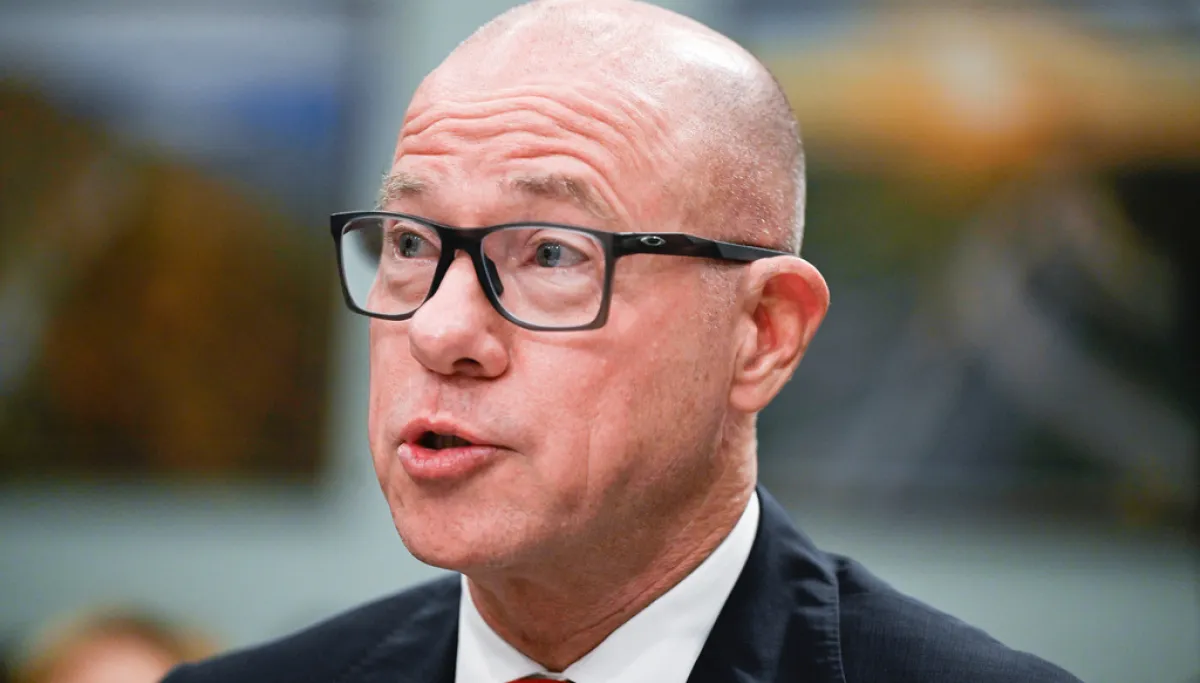
Democratic and Republican lawmakers questioned Federal Aviation Administration Bryan Bedford’s decision not to pay an annual raise to the nation’s 11,000 air traffic controllers for nearly five months since the funding was passed by Congress, suggesting at a congressional hearing on Tuesday that the decision may go against lawmakers’ intentions.House appropriators responsible for funding the FAA rebuked Bedford during an oversight hearing in Washington on Tuesday for not issuing a 2.8% pay increase to the nation’s air traffic controllers. Bedford, a former regional airline executive, maintained that controllers are underperforming and that the raise would only be unlocked once productivity increases, and that mass hiring efforts would address low morale, airport delays, and staffing shortfalls.Lawmakers on the House Appropriations Subcommittee on Transportation, Housing and Urban Development, and Related Agencies, including Chairman Steve Womack (R-AR) and the top Democrat, Rep. James Clyburn (D-SC), were taken aback by Bedford’s decision to hold a conservative pay raise over the heads of controllers. “I don’t think the law gave you the authority to squeeze more work out of [an] overworked, overstressed workforce,” Clyburn said. “So it would seem to me that this pay raise question, you’d taken some discretions not intended in the law, certainly not intended when Congress approved.”Rep. Mike Quigley (D-IL) has the nation’s busiest airport in his district, O’Hare International Airport in Chicago. The airport’s controller jobs are only 65% staffed, leading to employees becoming “burned out” from “working overtime for years,” he said.“You seem to be putting a condition on something that we passed,” Quigley told Bedford. Rep. Bill Shuster said he would make moving air traffic control from the government to a nonprofit a key part of the FAA reauthorization bill. (AP Photo/Seth Wenig) | Seth Wenig Bedford responded to a question from Rep. Jefferson Shreve (R-IN) that the controller shortage was a decadeslong issue and the agency was focused on hiring its way out of it. Roughly 2,000 trainees were hired in fiscal 2025, 2,200 in 2026, and 2,300 were slated to come on next year.However, those new hires do not automatically become certified controllers. New hires must pass training in Oklahoma, then undergo a one- to five-year process getting certified at whichever facility they are assigned to nationwide.Just 30% of trainees will make it through in a year, Bedford told the Washington Examiner in an interview in August.In addition to the existing shortage of controllers, the FAA has projected it will lose up to 6,900 controllers through 2028 due to retirements, resignations, transfers, and those who do not complete training. Despite this, Bedford defended his decision not to give the small raise to controllers and cited the legal language that he said gave him the authority to do so.“The language says specifically that, ‘Such adjustment has been implemented such that all employees, to the extent the administrator determines and has sole discretion, that improvements in workforce scheduling, staffing utilization, or other operational efficiencies are achieved,'” Bedford recited.Rep. Bonnie Watson Coleman (D-NJ) told Bedford his approach to low morale and understaffing was akin to a “Catch-22.”“You don’t think they’ve met that efficiency,” Watson Coleman said. “And you don’t think that they’re working as effectively. But then you say you’re understaffed. They say that they’re working six days a week, sometimes 10 hours a day, sometimes even more, and then have a responsibility to do the training. They’re contending that the morale in the agency is very bad, and that you seem to be operating it as if you’re a corporate bottom-line person who is concerned about money, and that’s what I’m concerned about.”Bedford pushed back and claimed Watson Coleman was “listening to a lot of anecdotal information” about the state of the air traffic control workforce and insisted the “data will tell us something entirely different.”“The complaints that I’m hearing from various venues are legitimate. … People are walking away before even spending all the time that they could to accumulate full pension,” said Watson Coleman, who asked Bedford for a specific date when the 2.8% raise would be paid out and what it would take for that to happen.Bedford did not provide a date or specific resolution, instead saying he had been to three dozen of the 313 air traffic control facilities nationwide in his 14 months in the job and saw hiring as the best solution to poor morale and exhaustion.“If we want to improve morale in our controller workforce, we’ll hire … who they need to hire and we’ll put them in facilities that don’t look like a junkyard,” Bedford said. “So why don’t we invest in building facilities for them where they have plumbing and air conditioning and working elevators.”Bedford also said that controller productivity while on the job was lower than the five hours per shift he said controllers were at the controls 15 years ago and that time at the controls per shift needed to increase before the raise could be issued.“On an eight-hour shift, they come in, and they do work when it’s assigned to them, and then when there’s no work assigned to them, we don’t know for sure what they’re doing, and that’s not to say they’re not doing the work,” he told Rep. Stephanie Bice (R-OK). “With the data that we have is we can tell that, you know, 15 years ago, we were operating many more hours on desk than we’re operating today.”However, an FAA chart that appeared in the agency’s 2026-2028 Air Traffic Controller Workforce Plan revealed that controllers who worked in 2011 only spent four and a quarter hours in position, meaning they were behind the controls, per shift. The average time in position per shift in 2025 was exactly four hours. Screenshot: Federal Aviation Administration Womack told Bedford his explanation for controllers underperforming yet needing to work more overtime did not make sense.“I can’t wrap my head around time on station or whatever you call it, going down and overtime going higher,” Womack said.Quigley added that Bedford’s refusal to pay out the 2.8% raise would only “discourage” someone who wants to pursue a job as a controller and current employees because it is “showing a lack of concern about the stress that they’re under, financial and otherwise.”AIR TRAFFIC CONTROLLERS TURN ON FAA CHIEF AS TENSIONS BOIL OVERBedford maintained that he had “the utmost respect” for controllers and pointed to the 1% raise that non-managerial controllers received in January and a separate 1.6% raise they received as part of their union-negotiated contract.“If they heard what you just said, they wouldn’t think that you’re showing them the full respect,” Quigley said. “Show them the full 3.8% to show the respect of what we need them for.”
FAA chief faces bipartisan pushback over decision to withhold air traffic controllers’ raises
Full Article
Original Source
Read the full article at Washingtonexaminer →KhanList aggregates and links to publicly available news content. We do not host full articles from third-party sources. Always verify important information with original sources.