
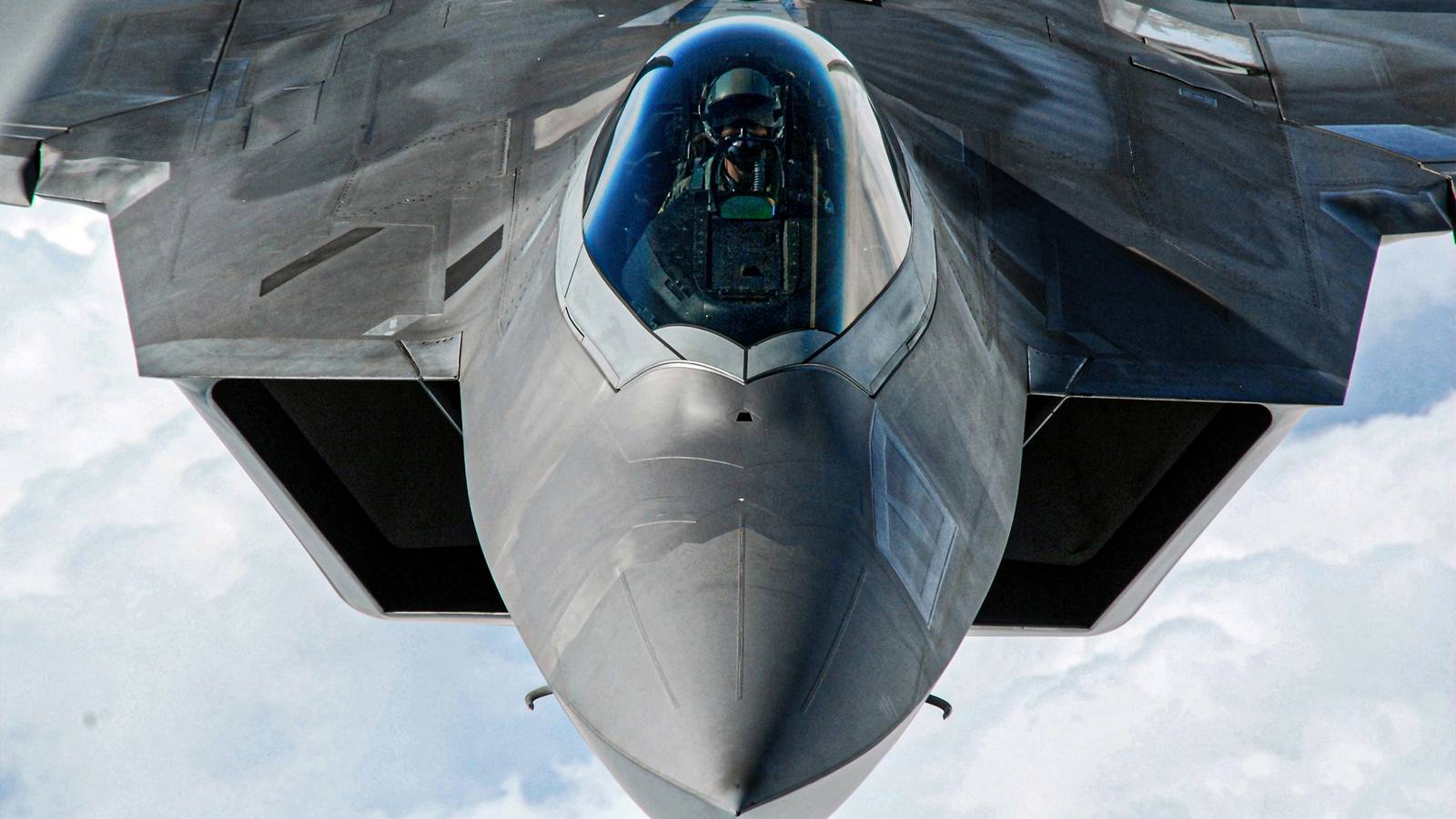
Published Nov 1, 2026, 8:00 AM EST Luke Diaz is a freelance military writer with experience with active duty experience in the US Navy as well as defense and industrial engineering. He is a former Naval Flight Officer who performed tactical air control on the carrier-based E-2 Hawkeye. It can take 15 or 16 months before a US Air Force pilot is even considered to fly the service's premier air superiority platform, the F-22 Raptor. As the world's first fifth-generation fighter, the angular stealth jet was designed to be built by the Skunk Works division of Lockheed Martin to defeat the deadliest warplanes in the Soviet Union. With a fleet size of less than 200 airframes, becoming a Raptor pilot is one of the most competitive selection processes in the US armed forces and global aviation. Assuming that an aspiring Air Force Aviator makes the cut on 'drop night' and successfully secures a slot to fly the F-22, they still have to prove themselves in the Introduction to Fighters and F-22 Basic Course. It is only after completing each of these training pipelines that a pilot will be officially assigned to an active-duty Raptor Squadron. Introduction to Fighter Fundamentals, or IFF, puts the student pilot in a Northrop T-38 Talon supersonic trainer jet. IFF goes beyond advanced airmanship and is designed to transform the pilot into a tactical wingman in contested airspace. This phase focuses heavily on the fundamentals of visual dogfighting and high-G tactics. Passing IFF means heading to the 43d Fighter Squadron for B-Course. This nine-month course is managed by the F-22 formal training unit, but there are no two-seat variants of the F-22 here. Pilots are entrusted to fly the F-22 solo from their first flight. Step One: Making The Cut For The Pilot Pipeline Credit: US Air Force The 43d FS only graduates 32 Raptor Pilots every year. However, the pipeline to get to the cockpit of the F-22 is a years-long test of patience, discipline, physical endurance, and mental acuity. Although the Air Force is often mocked for being 'soft' compared with the other services, its screening criteria are among the most exclusive, and its basic training is widely considered one of the harshest of all service branches. A bachelor's degree is a baseline requirement for all military officers in the US. Although it is possible for a citizen with an undergraduate degree to walk off the street and take a test to become an officer, most come from one of three sources: officer candidate school, Reserve officer training, or the US Air Force Academy.Then there are basic training programs, aviation aptitude tests, and a long list of other requirements to complete after receiving a four-year university degree. Criteria F-22 Pilot Pipeline Applicant Age 18 to 33 years Standing Height Window 64 to 77 inches (163 to 196 cm) Vision Correctable to 20/20 Initial Flight Training About 40 days Undergraduate Pilot Training About One year F-22 Basic Course (B Course) Length About Eight months (2022 account) B Course Classroom Instruction 380 hours B Course Simulator Missions 45 missions Start Of Pilot Training To Operational Pilot Two to three years Average Basic Course Graduates Per Year Before 2014 About Ten Basic Course Graduates In 2014 23 Air Staff Stated Need Per Year 42 Only 15% to 35% of applicants will pass through the initial gauntlet to be chosen as a pilot in the Air Force. Ironically, pursuing a career as a pilot in the Air Force can also be more competitive than an aviation career in the Army, Navy, or Marines. Selection boards weigh academic record, test scores, and fitness, and reliable public figures on acceptance rates are hard to find. Even a winning candidate has not been picked for fighters, because that decision comes much later and rests on how the student performs in every school that follows, in the classroom and in the air. Every single test, no matter how trivial it may sound, is either a step forward towards realizing the goal of becoming an F-22 Raptor pilot or a potential pitfall that could end the career aspirations of any young Air Force pilot. IFF: Testing The Best of the Best Credit: US Air Force Air Force pilots are assigned their specific aircraft platform at the end of undergraduate pilot training. This is the culmination of the initial Flight Training pipeline, which progresses student pilots from the cockpit of piston-powered light planes to turboprop and jet-powered trainers. Demonstrating aptitude in UPT determines the course of a pilot's career in many ways. However, even if you are the top student, if there are no openings in the community that you want to fly with, the Air Force will simply assign you to a different plane. That means even if you have spent years hoping to become an F-22 pilot, unless there is an 'open seat,' it doesn't matter how well you do in training, and you simply will not be given the opportunity to ever fly the Raptor. There are some exceptions. However, they are rare; assuming everything goes according to plan, the next step is Introduction to Fighter Fundamentals. In IFF, you are no longer fighting for your seat to fly a Raptor but rather relearning how to fly in a combat scenario instead of the general skills and flying techniques taught in UPT. The training is conducted in T-38 Supersonic jets made in the early years of the Cold War, which are brutally fast and equally unforgiving at high speed and high-G forces. If you fail your check rides, a pilot can be reassigned to a different community. As one of the final check filters before aviators are entrusted with the control of the F-22, the standards are exceptionally high and inflexibly strict. Breaking a training rule, using a floor altitude during a dogfight, passing out from improper G-strain technique, or any violation of exercise rules of engagement is an automatic failure. Each prospective Raptor pilot has very few second chances if they fail to pass a training evolution. The Basic Course Allows No Retakes Credit: US Air Force Successfully completing IFF means upcoming Raptor Pilots finally reach the last stage of training before stepping into the cockpit of the world's most lethal stealth fighter. Since Lockheed never built a two-seat variant of the F-22, there are no 'training wheels' on the B-Course. The initial qualification phase is simulator-based due to the absence of a training airframe. This battery of tests focuses on technical skills and knowledge unique to the F-22, and once again stress-tests pilots to ensure the aviator can handle any scenario that could unfold. Instructors use the sim to completely overwhelm a pilot's brain. They will throw multiple, compounding emergency procedures simultaneously and expect instant troubleshooting with zero mistakes. Because the instructors cannot sit behind you and grab the controls if you mess up, the gatekeeping to get approved for the first flight is ironclad. Students must pass a grueling instrument and emergency-procedures simulator checkride. If the instructors see any sign of panic, poor judgment, or unstable flying in the sim, the pilot will not move on. They must be 100% certain that, when they take off, they can handle any catastrophic failure by themselves without panicking. The flying portion of the F-22 B-Course is run by the 71st Fighter Squadron, known as the Ironmen, which is part of the 1st Fighter Wing based at Joint Base Langley-Eustis in Hampton, Virginia. The 325th Training Support Squadron at Tyndall Air Force Base, Florida, supports initial academic and simulation training, but real-world flying begins and ends with the 71st Fighter Squadron. Air Combat Tactics Training in the F-22 Raptor Credit: US Air Force After the grueling simulator check, the Transition and Advanced Handling Characteristics phase begins. During this stage, new F-22 pilots take off on the very first solo flight while an experienced instructor pilot flies a separate chase plane. Students master basic instrument procedures, low-visibility approaches, and the critical skill of day and night Air-to-Air Refueling. Once you are a trainee, you can safely handle the basic physics of the airframe, and advance directly into the Basic Fighter Maneuvers phase. This is high-G, visual one-v-one dogfighting, where the 71st Fighter Squadron is heavily supported by the T-38 Aggressors of the 7th Fighter Training Squadron, the Screamin' Demons. IPs will push trainees to the ragged edges of control at high altitudes and force extremely high Angles of Attack to test the thrust-vectoring in post-stall maneuvering. If a pilot cannot stay ahead of the rapid pitch and roll rates of a vectoring jet during these initial flights, they get pulled from the schedule and reassigned. Surviving the dogfights leads to the Air Combat Tactics and Beyond Visual Range Intercepts phase, which transitions into multi-ship, stealth, fifth-generation warfare.Flights of two to four Raptors hunting down multiple Red Air adversary threats from dozens of miles away using advanced tactics and weapons. Next is the Surface Attack phase, which supports multirole certification as a precision strike pilot. Trainees will practice penetrating integrated air defense systems and taking out high-value targets on the ground. The entire flying syllabus culminates in the Capstone phase, which focuses on Dissimilar Air Combat Training and large-force employment. The 71st Fighter Squadron holds advanced dogfighting drills over the Atlantic Ocean near Langley AFB. During this stage, new Raptor Pilots are thrown into massive, complex simulated air wars against other fighters like F-15s, F-16s, or Navy F/A-18s playing the role of an enemy force. Only after proving their tactical prowess in DACT is a pilot considered fully combat-ready in the F-22 Raptor.
F-22 Raptor Pilots: What It Takes To Fly America’s Top Stealth Fighter
Full Article
Original Source
Read the full article at Simpleflying →KhanList aggregates and links to publicly available news content. We do not host full articles from third-party sources. Always verify important information with original sources.