
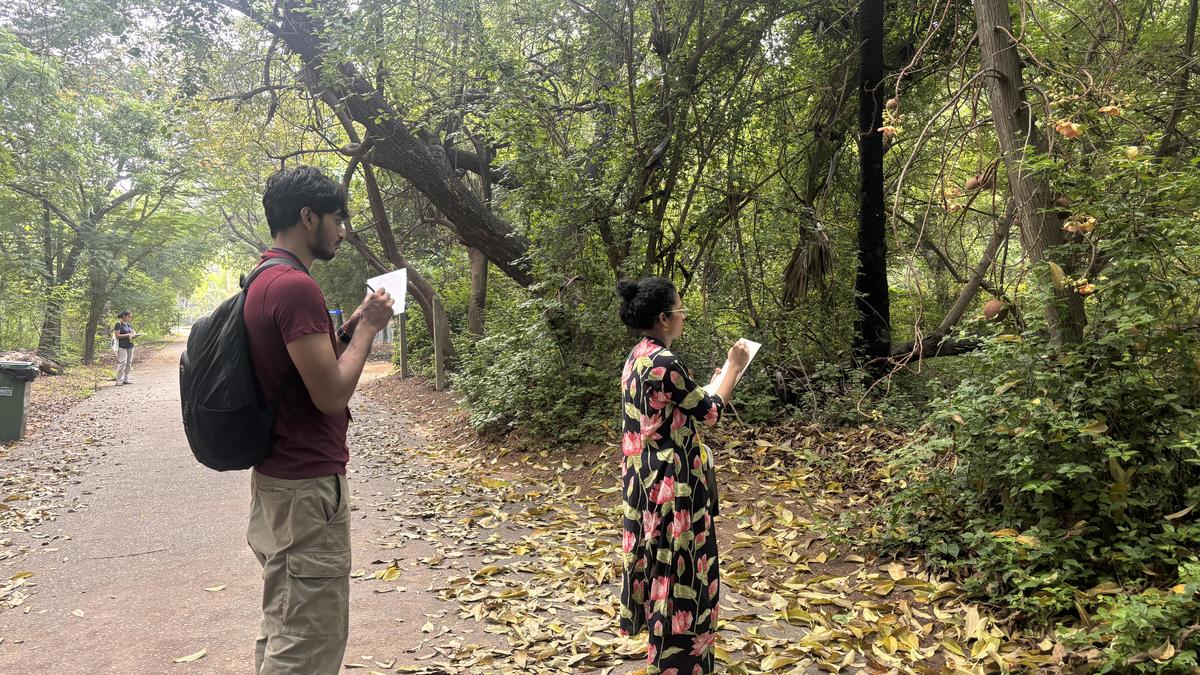
How difficult can drawing a tree be? Two lines for the branches and a bush on top? That was the strange confidence I had before setting out for a tree-drawing walk organised by Palluyir Trust, a Nature education and research organisation, at the Theosophical Society, Adyar on October 31.Before I knew it, I was standing in front of a mahogany tree, attempting a blind contour drawing — an exercise in which you keep your eyes fixed on the subject rather than looking at the paper while drawing. It did not take long to realise that trees are far too complex to be captured in two straight lines.Guiding us through the exercise was Karunya Baskar, a Nature educator and designer at Palluyir Trust. “Trees live on a different timescale than us. Many live way longer, like the banyan tree here, which is said to be 450 years old. They’re still growing, changing beings, but they like to take their time. This perceived ‘stillness’ perhaps makes us forget that they’re living beings at all,” she says, adding that it is important to acknowledge all kinds of life and be sensitive to see trees as they are — intelligent beings in their own right — and be more perceptive. Palluyir Trust, started in 2021, attempts to make Chennaiites aware of this tangible and intangible natural world around them. | Photo Credit: Special Arrangement Palluyir Trust, started in 2021, attempts to make Chennaiites aware of this tangible and intangible natural world around them. Founder Yuvan Aves says, “we have beaches, wetlands, and trees on our streets. We live amidst them without kinship or a relationship with them. If a tree is not part of your family, you may not feel compelled to act when it is cut down”. The trust conducts around 50 to 60 Nature walks a year, with one or two walks taking place almost every week. This particular exercise of sketching a tree is a first. Drawing, Karunya says, encourages people to look closely at these details and discover the stories behind them. It becomes a tool of observation that helps people develop a deeper connection with leaves, branches, stems, and the very lives they shelter.“Trees are often-ignored as part of our environment but their shape and growth patterns can tell us a lot about their life history. The way their branches twist, roots emerge in certain places, or a tree grows out of a building makes it an interesting intellectual exercise to imagine what its life might be like,” says Karunya. In the city we experience a deep emancipation from our natural environment. Drawing trees, and the other sessions that we conduct aim to regrow that connection through observation, which then fosters a sense of care | Photo Credit: Special Arrangement I end up realising that the often-spotted swollen, ball-like structures on the trunk or branches are caused by a foreign infection from a nail or fungus that may have damaged a part of the cambium. The tree tries to regrow the cambium around this foreign entity, often engulfing it and creating large, round burls.Karunya adds that the eye spots we find on the trunk are marks left behind by a branch that was cut off or self-pruned by the tree. If a lower branch is not getting enough sunlight, the tree sheds it. It was probably not worth the amount of energy the tree needed to keep it alive, she adds.Nitin Srirang, a writer, says he was drawn to the walk by his interest in the poetic significance of trees. “I like Palluyir’s twin focus on knowledge and experience in its Nature walks. I wanted to get more visual, strange perspectives on trees and their place in ecosystems,” he says. Artwork by a participant at the tree walk | Photo Credit: Special Arrangement The experience, he adds, has left him feeling “relaxed and full of life and energy”. “Trees are metaphors of the slow life and resilience. I was happy to be reminded of these in their presence.”“In the city we experience a deep emancipation from our natural environment. Drawing trees, and the other sessions that we conduct aim to regrow that connection through observation, which then fosters a sense of care,” Karunya says, explaining that our natural world is constantly under threat and we are in need of a community of well-informed, sensitive people who can care for it.Many times, Chennai can feel like a city made entirely of concrete, says Karunya. However, even seemingly empty plots that get flooded during the rains can be home to a diverse range of wildlife, including frogs, dragonflies and insects. “If you hang out with the team for a day, you’d notice we spend half our time crouched on the ground, looking at something tiny perhaps crawling across and carrying prey, or rolling along a tiny ball of dung. We’re proud to say that we’ve been able to get many more people into the habit,” she says.Yuvan adds that the motivation behind the trust is to support young people who want to work full-time in ecology and also to build an infrastructure to take up important ecological fights. These walks, hence, become instrumental to the process.Follow Palluyir Trust at palluyirtrust.org for updates on upcoming nature walks.
Explore Chennai’s green spaces through Palluyir Trust’s Nature walks
Full Article
Original Source
Read the full article at Thehindu →KhanList aggregates and links to publicly available news content. We do not host full articles from third-party sources. Always verify important information with original sources.