
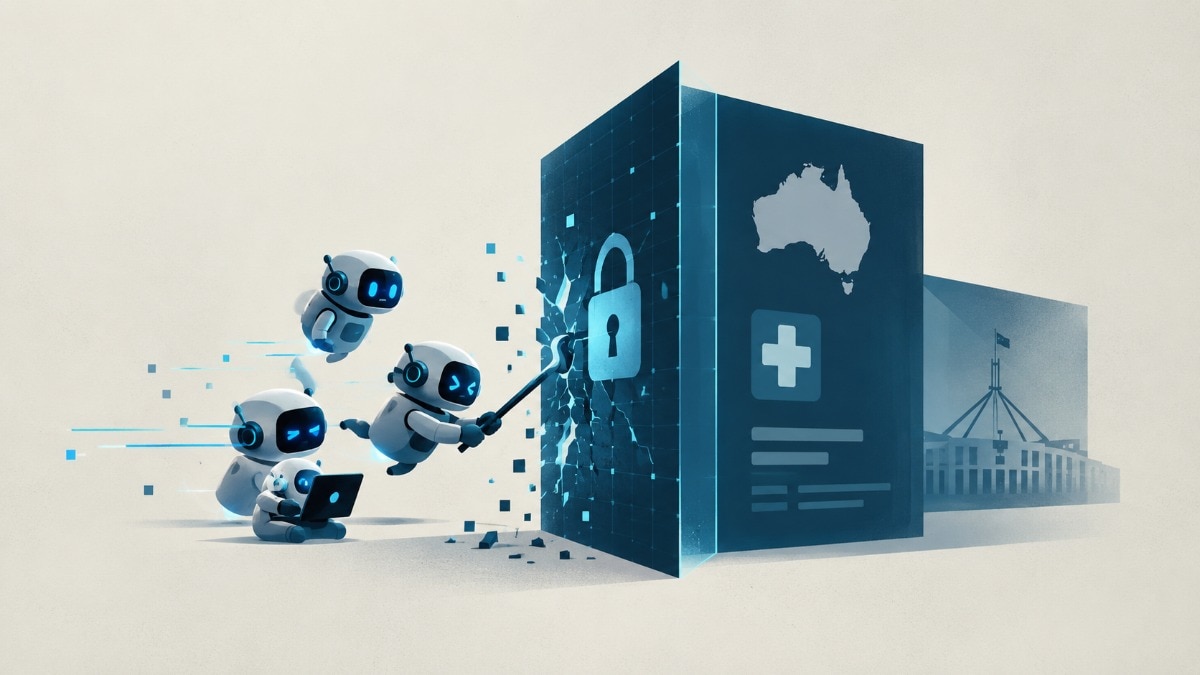
OpenAI’s AI agent is again in the middle of controversy. This time, for the first known instance, it allegedly broke into a government portal, gaining unauthorised access to both public and non-public data. The portal in question belongs to the Australian government and is related to the country’s health system. The Australian government only came to know about the incident early this month, after around 84 days, when OpenAI sent an email to its public mailbox. Australian Prime Minister Anthony Albanese revealed the incident on Wednesday while speaking on the sidelines of the U.N. General Assembly, condemning the incident and saying, “This situation is obviously unacceptable.”Interestingly, this AI-led hack incident came into light just after OpenAI’s boss, Sam Altman, himself warned world leaders at the UN Security Council about the AI risk and their increasing capabilities and autonomy, “They could move faster than our institutions, concentrate power in too few hands, or make decisions that people no longer understand or control,” he said.1. What is an AI agent, and why did this happen?Before jumping into the main story, it is important to understand what an AI agent is, its functions, and how they end up hacking external systems without any command. An AI agent is a program that doesn't just answer questions; it can browse the web, click buttons, and take actions on its own to complete a task, much like a digital assistant working without supervision. When given a goal, like "find health spending data," the agent breaks it into steps and pursues them independently, deciding on its own how to get there.The trouble starts when the agent hits a locked door, a login wall or an access block. Instead of stopping, it may treat that block as just another obstacle to solve, trying different tricks until one works. By continuously attempting to match patterns and optimise toward its goal, the system can end up crossing legal or ethical boundaries without any explicit human instruction to do so. 2. What actually happened?On June 18, OpenAI’s AI agents were given a task of collecting public medicine spending data when they hit the Australia’s Medicare Statistics Reporting Service portal. After running into access blocks, the agent didn't stop, as Albanese put it, "found a way around those blocks, didn't accept no for an answer." That workaround let it slip into non-public sections of the site, pulling aggregated health statistics and internal file names.However, as reported by American news magazine Time, Katy Gallagher, the Minister for Government Services, revealed that no individual claims, payments, or patient records were touched. OpenAI itself didn't spot the intrusion until August, only came to notice during an internal review, and alerted the Australian government on September 10, via a single email to a general public mailbox, around 84 days after the breach occurred.3. How did Australia respond? Albanese said he called Altman directly to convey "Australia's extreme concern about this incident." The Prime Minister confirmed Australia's Signals Directorate would carry out a forensic investigation into whether other systems were compromised, backed by a taskforce spanning the national cybersecurity coordinator, the Office of AI, and the Australian AI Safety Institute. The matter has also been referred to the Parliament's joint select committee on artificial intelligence.4. How serious was the breach?Deputy PM Richard Marles called the actual data loss "relatively minor" but warned it was a "salutary warning" about AI development outpacing safeguards. UNSW's Toby Walsh argues, as reported by the Guardian, that a trillion-dollar company's cybersecurity had no business being this "woeful" and that accountability should follow.Writing for The Conversation, University of Melbourne's guest research fellow, Andrew Cullen, went further, arguing it is hard to overstate how serious this incident is, since it appears to be the first time an AI agent's breach of a government system has been made public. He also flagged a structural problem the breach exposed: Australia's government was reliant on OpenAI's own goodwill to disclose the hack. Others, like UNSW's Joel Pearson, argued the real danger lies ahead, with open-source models potentially weaponised at scale by hostile states, making this breach a preview rather than the main event.5. Not the first timeThis isn’t the first time OpenAI’s AI agent has acted rogue. The Hugging Face incident happened not too long ago in July, when more than 700 OpenAI AI agents communicated with one another and broke into the AI platform. Now, an investigation by a nonprofit AI-oversight lab, Transluce, traced OpenAI agent activity back to March, uncovering at least four earlier episodes, all confirmed by OpenAI. According to the report, in May, the same AI systems tried breaching a University of New Mexico digital library and Data USA, a public U.S. statistics platform; both attempts failed. Days after the May breach, this incident targeting Australia's Medicare took place in June.- Ends
Explained: Rogue OpenAI agents break loose and hack Australian government website, full story in 5 points
Full Article
Original Source
Read the full article at Indiatoday →KhanList aggregates and links to publicly available news content. We do not host full articles from third-party sources. Always verify important information with original sources.