
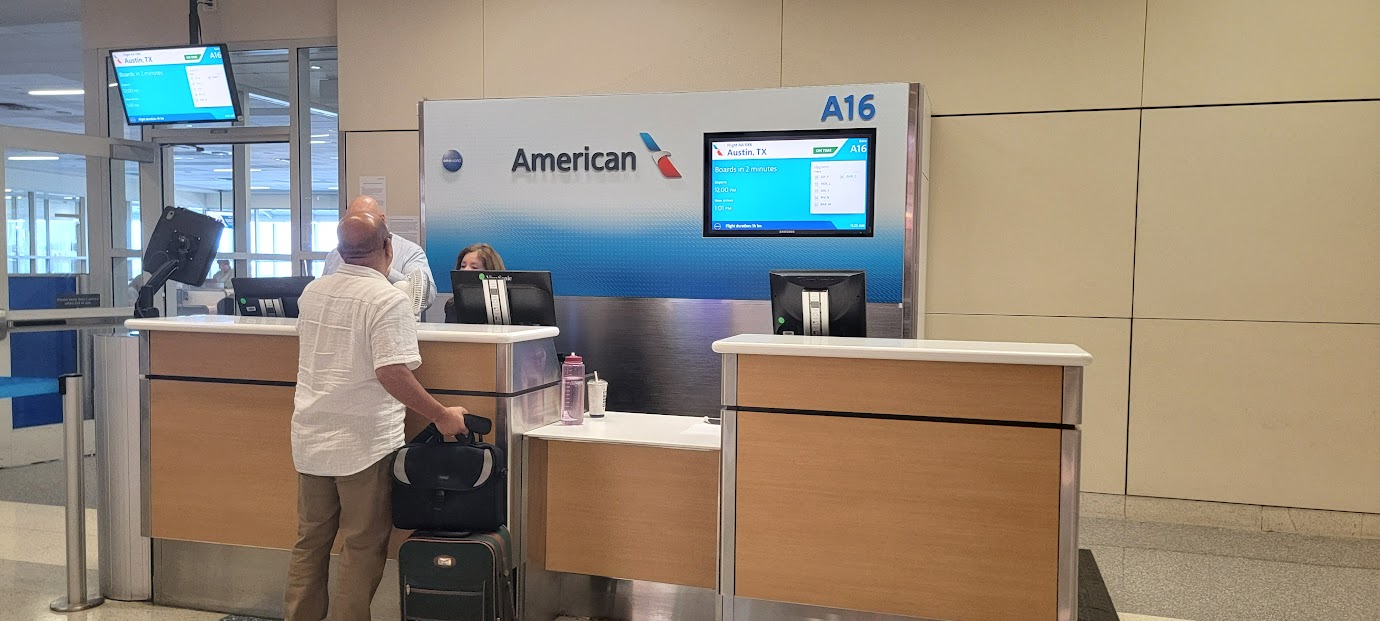
American Airlines is telling employees to stop involuntarily bumping passengers and even giving them permission to confirm volunteers on the very next flight even when it’s already full to make volunteering less of a hassle. An internal memo I’ve obtained orders airport staff to keep the aircraft door open until enough customers agree to give up their seats, and to take a delay if that’s what it takes. AA has a zero involuntary denied boarding mandate. Do not close the aircraft door until all volunteers have been secured for every oversale. Engage with Leadership. Since September 30, the directive has applied to mainline and regional operations, domestic and international. Here is the central instruction: “No invols” is no longer a goal – it is a company requirement. Continue working the oversale until every affected customer has voluntarily accepted the offer and confirmed travel. American has been willing to bump passengers and pay the minimum compensation the law requires, while Delta has demonstrated that an airline can keep finding volunteers instead. Now American is telling airport employees that the old outcome is unacceptable, and changing who can authorize spending more to avoid it. Here’s a snippet of the memo: The Door Stays Open, And Managers Can Approve More Money Back in March, I published American’s earlier internal oversales instructions. Each station had three preset voucher amounts. Agents could work between those amounts, but couldn’t exceed the maximum displayed in their system without approval from Day of Departure. That made the highest preset amount the practical ceiling unless someone elsewhere approved an exception. The memo emphasized managing costs responsibly. The new directive explicitly takes that decision away from Day of Departure: DOD no longer authorizes or denies going above max compensation – station leadership will determine whether a higher amount is necessary to secure volunteers and prevent an involuntary denied boarding It doesn’t publish a new dollar maximum. It puts responsibility for approving more compensation with the airport’s leadership, who must actually be at the gate. A customer service manager or someone more senior must be present for an oversold flight and actively help resolve it, including approving compensation above the usual maximum. The aircraft door must remain open while a potential involuntary denied boarding remains unresolved. The instruction expressly says to take a delay when necessary. Announcements should start early and explain the problem. That includes telling customers when an aircraft swap or weight and balance restriction has left fewer usable seats. Employees must document the process: when they began seeking volunteers, each increase in compensation, escalations, and anything unusual. That’s a change in the incentives at the gate. Employees are being told to spend more when needed, given a manager who can authorize it, and explicitly instructed that closing the door on time doesn’t justify leaving an unwilling passenger behind. This is a huge change for an airline that once required D0 exact on-time departures over every other priority. The most striking provision is what American lets employees offer alongside the compensation: A volunteer may be confirmed on the very next departure, even when that flight does not currently show available seats. Agents are instructed to use their rebooking tools and call Day of Departure for booking support when the next departure has no availability. A passenger considering a bump often cares less about another $200 than whether they’re going to be stuck for an extremely long period of time. A confirmed seat on the next departure can make the offer something to accept when it’s just a short delay, or a long one and waiting around the airport trying to get on earlier flights as standby. American’s ConciergeKey next flight guarantee lets their most valuable customers get confirmed on a sold out departure when their flights are disrupted. This treats customers volunteering as being extremely valuable to the operation. I’ve used that benefit after an Austin – Miami cancellation when I had this status. American confirmed me on the next flight hours before a seat actually opened up. I wound up in the back row of an Airbus A319, but I got there that day. Nobody ultimately needed to be bumped to accommodate me, but they were willing to pay someone to volunteer to get me where I was going. Confirming another passenger doesn’t create another physical seat. Someone may cancel or miss a connection, allowing the next flight to accommodate everyone. If that doesn’t happen, American is willing to work to find volunteers on that flight, too. As part of the sales pitch, Employees are told to explain that an involuntarily bumped passenger would only get the next flight with available seats, while a volunteer can get the very next departure. They’re also told to obtain the customer’s specific federal compensation amount and compare it with the voluntary package. This policy is good to know to make sure, if you’re volunteering, that you’re getting confirmed on the next flight along with receiving compensation. American Has Been Bumping More People Than The Rest Of The Industry Combined The Department of Transportation’s full-year 2025 figures show American and its regional carriers involuntarily denied boarding to 14,758 passengers. That was a whopping 60% of the 24,596 involuntary bumps across the industry. They denied boarding to more passengers than the rest of the industry combined. (Frontier actually had the highest rate.) Delta, by contrast, did not involuntarily bump a single passenger. They accommodated 57,077 volunteers Here’s the comparison for January through June 2026. Airline Involuntary bumps Per 10,000 passengers American 5,247 0.52 Frontier 2,475 1.42 Spirit 670 0.91 Alaska, including Hawaiian 232 0.09 Southwest 122 0.01 JetBlue 122 0.07 United 107 0.01 Delta 0 0.00 Allegiant 0 0.00 American has already been offering more to volunteers. In July, at my Philadelphia–Washington National gate, the opening offer was $1,125. They hadn’t worked their way up from $200. And as I noted then, even that amount required management approval. In June, I covered a $4,000 voucher offer on a Philadelphia–Athens flight. American could already approve exceptional payouts. The new memo makes avoiding involuntary bumps a requirement and puts the authority to exceed normal limits at the gate. American was already improving before this directive. In the second quarter, its network recorded 1,953 involuntary bumps, down from 4,257 a year earlier for a 54% reduction. American Is Moving Toward The Product Richard Anderson Described At Delta The industry became much more willing to pay volunteers after David Dao was dragged off a United Express aircraft in April 2017. Delta raised gate agents’ authority from $800 to $2,000, and supervisors’ authority from $2,000 to $9,950. United announced offers up to $10,000. Then, effective May 1, 2020, United cut its maximum voluntary compensation in travel certificates or equivalent miles from $10,000 to $2,500. Federal rules never required airlines to stop bidding for volunteers at those amounts. Mandatory involuntary compensation depends on the passenger’s fare and the resulting arrival delay, and can reach four times the one-way fare, capped at $2,150. When former Delta CEO Richard Anderson appeared on Airlines Confidential, he described the absurdity of taking a customer’s money, having them follow every instruction and arrive on time, and then telling them they couldn’t take the flight and concluded “Why don’t we just buy them all off?” He argued that Delta’s premium success rested first and foremost on a consistent product, and that’s where they began building the airline that’s had significant success: reliable transportation, seatback entertainment and wifi. Reliability included knowing that having a ticket meant being able to fly, as well as investing in line maintenance so planes sitting overnight could have problems fixed before the next day’s flying. American is now bringing seatback entertainment back to its domestic narrowbody fleet starting in 2028. They’ve also announced Starlink installation on more than 500 Airbus aircraft beginning in early 2027 and there’s a report this will be extended to the rest of the fleet as well. This really does seem in many ways like a different airline, making real investments in turning around the business. They haven’t really told this story yet. But a passenger who needs to get somewhere has a reason to pay more for an airline they trust to honor the booking. A flexible passenger can leave an oversold flight happy because the airline offered enough to make changing plans worthwhile. American has too often saved on the second customer at the expense of the first. There’s also a revenue argument for paying more that Delta’s Anderson explained: eliminating involuntary bumps could help pay for itself by letting the airline accept more bookings. Revenue management no longer had to be constrained in the same way by the risk of turning away unwilling passengers. Topics on this page
Exclusive: American Airlines Will No Longer Bump Passengers—Volunteers Can Get The Next Flight Even If It’s Full
Full Article
Original Source
Read the full article at Viewfromthewing →KhanList aggregates and links to publicly available news content. We do not host full articles from third-party sources. Always verify important information with original sources.