
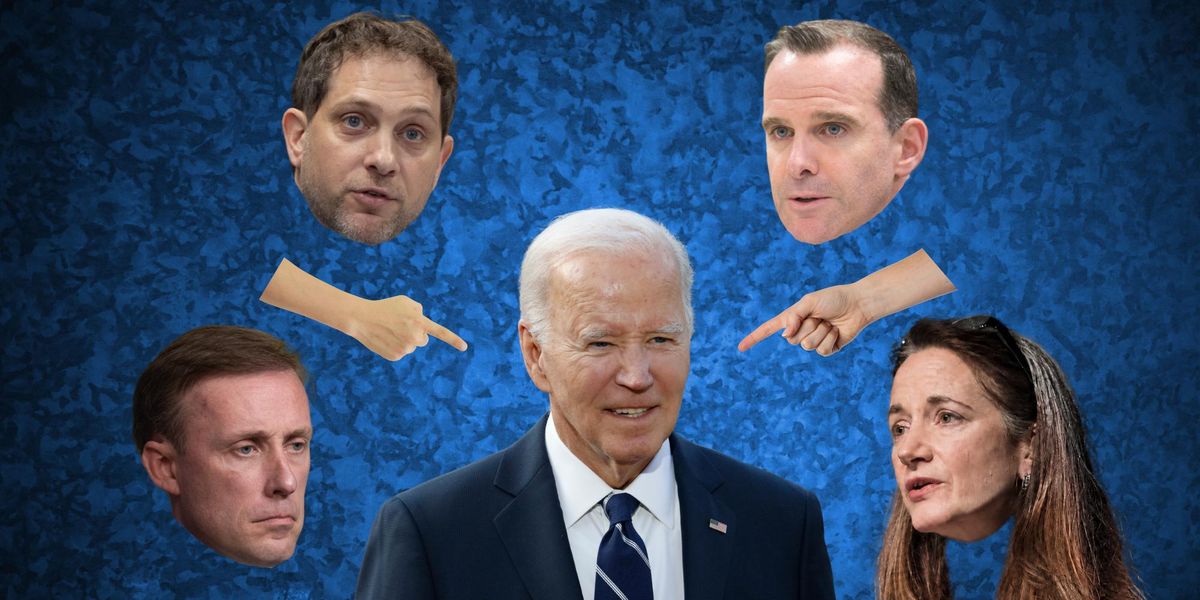
There’s something profoundly human about the scapegoat. From the ancient Israelites and Greeks to the Aztecs, global cultures have long sought to concentrate society’s ills in a single vessel, cleansing the rest of us in the process.Today, the Democratic foreign-policy establishment is looking for a scapegoat of its own. Tainted by the sins of enabling Israeli conduct in Gaza and beyond, many national-security mandarins are seeking absolution by proxy, perhaps in hopes of returning to the halls of power in 2029. Joe Biden has emerged as the bearer of these iniquities. As numerous former Biden administration officials have asked me over the past year, can you really blame the bureaucrats for implementing the whims of an obstinate president?In his new book, “Crossing the Red Line,” journalist Akbar Shahid Ahmed offers the first comprehensive opportunity to evaluate this scapegoating exercise. Across more than 300 pages of excruciating detail, Ahmed narrates the many small decisions that allowed Israel to pursue a campaign numerous scholars and human rights organizations have since deemed a genocide. What emerges is a portrait of fecklessness — a story of an ever-shrinking group of officials who consistently refused to restrain Israel, ignoring the advice of their own experts and the fury of their own party’s voters.As the next presidential election cycle looms, Ahmed’s extraordinary work allows us to ask a thorny question — one that many progressive Democrats are already grappling with: Should anyone who served at the highest levels of the Biden administration ever enter government again? Israel’s War on Terror During a speech in Israel on October 18, 2023, Biden drew parallels with recent American history, describing Hamas’ October 7 attacks as “like 15 9/11s.” The comment was an early example of the “bearhug” strategy that would come to define America’s approach to the war. Biden and his team hoped that, by sympathizing with Israel and rushing to its defense, they could shape the looming invasion of Gaza. Indeed, he used the same speech to warn Israelis against being “consumed” by the rage they felt lest they repeat the “mistakes” of America’s own War on Terror. The administration saw this approach as practical, having concluded that the U.S. would have “no leverage whatsoever” if it pressed Israel too hard early on, one former senior official told Ahmed. But the central flaw of the bearhug soon became clear: with no clear indication the U.S. would ever use its leverage to shape Israel’s campaign, Tel Aviv could focus narrowly on the signals it wanted to obey. And in this case, the Israelis saw only a green light. As Biden publicly counseled a measured response, his administration was privately supporting Israel’s maximalist goals. “Evidence of War on Terror habits quickly emerged,” Ahmed writes. “In conversations with Israeli counterparts, Biden aides encouraged the idea that an offensive in Gaza could end support for Hamas among Palestinians.” Whatever misgivings U.S. officials had about the ensuing campaign, they never wavered in their support for imposing a new political reality in the strip through force. This conviction would in time require a great deal of wilful ignorance about the realities on the ground within Biden’s inner circle, which shrank as Palestinian casualties mounted and criticism of the bearhug grew louder. Among the real decision makers were Secretary of State Antony Blinken; National Security Adviser Jake Sullivan; Deputy National Security Adviser Jon Finer; and Brett McGurk, who led Middle East policy on the National Security Council. The latter may fairly be described as the central villain of Ahmed’s story. A quintessential War on Terror bureaucrat, McGurk had worked in every administration since that of George W. Bush, allowing him to amass enormous bureaucratic power. One senior official described McGurk’s perspective on the war as “this is awful, but they did it to themselves.” McGurk’s central goal throughout the campaign, according to the book, was achieving a Middle East grand bargain whereby Israel would end its Gaza campaign and give the Palestinians a path to a state; Saudi Arabia would normalize diplomatic relations with Israel; and the United States would sign a mutual defense agreement with Saudi Arabia. In pursuit of this goal, he frequently discouraged the idea of publicly pushing Israel toward a ceasefire, in part based on his argument that a negotiated end to the war was just around the corner. Ahmed’s portrayals of Blinken and Sullivan are similarly unsparing. Throughout the war, the influential duo consistently held back attempts to reach formal conclusions about alleged Israeli war crimes. Alongside McGurk, Sullivan privately cast doubt about whether images of starving children in Gaza were real even as numerous international monitors indicated that famine was spreading, Ahmed reports. (A Sullivan spokesperson denied this to Ahmed.) And Blinken consistently empowered officials who were willing to accept Israeli claims that Tel Aviv was doing its best to avoid civilian casualties. Even prominent internal critics found themselves muzzled or sidelined. When USAID Administrator Samantha Power and U.N. Ambassador Linda Thomas-Greenfield spoke out internally against the bearhug policy in December 2023, Sullivan started boxing them out of Gaza-related meetings; chastened, the pair began “pulling their punches” during the meetings they did join, a White House official told Ahmed. As the chorus of criticism grew, the inner circle found itself whittling away at the margins of Israeli policy. McGurk and Sullivan spent time tracking individual aid trucks while shielding Israel from pressure despite U.S. laws banning the provision of military support to countries that impede the delivery of American aid. Finer, who more than any other Bidenista pushed for pauses on weapons shipments and recognizing the suffering of Palestinians, referred frequently to concerns about alienating “pro-Israel forces” in the U.S., Ahmed writes. In April 2024, Israel’s killing of several aid workers affiliated with World Central Kitchen briefly broke this pattern, shocking the conscience of Biden and his team. Sullivan privately told an aid agency representative the U.S. had let Israel “drive drunk,” and the president upbraided Israeli Prime Minister Benjamin Netanyahu, forcing him to open crossings to allow aid into Gaza. But the “bearhug” approach soon returned as the U.S. scrambled military assets to defend Israel from an Iranian attack. Then, the administration quietly allowed Israel to cross the supposed “red line” of invading Rafah, where huge numbers of civilians were sheltering, even though Tel Aviv had developed no plan for protecting innocents. As former Obama administration official Ben Rhodes told Ahmed, "There's something about these jobs where you just don't see the Palestinian kids." See no evil, speak no evil A scapegoat can only work if society is convinced of its guilt. For Biden, the case is easily made: the president was haughty and sure of his expertise on the Middle East, and he showed far more sympathy for Israeli suffering than that of the Palestinians. Biden was, without doubt, the person most responsible for enabling Israel’s slaughter, as Ahmed makes clear. But sins this grave cannot be so easily contained. They spill through Ahmed’s narrative, tarring a broad swathe of officials as they cascade down the bureaucracy. Even as evidence of Israeli crimes grew irrefutable, Biden’s staff worked assiduously to ensure the government produced no formal legal conclusions about Israeli conduct in Gaza that would have required taking specific actions to rein it in. As Ahmed demonstrates, this myopia took careful effort. Arms-sales officials were given authority over evaluating Israeli human rights violations despite their coziness with the Israelis and lack of experience in such work. For much of the war, State Department memos were crafted to avoid requiring Blinken to weigh in on any incident one way or another. A spokesperson for McGurk told Ahmed he had never “received reports of US legal violations.” Yet McGurk and his fellow travelers had not requested such reports, perhaps knowing that they would not like what they heard. The culminating chapters of Ahmed’s book cast a particular pall. After Vice President Kamala Harris lost the election, the administration received intelligence that Israeli officials had started to seriously discuss among themselves whether their brutal campaign had violated international law. The administration called an emergency meeting to evaluate whether American officials had put themselves in legal jeopardy. At several gatherings, officials debated “whether intelligence sharing with the IDF could even continue,” a source told Ahmed. But Director of National Intelligence Avril Haines distanced herself from staffers pressing for an inquiry into this question; in the end, the intelligence community declined to even provide a briefing on the issue. Perhaps most challenging is the fact that most former Biden administration officials have avoided completing the scapegoating exercise. None of the people mentioned here have flatly renounced the Biden administration’s Gaza policy, even if they’ve expressed regret about how it unfolded. Finer argued just this month that resigning would have been “self-serving” and that he couldn’t bear the thought of prejudicing Biden’s reelection chances. Sullivan has continued to insist that the Biden team’s “relentless work” had a real impact on Israeli policy. While many former senior officials are happy to pin the blame on Biden in off-the-record conversations, none have made a full-throated version of that argument for the public. Hence the futility of this scapegoating effort. The herd mentality of the foreign-policy “blob” strongly incentivizes a tribal approach; war crimes are bad, sure, but bad-mouthing your colleagues is worse. So far, these former officials have had little reason to question this approach. Sullivan and Finer now co-host a Vox podcast and hold coveted positions at Ivy League universities. McGurk is an on-air personality for CNN. Just this week, Haines took over as the president of the Carnegie Endowment, one of Washington’s most influential think tanks. Still, with the battle for 2028 on the horizon, activists are looking to break this old-boys’ network. One effort, called “Drop the Genocide 20,” urges Washington institutions and any future administrations to box out the 20 officials “most responsible for promoting, lying about, and covering up the Gaza genocide in the Biden White House.” Every official noted in this article is on the list; Ahmed’s book will provide further ammunition to back up such initiatives. Ultimately, voters will decide. Those who read Ahmed’s book may have more sympathy for, say, the anguished Power or Finer than for the relatively unrepentant Sullivan or McGurk. But one thing is certain: there is more than enough guilt to go around.
Ex-Biden officials are desperate for a Gaza scapegoat
Full Article
Original Source
Read the full article at Responsiblestatecraft →KhanList aggregates and links to publicly available news content. We do not host full articles from third-party sources. Always verify important information with original sources.