
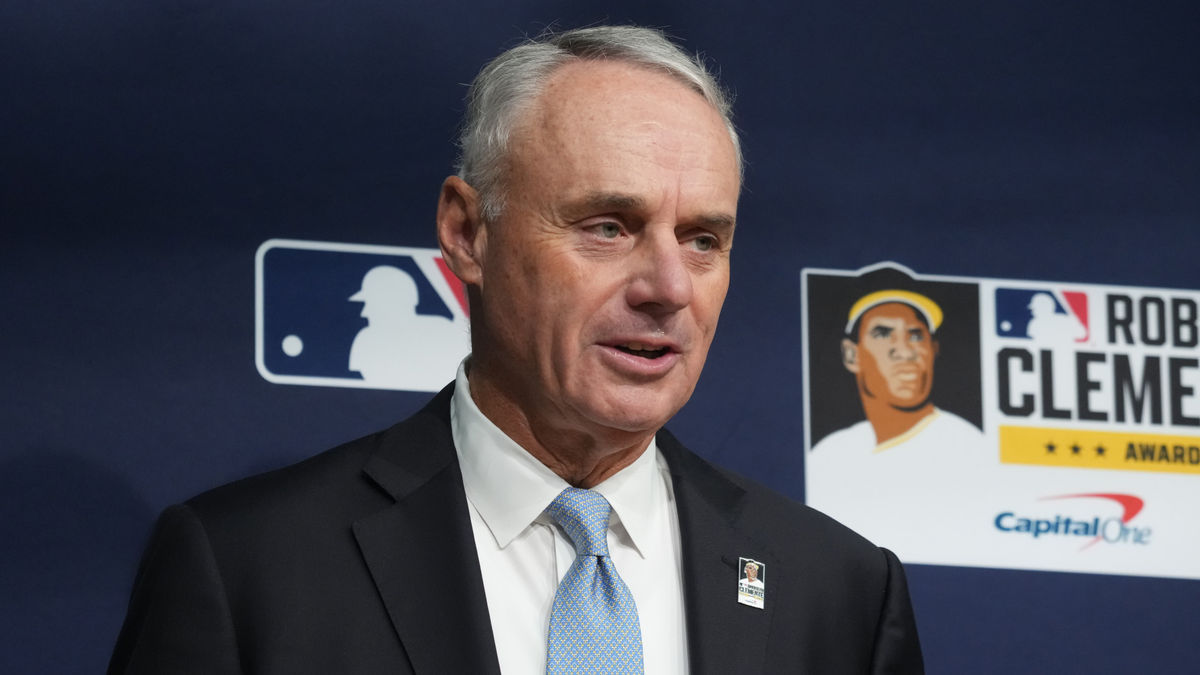
Oct 27, 2025; Los Angeles, California, USA; Major League Baseball commissioner Rob Manfred before game three of the 2025 MLB World Series between the Toronto Blue Jays and Los Angeles Dodgers at Dodger Stadium. Mandatory Credit: Kirby Lee-Imagn Images There are still almost three full days until the collective bargaining agreement between Major League Baseball’s owners and players expires Tuesday night at 11:59 PM EST.So there’s technically almost three full days for Rob Manfred to be visited by the ghosts of baseball work stoppages past and to come to his sense instead of locking out the players and plunging the sport into what could be the sport’s longest and most destructive pause since 1994.But this is real life, not a Christmas movie. And even if Manfred, the only person in America who doesn’t like Thanksgiving, was visited by the ghosts of baseball work stoppages past, he’d probably call for an exorcist instead of heeding their advice.Make no mistake, this lockout is happening, and it could get really messy and really lengthy. How messy and how lengthy? Here’s our view of just how messy and lengthy it could become — and what’s really at the core of the lockout.1.) Why is the lockout happening?Owners will tell you it’s because their carefully curated polling indicates fans believe there’s a giant competitive balance problem and the only solution is a salary cap. Weird how owners never poll fans on what they think of how much it costs to take the family to the ballpark once or twice a season!Anyway, MLB remains the only major North American pro sports league without a salary cap. But baseball’s had more champions this century (17) than the NHL (14), NFL (13) and NBA (13).And over the last 10 years, 28 out of 30 MLB teams — everyone except the forever woeful Los Angeles Angels and Pittsburgh Pirates — have made the playoffs. That’s right in line with the percentages of playoff teams over the last 10 years in the NFL (31 out of 32, LOL New York Jets), NBA (29 out of 30, sorry Charlotte Hornets) and NHL (32 out of 33, what happened to the Detroit Red Wings?).What this really comes down to is franchise values. And without a cap, baseball owners are forced to settle for presiding over billion dollar enterprises that don’t increase in value nearly as fast as NFL, NBA and NHL teams.Per Sportico, the New York Yankees are the most valuable franchise in MLB at $9.4 billion, up from just over $7 billion in 2022. But over that same period of time, the most valuable franchise in the other major sports have basically doubled in value.The NFL’s Dallas Cowboys are worth $15.5 billion in 2026, up from $7.64 billion in 2022. The NBA’s Golden State Warriors are worth $14.5 billion, up from $7.56 billion in 2022. And the NHL’s Toronto Maple Leafs are worth $4.25 billion, up from $2.12 billion in 2022.Most of us would be content going from $7 billion to $9 billion, but that’s not how you become the owner of a sports team. Better start running a bake sale for Hal Steinbrenner!2.) How messy will this get?It’s already messy, as evidenced by Manfred doubling down on his Thanksgiving stinks mantra on Wednesday, when the owners sued the MLBPA in an attempt to prevent the union from decertifying during the lockout.The Bryce Harper “hold me back bro” story about him supposedly telling Manfred to get the (heck) out of the Philadelphia Phillies clubhouse if he was going to start talking about a salary cap during a 2025 meeting is both peak silly Harper-ness as well as symbolic of the pride players take in being part of the only sports union that’s fended off a salary cap.But this is the first time owners have pushed for a cap in CBA negotiations since 1994, when the players’ strike lasted 232 days, led to the cancellation of the World Series and nearly resulted in the 1995 season starting with replacement players before the National Labor Relations Board issued an unfair labor practices complaint against owners.It’s worth noting that the NLRB is much likelier to be friendlier to owners than it was in 1994-95. Manfred also said that quiet part out loud earlier this month.Both sides are entrenched in their beliefs and openly contemptuous of the other. There will be lots of invective fired back and forth and lots of billable hours piled up for however long this lasts.3.) So how long will this last?Your guess is as good as ours. One thing is certain: A 99-day lockout, as was the case following the 2021 season, is the best-case scenario here.Nothing much is going to get done for months once the lockout begins on Wednesday morning. While both sides are more willing to miss games than they’ve been since 1994, nobody is going to feel any pressure to negotiate until spring training is endangered and the cancellation of games begins to feel imminent.If the sides can’t hammer out a CBA by early March — thereby allowing for something resembling a full spring training followed by a full 162-game season — then the season will come down to whether or not an agreement can be reached by late April, which would allow a schedule of at least 102 games to begin in late May or early June.Why at least 102 games? Because baseball’s current television deals will all toll for an additional season if each team misses at least 60 games and Manfred wants to renegotiate those deals for the 2029 campaign.This is the best card in the players’ deck. But what if Manfred and the owners are willing to blow it all up to get the landscape they’ve always desired?It would be a disastrous outcome, but one of the perks of being a billionaire is being able to tank an entire season or more without feeling too much of a pinch — especially now that private equity has wormed its way into ownership groups around the sport.If Manfred and the owners are really salary cap or bust, this lockout will last well into 2028 — and ensure these work stoppage ghosts are far more demonic and haunting than any of their predecessors.
Everything To Know Ahead of the 2026-27 MLB Lockout
Full Article
Original Source
Read the full article at Deadspin →KhanList aggregates and links to publicly available news content. We do not host full articles from third-party sources. Always verify important information with original sources.