
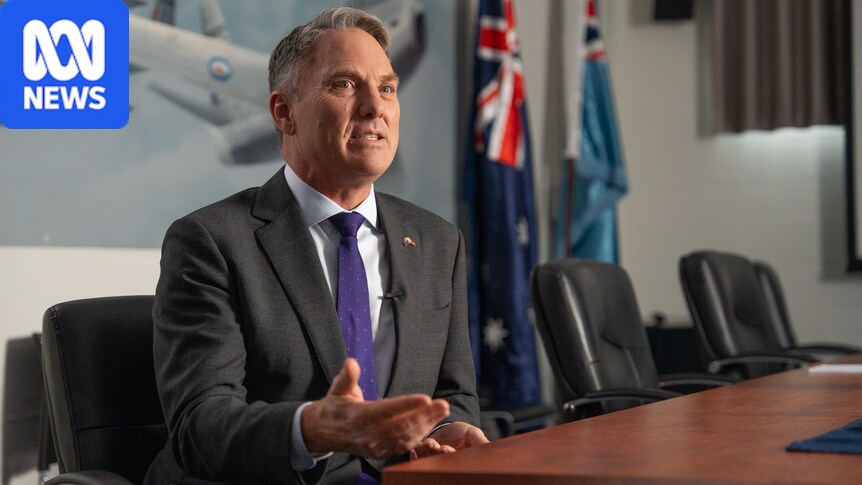
If there has been an underlying theme in global politics in the past 18 months it has surrounded the lack of reliability of the United States as an alliance partner, or more recently, the cost of having such an alliance with the US.As Donald Trump has led his country away from its alliances and into a war which has made the majority of its allies in the Middle East vulnerable Iranian targets, countries around the world have been left scurrying to re-evaluate their needs and their friendships.Except Australia.No one inside federal politics seems particularly interested in discussing the large orange elephant in the room and how it is materially changing every other country's views of the world.Donald Trump has led his country away from its alliances and into a war which has made the majority of its allies in the Middle East vulnerable Iranian targets. (Reuters: Evelyn Hockstein)Two major conflicts mergeThere is an increasing unease in the Northern Hemisphere about how the Ukraine and Gulf conflicts seem to be slowly melding into each other, particularly as the links between Iran and Russia seem to expand, and stories of their deep technological cooperation on weapons continue to appear.In Europe, there is growing consternation about Russian incursions into European airspace, into drone attacks in Germany and Poland, and into European political campaigns.This weekend, the German state of Saxony-Anhalt goes to the polls, amid allegations of heavy Russian interference in an area which was once part of East Germany and where the far right AfD party is predicted to win a huge majority.The implications of this result for the government led by German Chancellor Friedrich Merz, and for the balance of policies in Germany, is significant.The AfD is hostile to Ukraine and supportive of Russia. The result will intensify pressure on Merz to back away from Germany's current support for Ukraine, which of course wouldn't so matter so much if European states weren't already trying to make up for the withdrawal of US support for Ukraine.The German state of Saxony-Anhalt goes to the polls this weekend, amid allegations of heavy Russian interference in an area which was once part of East Germany and where the far right AfD party is predicted to win a huge majority. (Reuters: Thilo Schmuelgen)Europe, the Middle East, the Baltics, the subcontinent, South East Asia, North Asia — they are all pragmatically reorganising themselves to deal with the growing absence of the US.But not Australia.Instead, our deputy prime minister and defence minister Richard Marles turned up in Washington this week, beaming like a kid in a lolly shop next to defence secretary Peter Hegseth, announcing that the US was going to be escalating even further its military presence in Australia.Marles' spin on AUKUSAustralia and the US, along with the United Kingdom are now operating under the AUKUS alliance. The most notable aspect of that alliance agreement was supposed to be the transfer from the US to Australia of (initially) some US nuclear-powered submarines and (later) the technology to build a new nuclear-powered submarine class, the SSN AUKUS, in Australia in conjunction with building in the UK.But in Washington this week Marles put a different spin on what "making real progress in relation to AUKUS" now means.That is, AUKUS is, not altogether surprisingly, morphing into an arrangement where the US has a base in Australia, as opposed to Australia having its own capabilities.The Perth submarine presence is in addition to the annual rotation of US Marines through Darwin, and the significant US presence at the Tindall air base in the Northern Territory which is speculated to host nuclear-armed B52 bombers.Pete Hegseth and Richard Marles met at the Pentagon this week. (Reuters: Kylie Cooper)Marles was asked why any US president would agree to give Australia a valuable asset like a submarine when "America simply can't produce as many of as it wants to"."Because what AUKUS is doing is providing more sea days for the Virginia class fleet for the United States Navy, and more sea days' worth than a single submarine," he replied. (Emphasis added.)"The establishment of the Submarine Rotation Force West at HMAS Stirling, as well as the establishment of the Henderson Defence Precinct offers the opportunity for US Navy submarines to undergo maintenance much closer to their critical area of operation, which creates sea days for the United States Navy, and that's ultimately why this is such an important agreement from the United States point of view."Australia, Marles said, was facing "as significant a sovereignty moment" as it has faced since the end of the Second World War.But the threat to our sovereignty, according to Marles, doesn't come from passively agreeing to become an even bigger military base for another country, but from the country perceived to be the greatest threat to us: China.A three-way split on China in the USAt the global level, with all the noise being generated by the conflicts in the Middle East and Ukraine, analysts occasionally look aside to mutter with uncertainty about what role China is playing in either of these conflicts, or what it may win or lose from them.One thing it has 'lost' is a significant slab of the US military presence off its coastline as the US has had to move an aircraft carrier and significant personnel and armaments from the region to the Middle East.That's certainly made Taiwan, Japan and South Korea nervous.But there seems to currently be a three-way split in the assessment of China in the US, a point highlighted by former prime minister Paul Keating this week in an appearance in Sydney with the author of a new book about Keating and foreign policy, Professor James Curran.The split breaks between the Trump view of the world, the US intelligence community's view of the world, and the US defence establishment's view of the world.Former prime minister Paul Keating describes Trump's view of the world as basically being akin to that of the American mafia. (AAP: Darren England)Keating describes Trump's view of the world (the US, China and Russia) as basically being akin to that of the American mafia. The New York mafia doesn't interfere with the Chicago mafia and neither interfere with the Florida mafia.Trump's mafia view lines up with Keating's continuing belief in the "great powers" view of the world. Which in turn is partly driven by a pragmatic assessment about numbers; numbers of weapon, armed forces, and manufacturing capabilities.But according to Keating the important point of it is that Trump does not want to go to war with China.Chinese leaders seek to reduce tensionKeating sees the US push for bases in Australia as one that comes primarily from the US defence establishment, rather than its political establishment, and argues the history of this goes back to the time when in a Eurocentric US, "policy in the Pacific was run by the Navy out of Honolulu".But the former PM highlighted another, and very different China assessment. This is that the US intelligence community doesn't see China as a risk.Keating pointed to the 2026 Annual Threat Assessment of the US Intelligence Community, published in March this year.In its China Strategic Overview, the assessment says "President Xi and his government aim to achieve 'the great rejuvenation of the Chinese nation' by 2049"."China will seek to increase its power and influence to shape its region and world events; create an environment favourable to Chinese interests; overcome perceived containment efforts by the US; secure its freedom of movement at sea; reduce US military presence and operations on its periphery; and fend off challenges to its reputation, legitimacy, and capabilities at home and abroad," it says. But significantly, the review, which summarises the views of 18 US intelligence agencies including the CIA, defence intelligence and national security agencies, says: "China also sees benefits to and is prioritising a productive, stable economic relationship with the US, as evinced by its approach to the Busan Agreement with the Trump administration"."Beijing has been deeply suspicious of Washington's intentions and has long viewed the US as pursuing a coordinated effort to contain China's development and rise, undermine Chinese Communist Party (CCP) rule, and prevent the country from achieving its aims," it says.But "at the same time, Chinese leaders will seek to reduce tension with Washington when they believe that such efforts benefit Beijing, protect China's core interests, and buy time to strengthen its position".Australia confused about its placeKeating observed: "Now, this doesn't sound like a wartime power. This is the US time view of them, right? This is the official US view for the Congress this year"."Of course, the absurdity of the American position is, they are a naval power," he continued."It's 10,000 kilometres from San Diego to the Chinese coast. There they meet a continental power with four times the population and a bigger economy and a bigger navy."But don't worry, you're gonna dust them off and put them in their place. And we're going along.""They're gonna show the Chinese who's in charge, you see?"What we want to see is an Asia where the two great powers coexist. The United States as the balancing power: we can all support that."But what we can't support is the American trying to contain China, ... with their base, 10,000 kilometres away in San Diego ... A military exchange between the Chinese and the Americans and East Asia would last about five days. It'll be all over."Given Taiwan has always been seen as the flashpoint for such a conflict, it's worth noting the US intelligence community assessment notes that China "prefers to achieve unification without the use of force, if possible"."The IC assesses that Chinese leaders do not currently plan to execute an invasion of Taiwan in 2027, nor do they have a fixed timeline for achieving unification."Chinese officials recognise that an amphibious invasion of Taiwan would be extremely challenging and carry a high risk of failure, especially in the event of US intervention."The world is a particularly confusing place just now. But no one seems more confused about their place in it than Australia.Laura Tingle is the ABC's Global Affairs Editor.
Everyone but Australia reconsiders relationship with America
Full Article
Original Source
Read the full article at Abc →KhanList aggregates and links to publicly available news content. We do not host full articles from third-party sources. Always verify important information with original sources.