
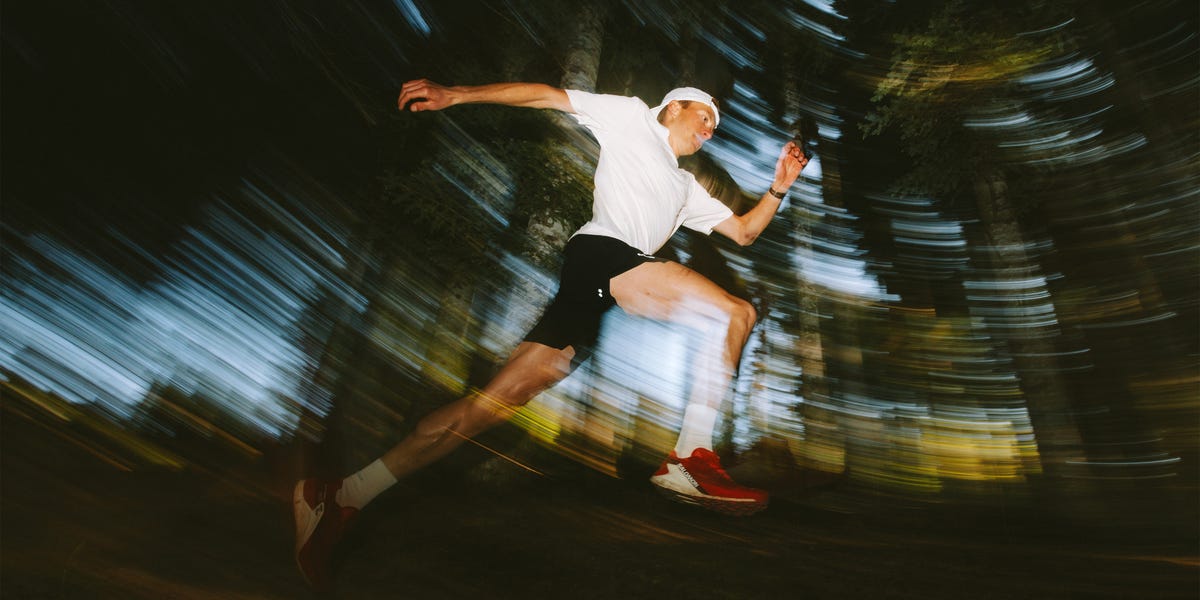
Our product picks are editor-tested, expert-approved. We may earn a commission through links on our site. Why Trust Us?Titouan Bessire4 min readWHETHER THE PAVEMENT PR was getting old or the gauntlet of rugged terrain and varying verticals called, or you just wanted more nature, everybody is running trails now. More than a million more people were doing it last year than the year before—that’s up 9.8 million since 2019. For many runners, the unplugged vibe, the great wide open, and the way the trail demands your focus and attention transform what was once a workout into a way of life. Even Swiss trail star star and Tudor ambassador Rémi Bonnet (pictured above) hasn’t lost touch with the intense lure of the trail. “It’s not that I like winning races or breaking records. What makes me happy is that I like mountains,” he says. Let today’s top coaches and athletes help you find your footing.Rethink PaceYOU’RE GOING TO run at least a minute or two slower on trails than the road. “It really bugged me how much slower my paces were [on the trail],” says trail running pro Caleb Olson, who just finished 3rd at UTMB. To take the stress out of pace, change your watch’s main data screen to show heart rate on interval days. For long run days, Olson just does “a sanity check” to be sure his heart rate data coincides with how the run felt.If you do check pace, let go of old numbers. “I think the biggest waste of training time is trying to maintain the same speed on trails as you do on the roads, and pushing on trails in parts of the trail that are just not as fast,” says ultradistance pro Michael Wardian, who talked to us from a two-month adventure run on the Pacific Crest Trail. A lot of great trail running is actually walking. When the gradient is steep, it’s actually more efficient to walk. Embrace that.Let the Trail Guide YouWHICH REALLY MEANS focusing on cadence, or the number of steps you’re taking per minute. “When [the trail] is more technical, my cadence goes up,” Olson says. Same on downhills. “I try to have quick, quiet feet and not take big committing steps.” Also important: building confidence in where you want your feet to land by seeing what Wardian calls “lines” in the terrain—basically, you look a bit ahead and mentally clock the smartest way through the trail.Get the Uphill Work inNOT ONLY ARE uphills lighter on your body, they train strength. If you don’t have a lot of hills in your area, a treadmill at a steep grade (Olson takes it up to 25 or 30 percent) or a stair climber can work. Downhill is also important, Olson says, “but it exposes you to a lot of injury risk, whether that’s tripping or putting a huge load on your bones and muscles.” Even on a modest 9 percent decline, your quads get hammered and every foot strike takes on as much as six times your body weight. The best way to master the ups and downs on trails is to run trails (surprise), and go slow. “To really work all the little stabilizer muscles that you’re specifically going to need for trail running, it’s really hard to beat hours out on those trails using those muscles,” says Olson.Kyle LaFerriereMichael Wardian has tackled all kinds of trails, including a 2600-mile Pacific Crest Trail adventure this year.Downshift to Lower ZonesDEPRIORITIZE YOUR V02 max as a training goal. “V02 max has a relatively poor correlation with endurance performance. People don’t recognize that VO2 max is an effect of performance, it’s not the cause of [it],” says Scott Johnston, who’s coached trail pros at Evoke Endurance.Running economy and your speed at the lactate threshold are much better predictors of performance. In lieu of VO2 max-building workouts, run just under lactate threshold—that’s the place where you cross over from a hard effort to one you can only sustain for 2 to 4 minutes. Think of it as the border of Zones 4 and 5. “You don’t go full gas,” Bonnet says. “This allows you to be able to do more intensity in the week without tiring your body.” And focus on form: Reducing wasted movements (like energy lost from an unstable core) improves running economy, which also helps performance. “If you don’t have good form running, it’s for nothing to have a high VO2 max,” Bonnet says.Outsmart Fatigue “WHILE THE CARDIOVASCULAR system is very important, it isn’t the limitation to people’s performance,” says Johnston. “The single biggest limiter is the fatigue in the muscles that are propelling you.” Trail races aren’t won by the runners who go the fastest; the ones on the podium are the ones who slow down the least. Typically, people’s paces fade about 30 percent from start to finish. They don’t have to: 2025 UTMB winner Ruth Croft—coached by Johnston—slowed just 17 percent.Build fatigue resistance with muscular endurance training. Put on a weighted backpack and hike steep uphills (if you have to come back down, use water as the weight and dump it at the top) or do weighted climbs via a stair machine. In the gym, target the primary propelling muscles: glutes, hamstrings, and especially the quads. Johnston recommends training eccentric muscle contractions with split jump squats, and work in step-ups and forward lunges. Start with body weight alone. Aim for high reps (6 sets of 10), and don’t go to failure in every set. Rest one minute between sets; each week, decrease recovery by a bit so it becomes an endurance workout (over about 14 weeks, you’re down to 10 seconds between sets).Fatigue-resistance training puts a lot more stress on your body than you think, Johnston says, so keep it to once a week—and that once shouldn’t be the day before your interval or long run day. “If you’re not improving from week to week, it’s not because the training’s not working,” he says. “You’re just not recovering well.”Trail Running GearMarty Munson, currently the health director of Men's Health, has been a health editor at properties including Marie Claire, Prevention, Shape and RealAge. She's also certified as a swim and triathlon coach.
Everybody’s Trail Running Now. Use These Expert Tips to Get Wild.
Full Article
Original Source
Read the full article at Menshealth →KhanList aggregates and links to publicly available news content. We do not host full articles from third-party sources. Always verify important information with original sources.