
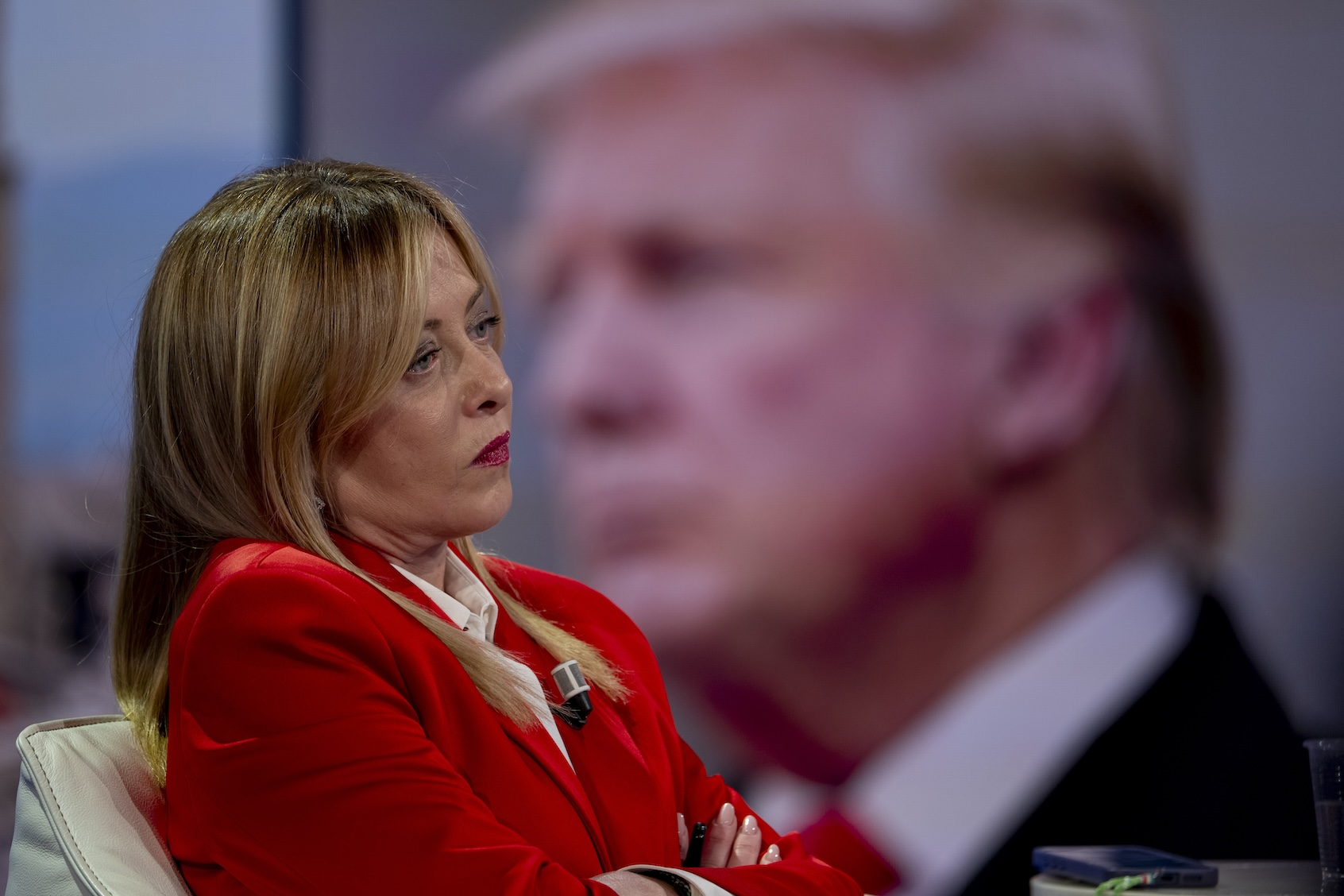
commentary So much for the transatlantic MAGA bromance. Europe's anti-immigrant, quasi-fascist parties are ready to move on Published October 19, 2026 6:30AM (EDT) A photo of Donald Trump is displayed as Italian Prime Minister Giorgia Meloni appears on the TV program "Porta a Porta," Jan. 21, 2026, in Rome. (Antonio Masiello/Getty Images) When Donald Trump returned to the White House in 2025, he seemed like the leader, or at least the dominant figure, of a globalized version of the MAGA movement, a worldwide network of far-right parties sometimes described as the “nationalist international.” We can make a long list, starting with Nigel Farage’s Reform UK, Marine Le Pen’s National Rally in France, the not-quite-neo-Nazi Alternative for Germany, or AfD, and Giorgia Meloni’s Brothers of Italy, along with other previously-fringe parties now creeping toward the mainstream in many different places. If it strikes you that the term “nationalist international” contains its own contradiction, by the way, you’re miles ahead of JD Vance and Stephen Miller and the rest of the Trumpian pseudo-intellectuals, who still haven’t figured that out. That vision of a MAGA-centric new world order was always an illusion, although it began with some fragments of plausibility and was enormously amplified by the Trump distortion effect, meaning our president’s uncanny ability to soak up media attention and make himself the main character of every narrative. Now that illusion has melted away like an ice cube in Europe’s catastrophic summer (where I personally experienced a 104℉/40℃ day in Berlin, the highest recorded temperature in that city’s history). Indeed, the world now faces another apparent contradiction, or at least a historical irony. If Trump still looms over the American landscape like an unkillable ogre in a third-rate AI fairytale, he is all but finished as a political force. He has done more damage to his own country than anyone since Jefferson Davis, his disillusioned supporters are deserting him, he is universally despised around the world and he’s headed for a potentially historic electoral defeat in November. Europe’s far right, on the other hand, is doing fine without him. It’s about a 50/50 proposition that by the end of this decade the four largest nations in Europe will be governed by right-wing populist parties. All of them at some time sought inspiration and financial support from Trump and his Mar-a-Lago hangers-on, and pretty nearly all of them have now ghosted him entirely, and pretend they never really knew the guy: “Neues Handy, wer bist du?” Trump’s second term began with a triumphal sense that a hard-right “vibe shift” was transforming not just America but the world (which Americans are always ready to perceive as a picturesque but unreliable subsidiary). Those early months of 2025 were undeniably terrifying and inordinately destructive, but they were also ridiculous. In retrospect, from half a tick into the future, those guys were immeasurably high on their own supply, based on a narrow electoral victory over incompetent and disorganized opposition. Early in Trump’s second term, Vance, Marco Rubio, Elon Musk and others were dispatched to various world capitals to urge support for right-wing candidates or to deliver preposterous blood-and-soil history lessons straight out of wingnut “Great Books” podcasts. As part of that extended touchdown dance, Vance, Marco Rubio, Elon Musk and others were dispatched to various world capitals to urge support for right-wing causes and candidates, or to deliver preposterous blood-and-soil history lessons straight out of wingnut “Great Books” podcasts. That tendency culminated in the now-legendary 2025 National Security Strategy, a document that offers most presidential administrations a chance to deliver boilerplate language about shared values, human rights and democracy. Not this time. As I wrote last year, the NSS featured a poisonous combination of “Great Replacement-fueled fanboy enthusiasm for far-right parties” and “unhinged and unconcealed racist panic.” Europe was losing its cultural identity, the document warned, and faced the “stark prospect of civilizational erasure” as well as the (entirely imaginary) possibility that “certain NATO members will become majority non-European.” That was one of many vainglorious MAGA failures to read the room, on an international scale. Right-wing European politicians traffic in similar rhetoric, to be sure. But nobody on that continent, of any dispensation, enjoys receiving arrogant lectures on history and civilization from Americans, and even extremist parties like Reform UK or the AfD prefer to cloak the bigotry in layers of euphemisms and some degree of plausible deniability. In a long and painful video interview with Economist editor Zanny Minton Beddoes published this past week, for instance, AfD co-leader Alice Weidel professed horror and amazement when asked whether her party contains overtly racist or proto-fascist elements. As Weidel took pains to point out, she is married to a Swiss woman of Sri Lankan ancestry, which presumably cleanses her of any bad intentions when she rejects “gender theory” or insists that all the Syrians and Afghans now living in Germany must leave. That interview is an instructive experience in other ways. Beddoes repeatedly asks Weidel why she can’t just be a normal budget-cutting conservative, of a variety less frightening to readers of The Economist. Oh, but she absolutely is, Weidel insists, lulling her interlocutor for a while with prodigiously dull business-school chatter before returning to her central theme: Germany’s financial woes will be cured, somehow, by expelling the Muslims. To return to our main theme, Weidel mentions Trump only twice, with evident distaste, in that hour-long conversation. That’s not exactly news at this point. By the time the above-mentioned NSS was published last December, Europe’s far-right populists had already reached the conclusion that Trump was a loser. Or, in the more delicate phrasing of Armida van Rij in the newsletter Strategic Europe, that “Trump’s repeated threats to invade Greenland, his attacks on the pope and Italian Prime Minister Giorgia Meloni, and his trade war on the EU have made the friendship electorally costly.” That became obvious to the entire world last April, when MAGA darling Viktor Orbán was routed in Hungary’s election after JD Vance’s campaign visit provided the “political kiss of death,” in the words of Daniel Hegedüs of the Institute for European Policy in Berlin. That was the same month, as it happens, when Meloni publicly broke with Trump over the latter’s criticisms of Pope Leo XIV. But Marc Bassets of the Spanish newspaper El País identifies the real turning point a full year earlier, in the Canadian elections of April 2025, when Trump’s threats and mockery drove mainstream liberal Mark Carney to an unexpected victory over a MAGA-friendly opponent who seemed to hold the advantage. That result, coming just three months into Trump’s term, “became an example closely watched in Europe,” Bassets writes, which was replayed in several subsequent elections. Then came Trump’s threatened annexation of Greenland, his raid on Venezuela and his disastrous war with Iran, all of which were blatant violations of national sovereignty, the core principle of Europe’s new right. Like Trump’s capricious tariff war and his public feuds with Meloni and the pope, this reflected the president’s profound ignorance about the world and a fundamental mismatch between the grandiose neo-imperialism of MAGA foreign policy and a European far right that “increasingly presents itself as a rebellion against Americanization” and wants no part of world maps plastered with the Stars and Stripes or arbitrarily renamed bodies of water. All of this reflects a fundamental mismatch between the grandiose neo-imperialism of MAGA foreign policy and a European far right that “increasingly presents itself as a rebellion against Americanization” and wants no part of world maps plastered with the Stars and Stripes. That quotation comes from Robert Benson of the centrist think tank Center for American Progress, who argues that the Trump administration “has mistaken cultural affinity for strategic alignment” in empowering political parties like the AfD that may “share mutual enemies” with MAGA — such as multiculturalism, racial justice, LGBTQ rights and climate policy — but “do not share American interests, or even the interests of this administration.” As Europe’s far-right leaders draw closer to holding power (or already do, as in Meloni’s case), Trump’s support “appears almost as a liability,” as Dominique Moïsi of the Paris think tank Institut Montaigne tells El País. Trump has long been massively unpopular among European voters across the political spectrum, and his approval ratings cratered to new lows after the Iran war drove energy prices into the stratosphere. Across Europe, the U.S. is now viewed less favorably than either Russia or China, a remarkable accomplishment whose long-term effects are impossible to calculate. In France, Marine Le Pen is focused on winning next year’s presidential election and has conspicuously avoided saying Trump’s name throughout his second term. She leaves that to her deputy and potential future prime minister, Jordan Bardella, who has repeatedly castigated Trump’s “totally erratic” war with Iran: “No one can say what the ideological backbone of this war is, a war whose end seems nowhere in sight.” Meloni recently became the longest-serving Italian prime minister since World War II — an extraordinary fact in itself — and over her four years in office has gone from “Trump whisperer” to the evident conclusion that Trump is a “toxic asset,” in Bassets’ phrase. (The “Trump whisperer” label has also been affixed to former British Prime Minister Keir Starmer and current German Chancellor Friedrich Merz, with dire political consequences.) Want more sharp takes on politics? Sign up for our free newsletter, Standing Room Only by Amanda Marcotte, also a weekly show on YouTube or wherever you get your podcasts. Even the AfD, despite its aforementioned “cultural affinity” with MAGA and a mutual eagerness to throw Ukraine overboard and make nice with Vladimir Putin, has evidently concluded that glowing endorsements from the likes of Musk, Vance and Rubio are a mixed blessing when the U.S. “has become so unpopular in Europe that being close to Trump is not a source of legitimacy,” in Moïsi’s words. Weidel has reportedly described the Iran war as a “catastrophe” in private meetings, while Björn Höcke, the most inflammatory figure on the AfD’s right flank, has mocked mainstream politicians as “German-speaking Americans” and demanded the withdrawal of U.S. troops from German soil. All of this points us toward the inescapable conclusion that Donald Trump was never the leader of anything. He was an empty vessel into which hundreds of millions of people in America and around the world poured their confusion, rage and desire. He became a global symbol of the failure of liberal democracy, but was not the reason for it. As he fades from the scene, the global crisis he came to represent is more urgent than ever. Donald Trump was never the leader of anything. He was an empty vessel into which hundreds of millions of people in America and around the world poured their confusion, rage and desire. He was a global symbol of the failure of liberal democracy, not the reason for it. As Italian journalist Mattia Ferraresi recently observed in a New York Times panel discussion, “Mainstream liberal politics, in both its left- and right-wing versions, failed to deliver on its promises, not only in terms of welfare and economic growth but also in the more complex realm of identity and meaning.” What we see around the world today, in the ascendant far right and in a newly radicalized generation of young people from Paris to New York, are “expressions of the same disillusionment with liberalism and its policies.” It has become almost irresistible to compare this era to the 1930s, when “bourgeois democracy” collapsed in Europe, plunging the world into murderous darkness. If the parallels are clear enough, the world is a very different place in this century and the outcome does not have to be the same. The future remains unwritten, and Donald Trump will not be its author. Related Topics ------------------------------------------ Related Articles
Even Europe’s far right is ready to dump Trump
Full Article
Original Source
Read the full article at Salon →KhanList aggregates and links to publicly available news content. We do not host full articles from third-party sources. Always verify important information with original sources.