
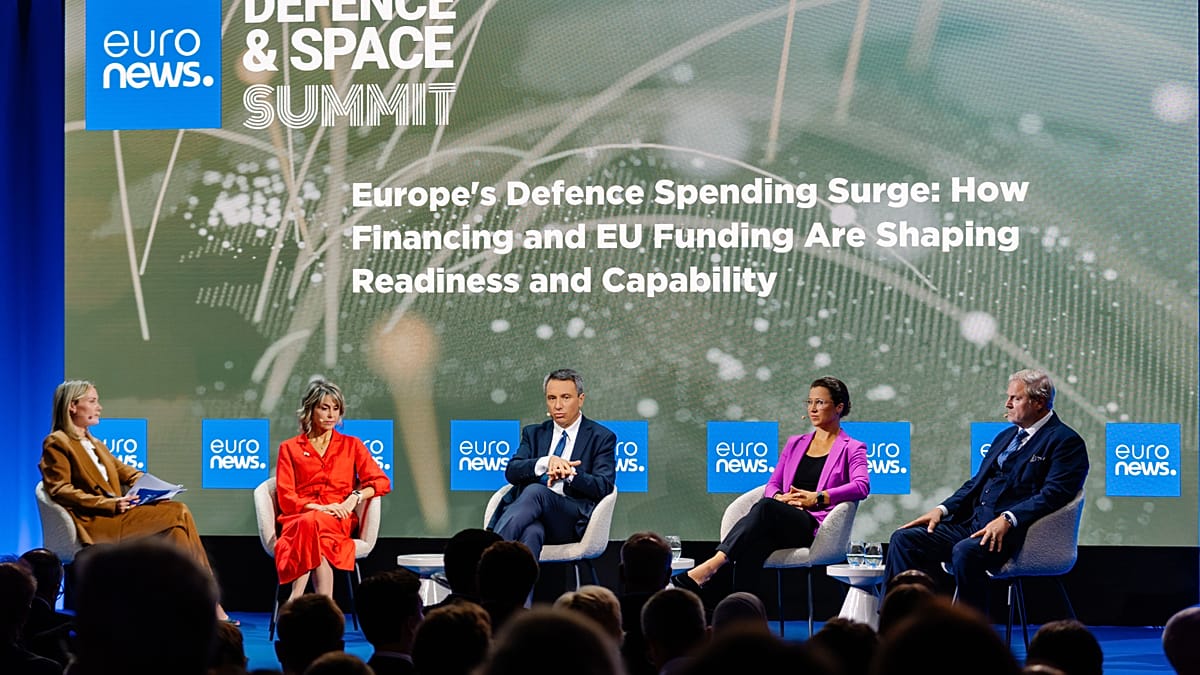
The European defence industry is not ready to produce what is needed to support Ukraine and replenish EU countries’ military stocks, according to Riho Terras, a senior European People’s Party MEP and former general in the Estonian Army. ADVERTISEMENT ADVERTISEMENT Terras argues that EU member states should buy the best and cheapest capabilities, regardless of their origin, pushing back against supporters of a “Made in Europe” strategy for defence procurement. “The European industry is not yet ready to produce in the numbers, in the speed, and in the quality which is needed for our armed forces to speed up quickly the capabilities,” he said on Wednesday during a debate on the surge in defence spending at the Euronews Defence & Space Summit. The debate, moderated by Euronews’s Shona Murray, also featured Greens/EFA MEP Hannah Neumann, Camille Grand, secretary-general of the Aerospace, Security and Defence Industries Association of Europe (ASD Europe), and Lorena Boix Alonso, deputy director-general of the European Commission’s department for defence industry. All participants agreed on the need to spend more on defence, and to do so in a more coordinated way. But they diverged on how to reach the target of raising defence spending to 5% of GDP, agreed by NATO last year. Grand argued that European industry faces “multiple tasks at the same time”, from supporting Ukraine and rebuilding military stocks to driving innovation, while decades of underspending have created a gap in military capacity. “If Germany had been at 2% [of defence expenditure] in the past 20 years, it would have spent 400 billion more,” he said, arguing that the EU now has a critical role to play in reducing countries’ dependence on US manufacturers. The European Commission’s “Readiness 2030” plan, presented last year, backs production of strategic equipment such as air and missile defence, artillery systems, missiles, ammunition and anti-drone systems, with a €150 billion loan package. The package includes a “Made in Europe” provision requiring at least 65% of military components eligible for funding to be European. However, EU countries remain divided over how to define “Made in Europe” in other industrial legislation, amid warnings from the US that such rules could alienate NATO allies. According to MEP Neumann, the EU must focus on building its own defence industrial capacity in the medium term, particularly by prioritising cross-border projects and developing a common strategy. “If 27 member states try to do something, maybe even to the best of their ideas, we will just not have the big puzzle that we need,” she said, arguing that either countries defend the European project together or “there is not going to be a European project” anymore. “People do not believe a threat is imminent” Another sticking point in the debate was the challenge of convincing European public opinion to support higher defence spending. For MEP Terras, the main problem is that people in Europe do not believe a threat from Russia is imminent. “People in Spain do not believe it,” he said, pointing to differences in the perception of danger between northern and southern EU countries and criticising the Spanish government’s refusal to raise defence spending to 5% of GDP. MEP Neumann called for the funding of the defence industry to be made more acceptable to European citizens through a fair discussion with their representatives. “If defence companies make huge benefits, I am not sure this is the best [way to invest] taxpayer money,” she said, arguing that profits made by the sector in recent years are disproportionate. “We need to find a different approach. If we don't find it, then we will have to talk about a windfall tax for defence companies,” she said.
Europe’s defence industry ‘not ready’ for rearmament push, Estonian MEP warns
Full Article
Original Source
Read the full article at Euronews →KhanList aggregates and links to publicly available news content. We do not host full articles from third-party sources. Always verify important information with original sources.