
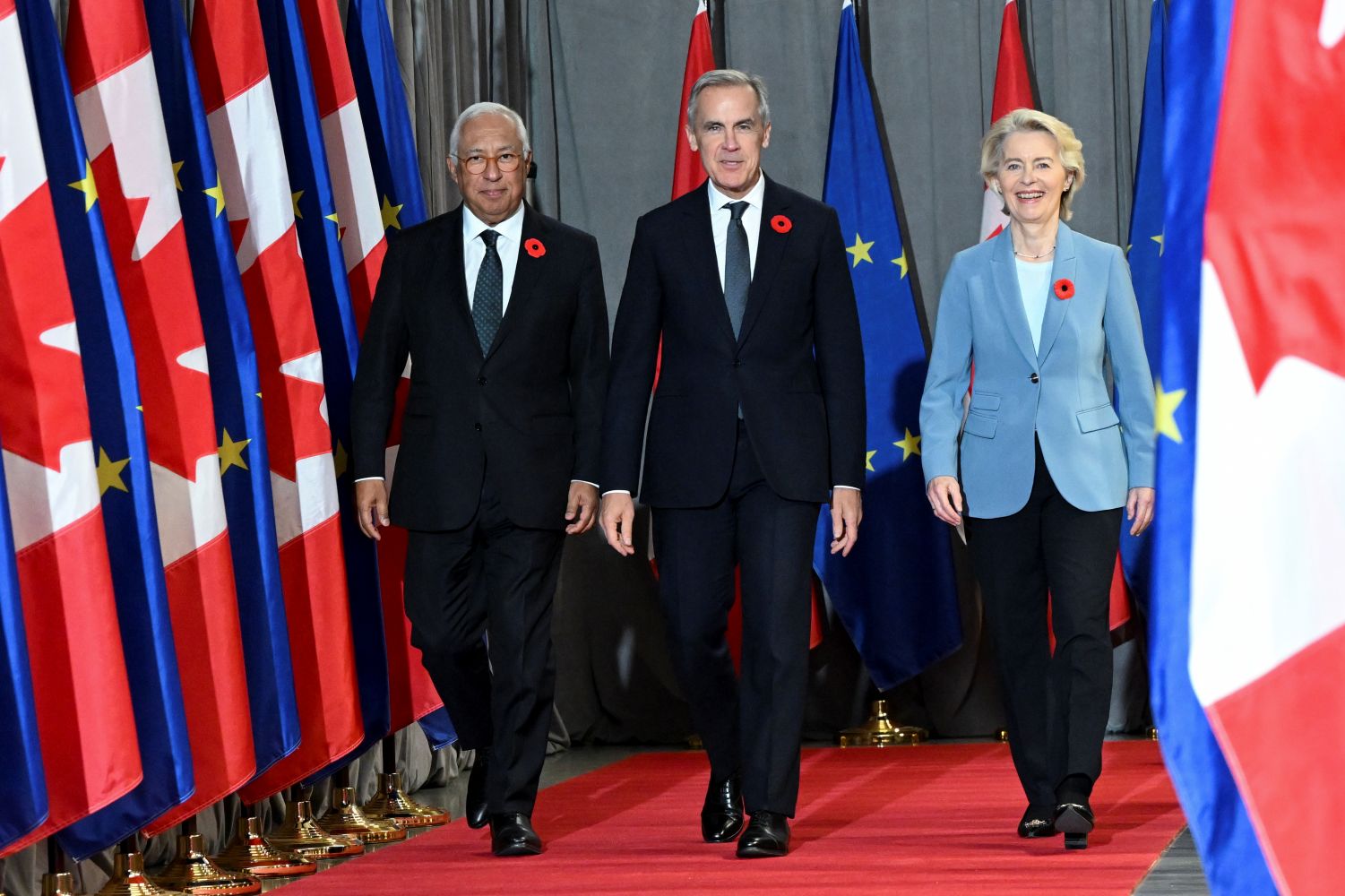
The 21st EU-Canada Summit closed on Friday with a joint statement addressing the future of Canada's relationship to the European Union.MONTREAL (CN) — After two days of talks in Montreal, the 21st European Union and Canada Summit concluded on Friday with the creation of the Alliance for the Future.The move strengthens ties between Ottawa and Brussels as Prime Minister Mark Carney pushes for Canada to become an EU associate member.The summit kicked off on Thursday with an opening statement from European Commission President Ursula von der Leyen, who doubled down on her proposal to the commission last September.“Of course, Canada cannot become a full-fledged member of the European Union because of geography, but we both want to bring our relationship to the highest level possible,” she told gathered dignitaries. “This is why we are discussing the idea of Canada becoming the first associate member of the European Union.”In the days leading up to the summit, some member states had expressed displeasure with this idea.Among them: France and Germany, which were taken aback by the unilateral proposal.The process of joining the EU usually takes years, said Oliver Schmidtke, a political science professor and European politics expert at the University of Victoria in British Columbia. Admitting Canada quickly could go against those established procedures.“What is important is really the mutual push to deepen the relationship between Canada and the European Union,” Schmidtke said.The disagreement highlights the complexity of the European Union. With 27 member states and many governing bodies, there are different views about Canada’s place in the bloc.Carney seemed to shrug off concerns before the summit, saying the nomenclature did not matter as much as the essence of partnership. A statement from his office on Friday alluded to Canada possibly “becoming the European Union’s first associate member.” But that term was noticeably absent from Friday’s joint statement, with CBC News reporting it was point of contention. The allies are set to meet again in June 2027, where Carney hopes to define the relationship.The new Alliance for the Future was announced by the Carney, von der Leyen and European Council President António Costa after multiple diplomatic talks and roundtable discussions. The concept of sovereignty was at the forefront of Friday’s statement.“By aligning more closely — economically, technologically, and strategically — Canada and the EU are building an Alliance for the Future based on trust and shared values,” the officials said.The alliance “meets the scale of today’s challenges and opportunities and will reinforce the freedom, prosperity and safety our citizens expect and deserve,” they continued. “We are stronger together.”Canada's Prime Minister Mark Carney, left, and European Commission President Ursula von der Leyen arrive for the annual State of the European Union at the European Parliament in Strasbourg, eastern France, Wednesday, Sept 16, 2026. (AP Photo/Pascal Bastien)This alliance sets up European investments in Canadian minerals, new AI regulations and a partnership to combat climate change. It aims to increase labor mobility, along with scientific and academic exchanges.Canadians will also soon find it easier to shop across the ocean, with a new Canada-EU Digital Trade Agreement that aims to promote trade.“We are building a transatlantic arch between Canada and the European Union,” Carney said in French. “An arch based on partnership, balance and mutual respect.”The summit unfolded against the backdrop of a trade war with Washington.Reiterating the need for an alliance at a closing press conference, Carney did not directly mention the United States.Still, he implied multiple times that the protectionist policies of the White House had played a role in the current situation.“Economic integration has become a weapon, and tariffs a means of pressure,” he said in French.Schmidtke says the threat of tariffs will be less effective if Canada can lessen its dependence on the U.S.“There is definitely more urgency now after Trump’s threat on Canada’s sovereignty [and] the attacks on the European Union,” he said. “Both Canada and the EU feel that they need to find a common voice.”In September, Trump threatened to impose more tariffs if Canada were to get EU associate member status, saying it would be a “hostile act.” But the White House — now apparently distracted by midterm elections — has not yet reacted to the latest developments.Courthouse News reporter Tatiana Mulowayi-Pelletier is based in Montreal, Canada.Subscribe to our free newslettersOur weekly newsletter Closing Arguments offers the latest about ongoing trials, major litigation and rulings in courthouses around the U.S. and the world, while the monthly Under the Lights dishes the legal dirt from Hollywood, sports, Big Tech and the arts.Additional Reads
European Union and Canada to form new alliance — but no associate membership yet
Full Article
Original Source
Read the full article at Courthousenews →KhanList aggregates and links to publicly available news content. We do not host full articles from third-party sources. Always verify important information with original sources.