
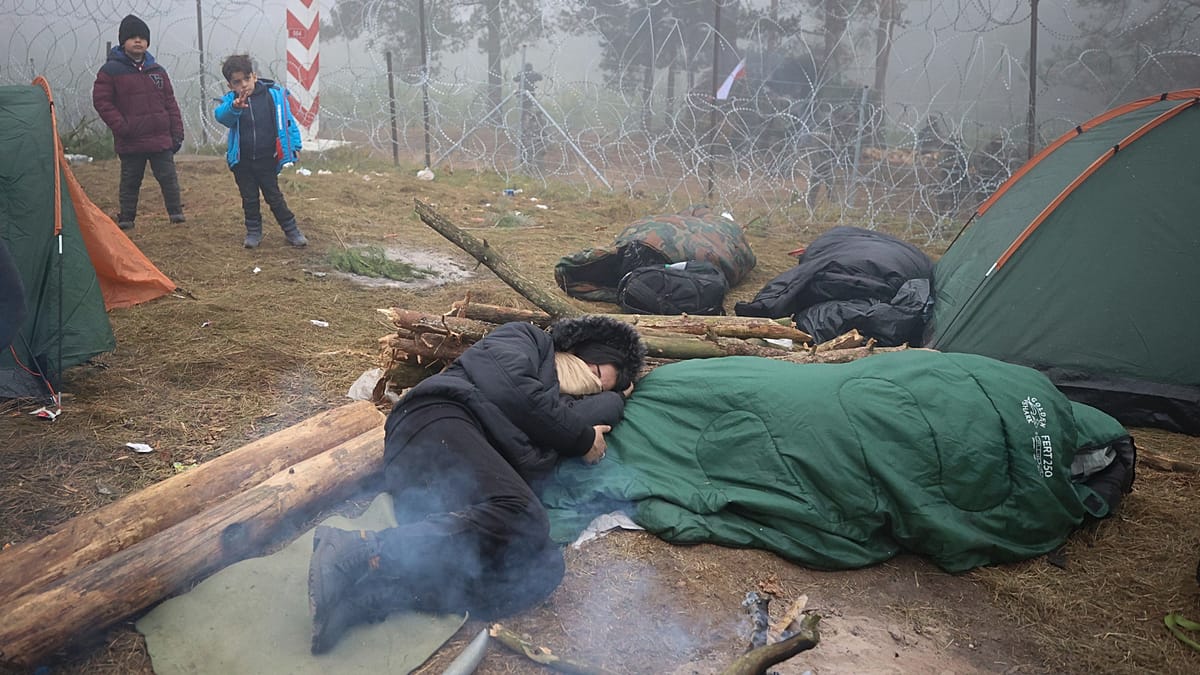
Published on 24 November 2026 - 15:07 GMT+1,Updated 15:07 The European Court of Human Rights (ECHR) ruled on Tuesday that Polish and Latvian authorities subjected individuals from Afghanistan and Iraq who tried to enter their territory from Belarus to inhuman or degrading treatment, potentially setting a precedent against summary pushbacks by EU countries. ADVERTISEMENT ADVERTISEMENT The ruling covers separate cases dating back to 2021, when irregular migrants used by Belarus as a tool of political pressure were intercepted at the border and summarily turned back. The decision was highly awaited, as it is the first to address the protection of people caught up in the instrumentalisation of migration. It could set a precedent for similar cases of state-sponsored pressure, such as the mass arrival of irregular migrants in Ceuta from Morocco last July. The first case concerned two Afghan nationals who crossed the Polish border from Belarus illegally and were left stranded in a makeshift camp on Polish territory between August and October 2021, before being pushed back across the border into Belarus. In the second, 19 Iraqi nationals of Kurdish origin, including six children, accused Latvia of pushing them back into Belarus after an irregular border crossing in August 2021. Both situations occurred in the context of hostile actions by the Belarusian authorities, described as "instrumentalisation of migration". Minsk had encouraged, facilitated or forced the movement of migrants across its borders with EU countries to destabilise neighbouring states. The Court held that countries have the right to control the entry of foreign nationals into their territory, and that removing irregular migrants to the instrumentalising state would not, in itself, violate Article 3 of the European Convention on Human Rights, which prohibits torture and inhuman or degrading treatment. However, national authorities must identify people who are particularly vulnerable to ill-treatment, including elderly, disabled or sick individuals, as well as anyone facing a clear and immediate risk of such treatment. As a result, the court found violations only in the cases of some applicants: one Afghan national who entered Poland, and all the children who crossed into Latvia, along with their accompanying family members. The Court stated that children must be treated as an extremely vulnerable group with specific needs and therefore cannot be pushed back, even in cases of instrumentalisation. Another case against Lithuania, concerning four Cuban nationals who repeatedly crossed the Lithuanian-Belarusian border in 2022, was rejected. The Court found no violation of Article 3. ECHR judgments are legally binding under the Convention, with their implementation overseen by the Council of Europe, a separate organisation from the EU that brings together 46 European countries.
European court rules against Poland and Latvia over migrant pushbacks at Belarus border
Full Article
Original Source
Read the full article at Euronews →KhanList aggregates and links to publicly available news content. We do not host full articles from third-party sources. Always verify important information with original sources.