
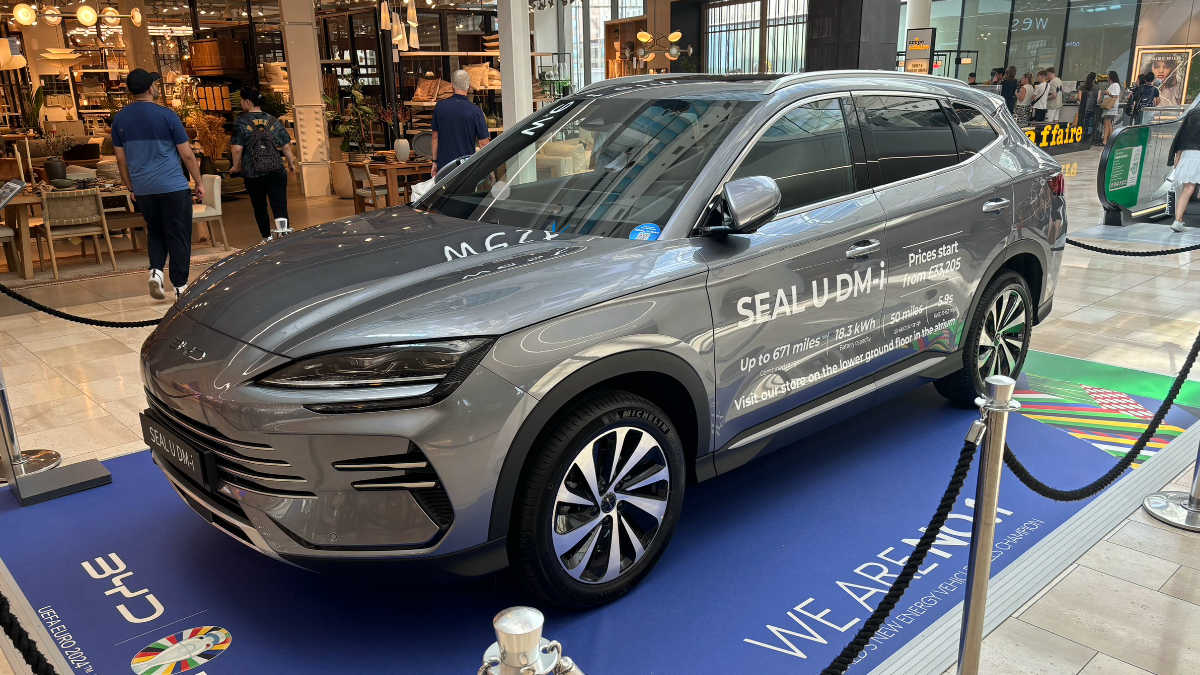
Beijing has rebuffed a European Union request to voluntarily cap hybrid car exports to the bloc, raising the prospect of new, steep EU tariffs on Chinese hybrids, which have so far escaped the duties on pure electric vehicles. China has refused to set quotas on its exports of hybrid electric vehicles (HEVs) and plug-in hybrid electric vehicles (PHEVs) to the EU, the Financial Times reported. Brussels had proposed that Chinese brands limit their share of the bloc’s hybrid market to about 15%, down from more than one-third now. After Beijing refused, the European Commission is weighing temporary safeguard tariffs that do not require proof of unfair trade practices, the newspaper said, citing two diplomats. Under the plan, a set quota of Chinese hybrids would enter the EU on standard terms, while shipments above that ceiling would face steep extra duties. Bloomberg reported on Wednesday that Brussels sees the hybrid curbs as a test case that could later be extended to other sectors with large trade imbalances. European Trade Commissioner Maros Sefcovic began two days of talks with Chinese Commerce Minister Wang Wentao in Beijing on Thursday (October 8) toward resolving the standoff. EU leaders will discuss the issue at the European Council summit in Brussels on October 15 and 16, as officials describe the bloc’s trade deficit with China of about 1 billion euros (US$1.15 billion) a day as unsustainable. In October 2024, the EU imposed five-year countervailing duties of 7.8% to 35.3% on Chinese-made battery electric vehicles (BEVs), on top of its standard 10% import tariff. Beijing responded with anti-dumping measures against European brandy, pork and dairy products. However, the probe excluded hybrids and left them subject only to the 10% duty. Over the past two years, Chinese carmakers led by BYD and Chery have shifted their export focus toward HEVs and PHEVs, rapidly winning market share in Europe while their BEV shipments faced the extra levies. HEVs cannot be plugged in and recharge their small batteries through their gasoline engines and braking, while PHEVs carry larger batteries that can be charged from the grid and run on electric power alone over longer distances. Eurostat data show EU imports of Chinese-made PHEVs rose from 56,706 units in 2022 to 217,764 in the first seven months of this year. Chinese HEV imports jumped from 659 to 160,662 over the same period. The surge has gathered pace in recent months. EU imports of new Chinese-made HEVs climbed from 23,711 units in May to 32,797 in July, while their monthly value rose from 335.6 million euros to 489.4 million euros, according to Eurostat. Pro-China commentators assert it is unreasonable to ask Chinese carmakers to limit sales in the EU when European hybrids simply aren’t competitive enough. “The EU’s so-called voluntary export restraint (VER) tramples on international trade rules, and China will not accept it,” a Zhejiang-based columnist using the pen name “Automobile Observe” says in an article. “Brussels is playing word games. An outright ban or a unilateral tariff hike would break the World Trade Organization’s rules, so it is pressuring China to limit its own exports instead.” She says China’s PHEV exports to Europe grew 155% year-on-year in 2025, far outpacing the 12% growth in pure electric models, as European consumers voted with their wallets for products that offer the best value for money. She says financial institutions such as Morgan Stanley expected the EU to extend its anti-subsidy duties to HEVs and PHEVs. “The EU wants to extend the tariffs on pure EVs to hybrids and give its slow-moving legacy carmakers more time to catch up,” she adds. “Chinese carmakers can simply get around the tariff barriers by setting up assembly plants in Europe.” On March 4, the European Commission unveiled the Industrial Accelerator Act (IAA), a “Made in Europe” proposal. Publicly funded or subsidized EVs and PHEVs would have to be assembled in the EU, with at least 70% of their non-battery components sourced locally. The IAA would also screen non-EU investments over 100 million euros in strategic industries, tying approval to technology sharing and local sourcing. Investors from free trade partners would be exempt, but China is not among them. If the European Parliament and member states approve it, the EV rules would apply from around mid-2027 and the other provisions from January 1, 2029. “Chinese carmakers won’t be stopped by the EU’s export quotas or tariffs as they are already building cars in the bloc,” a Liaoning-based writer using the pen name “Xingwan” says in an article. “For example, BYD’s plant in Hungary, which involves an investment of 4 billion euros, aims to make 300,000 cars a year and will begin mass production in the fourth quarter of 2026.” “EU policymaking is far too slow to keep up. Brussels moves on a yearly timetable, while Chinese firms can adjust their production every month,” she says. “Chinese carmakers have spread their capacity across Europe, Mexico and Turkey, so no single measure can stop them.” However, the columnist admits that the IAA’s 70% local-content rule and its limits on foreign ownership put pressure on Chinese carmakers, whose cars could lose their price advantage if buyers can no longer claim subsidies. She adds that, over the long run, Chinese carmakers with factories in Europe will be drawn deeper into the EU’s production ecosystem, facing pressure to share their technology and buy more parts from European suppliers. Japan’s two-decade integration Japan went through a similar Western market squeeze from the mid-1970s. Britain held Japanese brands to about 11% of its market and France to about 3%. The US pushed Tokyo to curb its car shipments and kept a 25% tariff on imported light trucks. In 1981, Japan agreed to a voluntary cap on its car exports to the US, which it kept until 1994. In 1991, Tokyo and Brussels agreed that Japan would restrain its car exports to the European Community until the end of 1999. The curbs expired as planned, as Japanese carmakers kept building plants and hiring workers in the US and Britain. Japan still exports traditional cars and HEVs to the US and the EU. “China-EU economic and trade relations are mutually beneficial in nature, not a zero-sum competition,” Chinese Foreign Ministry spokesperson Guo Jiakun said on September 18, when asked about the EU’s request that Beijing cap hybrid sales at about 15% of the bloc’s market. “We hope the EU will honor its commitments to market openness and free trade and observe WTO rules,” he said. “We will closely follow the EU’s moves and do what is necessary to protect the legitimate and lawful rights and interests of our businesses.” The flood of cheap Chinese EVs into Europe comes as Washington keeps its own door shut. The US imposed a 100% tariff on Chinese EVs in 2024 and has since banned Chinese software and hardware in connected vehicles on national security grounds. “We don’t allow his cars into the US, and we never did,” US President Donald Trump said in a Fox News interview on September 11, referring to Chinese President Xi Jinping. “Now, if China wanted to come in and open a plant to build their cars here, I’d be okay with it. Japan does it, but they hire our people.” He added that he did not want Chinese carmakers to build cars cheaply in Mexico and ship them across the border. Ahead of Xi’s September 24 visit to the White House, Ford, General Motors and the United Auto Workers union urged Trump to keep Chinese carmakers out of the US market. Read: ‘China Shock 2.0’ fuels EU push for united response to Beijing Follow Jeff Pao on X at @jeffpao3
EU weighs safeguard tariffs as China refuses hybrid car limits
Full Article
Original Source
Read the full article at Asiatimes →KhanList aggregates and links to publicly available news content. We do not host full articles from third-party sources. Always verify important information with original sources.