
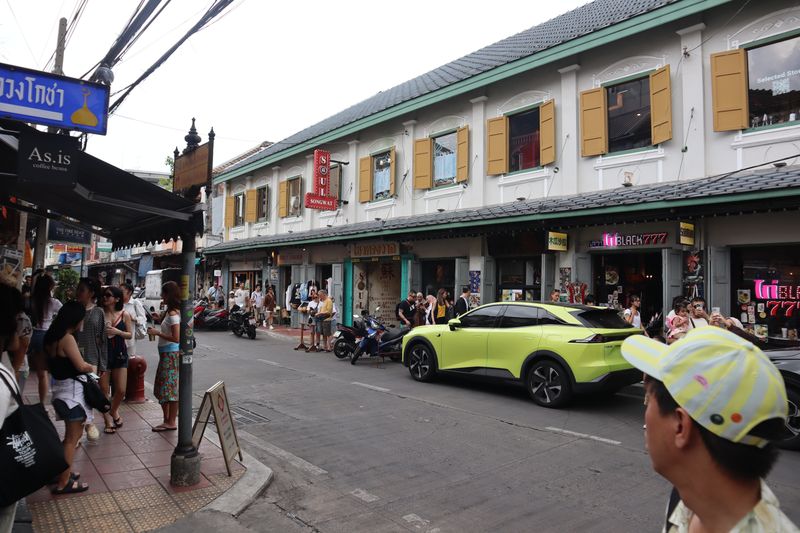
Thailand has, for almost a year, been in mourning. Difficult to believe in a country that seems genetically wired to lift your spirits, but it’s been an emotionally turbulent time for the monarchy. The king, Rama X, lost his mother, Queen Sirikit, in October 2025, and then his eldest daughter, Princess Bha, in June.In Krung Thep, the “City of Angels” known to most of us as Bangkok, reminders of the nation’s fidelity to the royals are everywhere. In hotels, museums and malls, no matter how contemporary the outlook, there are shrine-like tribute stations where visitors can pay their respects to the late royals. For Thais, such filial devotion is engrained.At the Grand Palace, my guide (and friend) Nattapong Jongboonsab – Bobo – respectfully dressed in black. And, among the tourist throngs at the city’s busiest attraction, queues of Thai people waited to prostrate themselves and place flowers and other tokens in front of portraits and at the royal funerary urn of the departed Queen Mother, who will lie there in state until her cremation ceremony in December.All of it is done with a great sense of ceremony and fervour, solemnity and grace; all of it virtually unnoticed by the rest of us, a mob of camera-toting dolts trying to make sense of what is nowadays a fantastical museum, the royal family having relocated elsewhere years before the abolition of absolute monarchy in 1932.Outside the palace grounds, hundreds more Thais waited in line to bid farewell to their former queen. And afterwards, from a kitchen set up in the parking area, these loyal subjects received a free meal prepared by the royal cooks.Such traditions endure across Bangkok, a paradoxical, palimpsestic city that mixes neon garishness with spiritual sophistication. Where the flamboyant fun of drag acts coexist alongside the testosterone-fuelled traditions of Muay Thai, where ultra-modern malls and gleaming towers jostle for space alongside tiered pagodas, and enormous golden Buddhas rub shoulders with hostess clubs and go-go bars.There’s a mix of grit and grace, the solemn in a ceaseless dance with the secular. In the way it straddles multiple worlds, Bangkok evokes a kind of time travel that lets visitors slip between realms like few other places on Earth.Bangkok at night. (Photo: Keith Bain)Into the futureIts evolution has been rapid. Apparently Bangkok’s last wild tiger was killed in the city in 1910. Bang Na, the neighbourhood where it was shot, is now a concrete jungle of glitzy malls. And Sukhumvit, Bangkok’s answer to London’s Oxford Street or New York’s Fifth Avenue, was – until the middle of the last century – pretty much an unpaved track trundled by elephants.Bangkok’s proliferation of marvellously newfangled high-rises has earned it comparisons with the megalopolis depicted in Blade Runner, the deployment of ever-flashier skyscrapers transforming it into a neon-lit hallucination. Look up and you see the upwardly mobile ascending towards heaven.Yet, while there are manifold reasons to sample the rooftop bars and high-altitude restaurants popping up above the smart, sophisticated districts of Siolim and Sukhumvit, there’s also plenty to see in the ancient alleyways and historic floating quarters.Alongside the sprawling modern city, remnants remain of a time when Bangkokians lived mostly on or over the water and a gargantuan labyrinth of khlongs (canals) served the trade, transport and irrigation needs of this veritable Venice of the East.In the canal-riddled Khlong Bang Luang neighbourhood, a large stretch of waterside homes has been transformed into a crowded, quirky tourist attraction, where, along with cafés and souvenir shops, there’s the famously discovered “artist’s house”, Baan Silapin, a teak villa where people sit and draw, paint or otherwise create, order drinks and snacks, maybe catch a shadow puppet show or take an art class.Exploring the khlongs or city canals. (Photo: Keith Bain)Seeing the canals from concrete walkways is one thing, but a very different experience is seeing them from the water, comfortably seated while an alternative world drifts by.Our engine-powered longboat collected us from a mooring point walking distance from the Grand Palace. We sped across the width of the Chao Phraya River and then slowed into the watery maze of khlongs that thread through the relatively low-rise city on the river’s western shore.Perched along the banks of some 1,600 remaining canals is a fascinating world of derelict rice mills, hidden temples poking through the foliage, and wooden houses precariously balanced on stilts, some of them half-submerged and shuttered. Some, though, have been given a second lease as guesthouses for visitors eager to experience authentic Bangkok.What seems like ironic provincialism also flies in the face of a certain kind of cultural baggage. Thais believe that material objects such as old buildings become infested by spirits. It’s why there’s a miniature ghost house outside every building – apartment blocks, museums, malls, hotels all have a dollhouse-sized dwelling where wandering spirits can find alternative shelter rather than entering the main building. Like shrines, these are kept supplied with offerings – bottles of red Fanta, mangoes, flowers, incense – to keep the ghosts happy.Another way to get rid of spirits from the past is to simply tear down old dwellings and erect modern mansions or apartment blocks. Such renewal has helped empty much of the inner city of its traditional houses. The downside to all those fabulously futuristic buildings is that many of Bangkok’s original handcarved gabled teak homes have disappeared.First come the artistsBut there’s an antithetical movement among young creatives; a generation of savvy entrepreneurs with a taste for repurposing nostalgia are pioneering rejuvenation.And such reset projects are infecting entire neighbourhoods. Take Chinatown. Until 2019, the area frequently came to a standstill thanks to an infinite loop of traffic jams. Then, an extension of the subway system loosened things up. And with that, a string of old enclaves have become objects of reclamation and revitalisation.One clever shop or restaurant will ignite a craze and quickly entire stretches are transformed into labyrinthine precincts full of eye-catching spaces – pop-up stores in alleyways, art galleries in former warehouses, vinyl shops that double up as sneaker boutiques, restaurants in former family homes.Tongue-in-cheek shop decor in a Bangkok mall. (Photo: Keith Bain)One afternoon, after we’d stopped at a temple with a pair of protected crocodiles living on the premises, Bobo and I zigzagged along the creatively fired-up Song Wat Road, the latest Chinatown quarter to have been transformed into an Instagram-fuelled feeding frenzy, to find Potong, a one-Michelin-star outpost of culinary cool.It is run by Pichaya “Pam” Soontornyanakij, not only a main judge on the new season of MasterChef Asia but – according to World’s 50 Best Restaurants – the world’s top female chef in 2025. Tucked into an alley off another alley, Potong occupies a 120-year-old five-storey shophouse where four generations of Soontornyanakij’s family have lived while operating a Chinese herbal medicine dispensary.Inspired by a childhood spent in this neighbourhood, Soontornyanakij’s tasting menus speak of a very particular kind of Sino-Thai heritage, and she uses her food to express aspects of the city’s history.It’s her reinterpretations of familiar flavours, though, that set her apart: there’s her deconstructed version of Thailand’s most famous dish, pad thai, made with noodles depicting the national flag; duck, dry-aged in hay; mooncakes with “fish floss”; and a delectably crispy sweet-and-salty turnip cake with Yunnan cured ham. And, in what was the family’s former opium den, there’s a bar serving head-bending drinks.Less than a kilometre away, in former red-light enclave Soi Nana, G.O.D. (“Genius on Dr*gs”) is a louche-yet-cosmopolitan bar carved out of another dilapidated shophouse. Its façade, featuring squares of coloured glass, gives away nothing of the experience inside, where it’s a mix of cave and crumbling cathedral.None of the vintage furnishings match, hills of candle wax are everywhere and a piano hangs midair. Among a crop of knowingly unflashy spaces serving knowingly clever cocktails, G.O.D.’s founders have accidentally conjured a fashionable drinking district imbued with similarly magnetic bars with names like TAX, Independence and Teens of Thailand, all of them places you can’t help getting lost in.South of this brazenly bar-riddled area, Talat Noi is (or, until five minutes ago, was) Bangkok’s hippest precinct. Settled in the late-1700s soon after Rama I established the new Siamese capital, it’s among the oldest parts of the city. Originally a trading port, it became a hub for second-hand car parts and scrap metal, and now blends centuries-old Chinese shrines and auto-repair workshops with modern cafés down narrow alleys.Changing of the guards at the Grand Palace. (Photo: Keith Bain)One such hot spot is Citizen Tea Canteen, a creation of designer Saran Yen Panya, who likens his artisanal tea parlour to equal parts acid trip, thrift store and a visit to grandma’s house. It’s like stepping into a wormhole of beautifully curated Chinatown kitsch and whimsical iconography with an emphasis on rekindling traditional kopi – café – culture, and serving Thai milk tea that was still so in vogue a couple of generations back.All aboardWalking distance from Talat Noi’s art galleries, cafés and edgy new restaurants (like chef Worathon “Tae” Udomchalotorn’s Sakkwa, a brilliant spot on the fourth floor of yet another nondescript building) is one of the city’s most fabulous boutique stays.With glimmers of Wes Anderson whimsy, husband-and-wife-operated Blu Dock Restel has a dozen airy, uncluttered rooms with a joyously maritime theme. With rooms sometimes available for as little as R650 a night, it’s the kind of bargain you don’t find in South Africa these days.Blu Dock’s a two-minute stroll from the Chao Phraya River’s Si Phraya Pier, where you can hop on a ferry to explore the city by water, a relaxing way to take in a handful of the city’s 400 temples.Nearby, too, is River City, a waterside mall packed with art galleries, and the embarkation point for Bangkok’s legendary dinner cruises. Bobo recommended dining aboard the Apsara (Dancing Angel), a magnificently restored antique rice barge that felt more like a small floating palace, with glass walls and hand-painted murals reinterpreting Thai mythology.I spent time on the open-air top deck and through the hot, humid air observed the neon-lit city around me pulsate and groan under the weight of 250 years of human endeavour.We drifted up and then back down the Chao Phraya, passing illuminated temples, malls, skyscrapers, fairground rides and karaoke parties on other dinner boats. It was strangely glorious, the city’s countless, diverse spirits magically let loose on the night. More than anything, it was a dream from which I did not wish to wake. DMThis story first appeared in our weekly DM168 newspaper, available countrywide for R39. The e-edition of DM168 is now free for readers who are signed into their Daily Maverick account. Click on the cover of the newspaper below to access the e-edition.
ESCAPE: Bangkok, a fever dream in neon and sepia, feeds hungry souls
Full Article
Original Source
Read the full article at Dailymaverick →KhanList aggregates and links to publicly available news content. We do not host full articles from third-party sources. Always verify important information with original sources.