
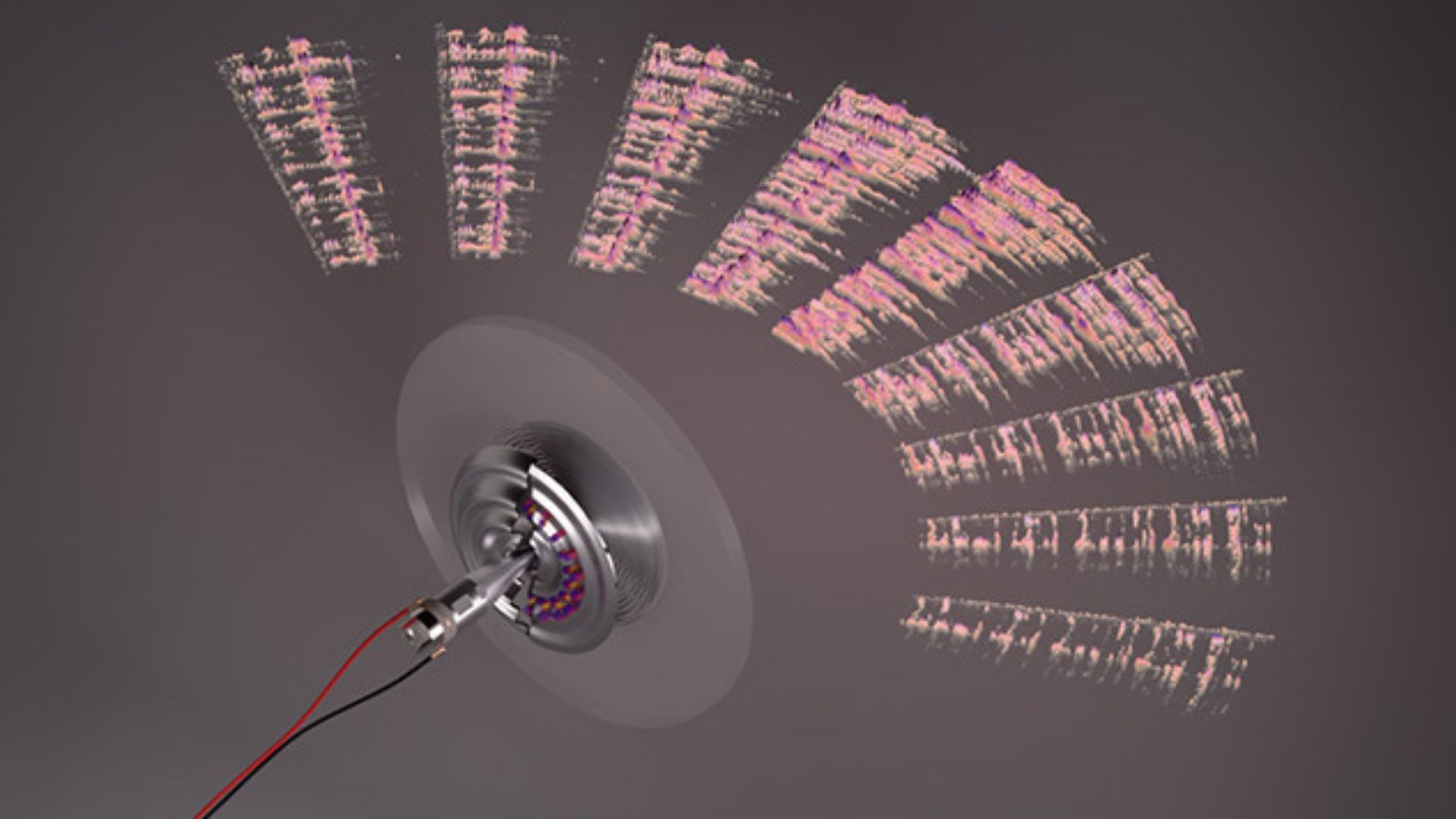
Looks like once-futuristic private sound could soon become an everyday reality. A new kind of speaker directs sound to a single listener using acoustic and elastic metamaterials to focus audio and block side leakage. Researchers at Pohang University of Science and Technology (POSTECH) designed this low-cost, single-element speaker called MiPAL. Once commercialized, this technology promises to personalize public audio experiences without noise pollution. The speaker system could help “deliver sound to a single listener.” It sounds like a gadget lifted straight out of a James Bond script. In the future, you could watch an explosive action movie on a jammed subway train with zero headphones, and the passenger pressed right against your shoulder wouldn’t hear a single thud. Likely there would be no tinny audio bleed, and no annoyed glances. “By co-designing the metamaterials and the ultrasonic device as a single system, we overcame the limitations of cost, complexity and design flexibility at the same time,” said Professor Junsuk Rho. “Research on acoustic and elastic metamaterials has largely remained at the stage of validating principles and demonstrating concepts. This study is the first to integrate metamaterials into a functional device and demonstrate their potential for practical use,” Rho added. Dual-domain metamaterials Light travels in straight lines. But sound naturally spreads out in all directions and bleeds into surrounding spaces. Conventional parametric array loudspeakers use complex, expensive arrays of hundreds of emitters to focus sound, while simpler single-element designs often fail because unwanted vibrations leak audio sideways. To overcome this, the new highly directional speaker uses a parametric array loudspeaker system. The technology modulates ultrasound waves with audible content to harness the nonlinear behavior of sound in air, focusing and beaming audio straight to a single listener just like a ray of light. The researchers integrated a dual-metamaterial safeguard into a single transducer: an acoustic metasurface at the front acts as a lens, shaping ultrasonic waves into a narrow beam. Also, rear elastic meta-units suppress parasitic vibrations to block lateral sound leakage. Sound only you can hear The single-element device directs audio across a broad range of 500 Hz to 10 kHz. Interestingly, it covers more than four octaves of the audible spectrum. In simulated aircraft seating tests using real broadcast and music signals, adding the elastic meta-units dramatically improved directional control, proving the system can deliver isolated sound to individual passengers without disturbing neighboring seats. Along with its directional precision, the device is designed for easy manufacturing and rapid customization. As its modular metamaterial structures are fabricated using 3D printing, engineers can quickly adapt and reconfigure the design to suit varying environments such as different seat spacings, beam angles, or unique operating conditions. Although the era of headphones might not end tomorrow, but the days of suffering through a stranger’s phone call on speakerphone might soon end. Eventually, commuters on planes and trains will be able to enjoy individualized entertainment or announcements headphone-free. On the other hand, museum visitors could hear tailored exhibit commentary simply by standing in front of a specific display. Get the latest in engineering, tech, space & science - delivered daily to your inbox.Mrigakshi is a science journalist who enjoys writing about space exploration, biology, and technological innovations. Her work has been featured in well-known publications including Nature India, Supercluster, The Weather Channel and Astronomy magazine. If you have pitches in mind, please do not hesitate to email her.
Engineers develop single-element speaker that beams audio to specific listeners
Full Article
Original Source
Read the full article at Interestingengineering →KhanList aggregates and links to publicly available news content. We do not host full articles from third-party sources. Always verify important information with original sources.